
What Is Pump Efficiency?
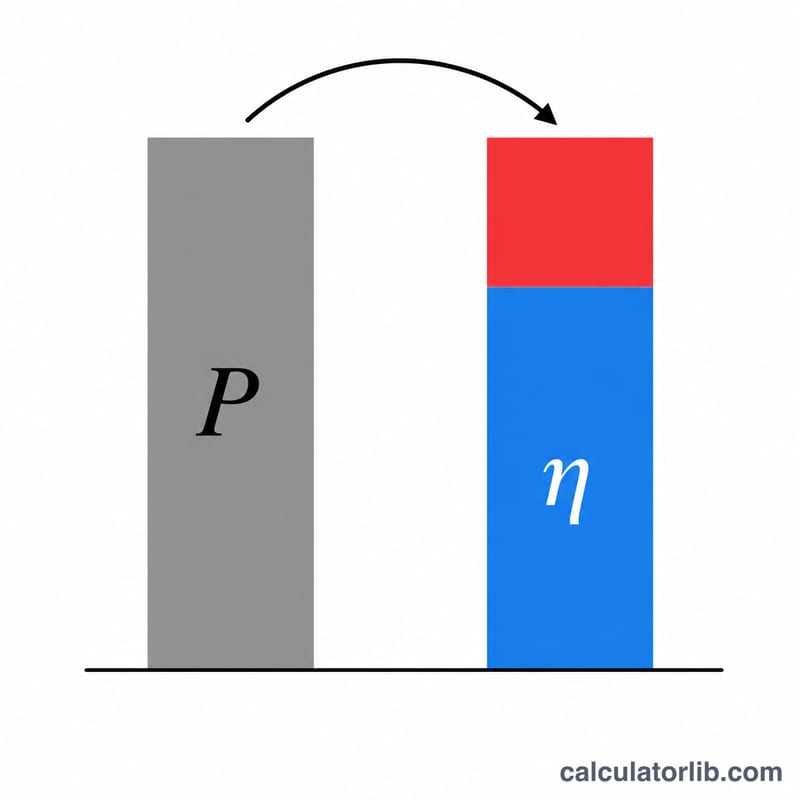
Pump efficiency measures how effectively a pump converts the mechanical power supplied to its shaft into useful hydraulic power delivered to the fluid. It is a dimensionless ratio (often expressed as a percentage) defined as the hydraulic power output divided by the shaft power input. A higher efficiency means less energy is wasted to friction, recirculation, leakage and turbulence inside the pump.
How to Use This Calculator
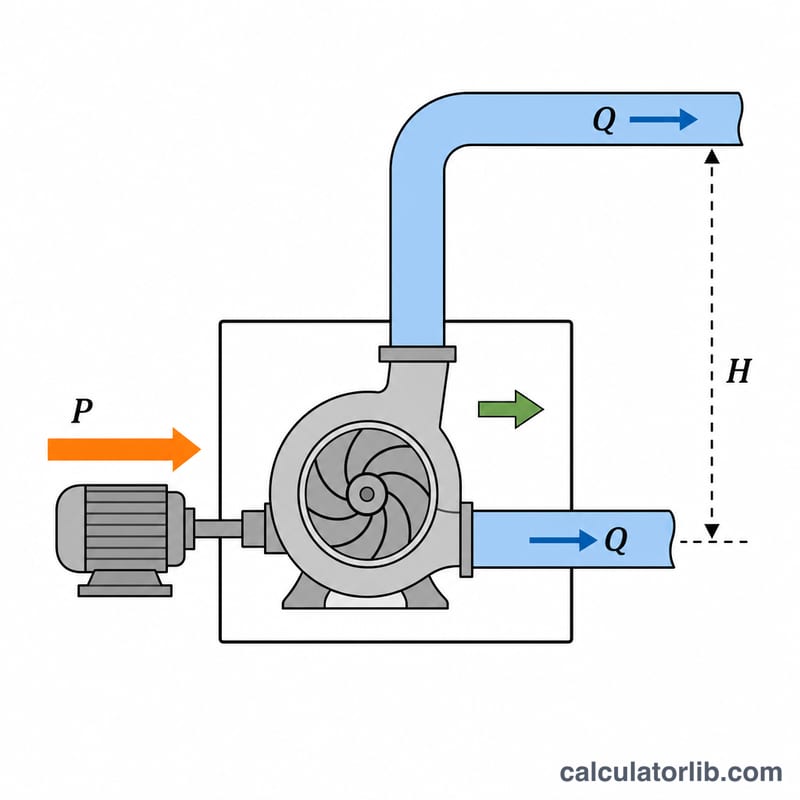
Enter the volumetric flow rate \(Q\) (in cubic metres per second), the total head \(H\) the pump develops (in metres), the shaft power supplied to the pump (in watts), the fluid density \(\rho\) (1000 kg/m³ for water at room temperature) and gravitational acceleration \(g\) (9.81 m/s²). The calculator returns the efficiency as both a fraction and a percentage, along with the computed hydraulic power.
The Formula Explained
The useful hydraulic power a pump delivers is \(P_{hyd} = \rho \cdot g \cdot Q \cdot H\). Dividing this by the actual shaft (brake) power gives the overall efficiency: $$\eta = \frac{\rho g Q H}{P_{shaft}}$$ Here \(\rho g Q H\) represents the rate at which potential and pressure energy are added to the fluid, while \(P_{shaft}\) is the real mechanical input measured at the drive shaft.
Worked Example
Suppose a pump moves water (\(\rho = 1000\ \text{kg/m}^3\)) at \(Q = 0.05\ \text{m}^3/\text{s}\) against a head of \(H = 20\ \text{m}\), drawing a shaft power of 12,000 W. Hydraulic power $$1000 \times 9.81 \times 0.05 \times 20 = 9{,}810\ \text{W}$$ Efficiency $$\frac{9{,}810}{12{,}000} = 0.8175$$ or about 81.75%.
FAQ
What is a typical pump efficiency? Centrifugal pumps commonly operate at 70–90% at their best efficiency point; small or poorly matched pumps may be much lower.
What units should I use? Use SI units: \(Q\) in m³/s, \(H\) in metres, power in watts, density in kg/m³. The result is unitless.
Why is my efficiency over 100%? That usually means an incorrect input — check that shaft power is the real input power and that flow/head are measured at the same operating point.