
What this calculator does
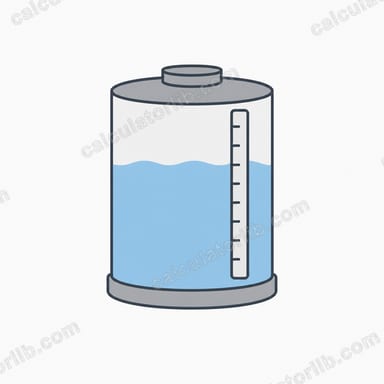
This tool estimates how long it takes for a tank to fully drain through a small hole or orifice near the bottom, driven only by gravity. It is based on Torricelli law and the integration of the outflow as the liquid level falls. It is useful for engineering problems, physics homework, and quick estimates for water reservoirs, fuel tanks, and process vessels.
How to use it
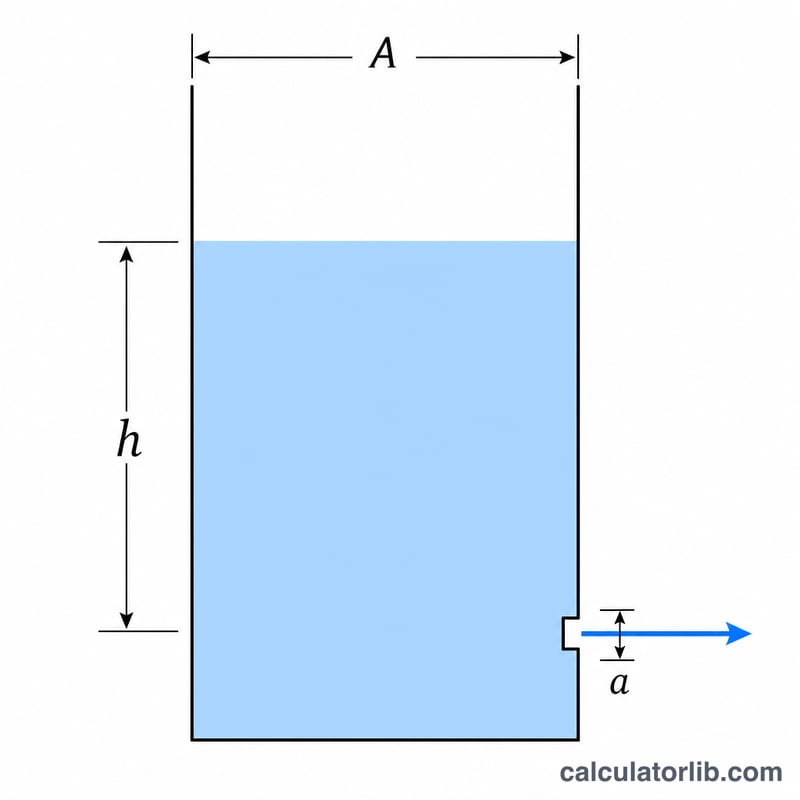
Enter the tank cross-sectional area A in square metres, the hole (orifice) area a in square metres, the initial liquid height h above the hole in metres, and the discharge coefficient Cd (typically about 0.62 for a sharp-edged orifice). Gravity defaults to 9.81 m/s². The result gives the total drain time in seconds and minutes, plus the initial exit velocity.
The formula explained
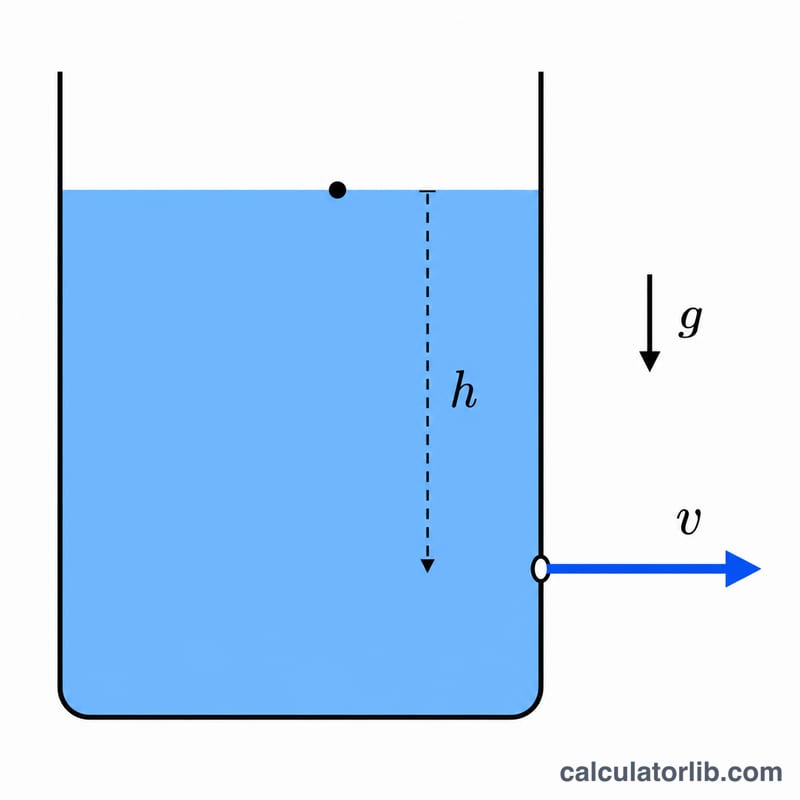
The outflow velocity at the hole is \(v = \text{C}_d \sqrt{2\,\text{g}\,\text{h}}\). Because the height h decreases as fluid leaves, integrating the level drop from h to 0 gives the closed-form drain time $$t = \frac{\text{A}}{\text{C}_d \cdot \text{a}} \sqrt{\frac{2\,\text{h}}{\text{g}}}.$$ A larger tank area or smaller hole increases the time, while a higher starting level increases it as the square root.
Worked example
For a tank with A = 1 m², hole area a = 0.01 m², initial height h = 2 m, Cd = 0.62 and g = 9.81 m/s²: $$t = \frac{1}{0.62 \times 0.01} \times \sqrt{\frac{2 \times 2}{9.81}} = 161.29 \times \sqrt{0.40775} = 161.29 \times 0.63855 \approx 103.0 \text{ seconds},$$ or about 1.72 minutes.
FAQ
What is the discharge coefficient? It accounts for the contraction and friction of the real jet. A value of 0.62 is common for a sharp-edged round hole; a rounded nozzle can approach 0.97.
Does this work for any liquid? Yes, for low-viscosity liquids like water the density cancels out, so the time depends only on geometry and gravity.
Why does the time scale with sqrt(h)? Because the discharge velocity scales with \(\sqrt{\text{h}}\), the integrated emptying time grows as the square root of the starting depth, not linearly.