
What this calculator does
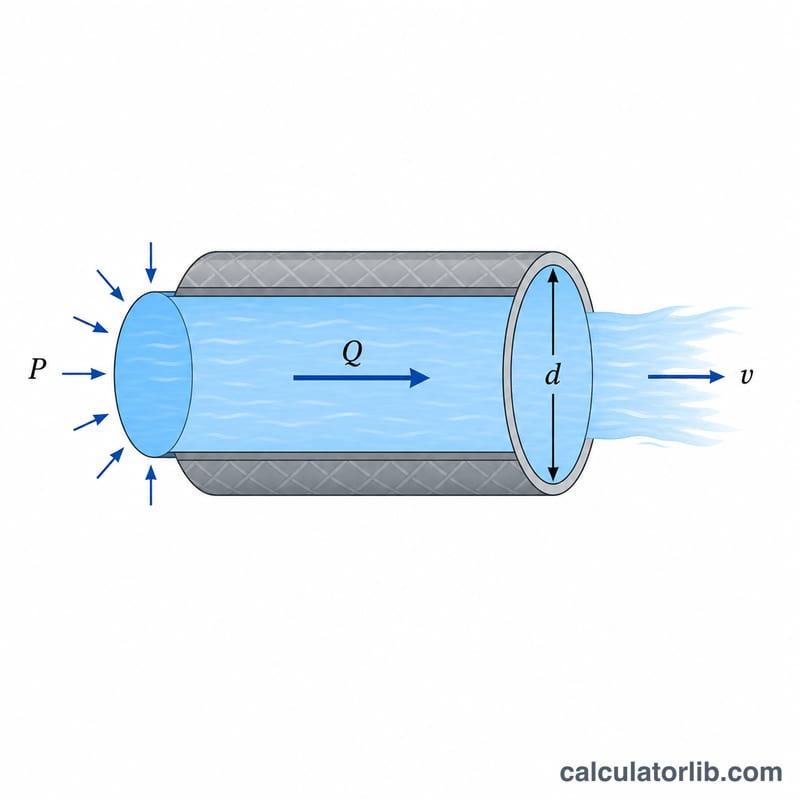
This tool estimates the volumetric flow rate of water leaving an open hose using Torricelli orifice theory. Given the hose inner diameter, the supply (gauge) pressure and a discharge coefficient, it returns the flow in liters per minute and US gallons per minute, plus the exit velocity and opening area. It is useful for irrigation planning, firefighting estimates, pump sizing and pool draining.
How to use it
Enter the hose inner diameter in millimeters, the supply pressure in bar, and a discharge coefficient (Cd). A sharp-edged orifice is about 0.62, a smooth rounded nozzle approaches 0.8-0.98, and a typical garden hose end sits near 0.6-0.8. Press calculate to see the estimated flow.
The formula explained
The flow rate is $$Q = \text{C}_d \cdot A \cdot \sqrt{\frac{2P}{\rho}}$$ Here \(A\) is the cross-section area \(\pi d^2/4\) in square meters, \(P\) is the pressure converted from bar to pascals (\(1\ \text{bar} = 100{,}000\ \text{Pa}\)), and \(\rho\) is water density (\(1000\ \text{kg/m}^3\)). The square-root term is the ideal Torricelli velocity, and \(\text{C}_d\) accounts for real losses through the opening.
Worked example
For a 13 mm hose at 3 bar with Cd 0.62: $$A = \frac{\pi \times 0.013^2}{4} = 1.32732 \times 10^{-4}\ \text{m}^2$$ $$v = \sqrt{\frac{2 \times 300000}{1000}} = 24.495\ \text{m/s}$$ $$Q = 0.62 \times 1.32732 \times 10^{-4} \times 24.495 = 2.0158 \times 10^{-3}\ \text{m}^3/\text{s}$$ which is about 120.95 liters per minute.
FAQ
Is this exact? No. It is an idealized estimate. Real flow is reduced by pipe friction along the hose length, fittings, and elevation changes, which this simple orifice model ignores.
What pressure should I use? Use the gauge pressure available at the hose outlet. Mains pressure is commonly 2-6 bar, but pressure drops with longer or narrower hoses.
Why does Cd matter so much? Cd scales the result directly, so a nozzle (high Cd) flows far more than a sharp opening (low Cd) at the same pressure and diameter.