
What this calculator does
This tool computes the volumetric flow rate (Q) of a fluid moving through a circular pipe. By entering the pipe's inner diameter and the average flow velocity, you instantly get the flow rate expressed in cubic meters per second (m³/s), liters per second (L/s), and cubic meters per hour (m³/h). It works for water and any incompressible fluid, and is used by engineers, plumbers, HVAC designers, and students worldwide. The calculation is unit-consistent SI, so it applies universally.
The formula explained
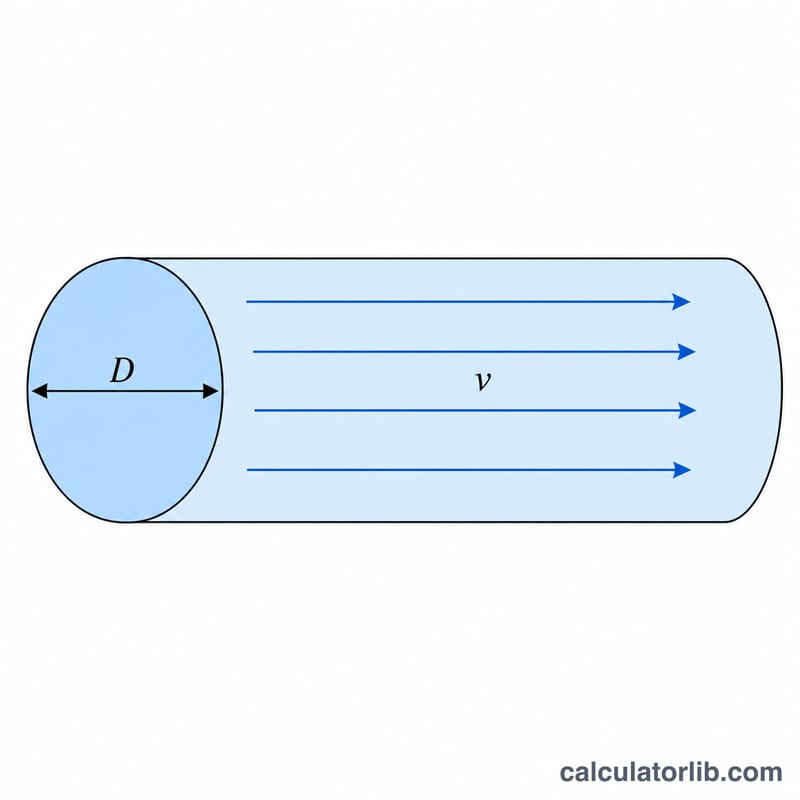
The flow rate equals the pipe's cross-sectional area times the average velocity: $$Q = \frac{\pi \cdot D^{2}}{4} \cdot v$$ The term \(\pi D^{2}/4\) is the area of a circle of diameter \(D\). Multiplying that area by velocity \(v\) gives the volume passing any cross-section per unit time. Keep units consistent: use meters for \(D\) and meters per second for \(v\) to get m³/s directly.
How to use it
1. Enter the inner diameter of the pipe in meters (for example, a 100 mm pipe = 0.1 m). 2. Enter the average flow velocity in meters per second. 3. Read the resulting flow rate. The calculator also shows the cross-sectional area used in the computation.
Worked example
Suppose \(D = 0.1\) m and \(v = 2\) m/s. Area = $$\frac{\pi \times 0.1^{2}}{4} = \frac{3.14159 \times 0.01}{4} = 0.00785398 \text{ m}^2$$ Flow rate $$Q = 0.00785398 \times 2 = 0.0157080 \text{ m}^3/\text{s}$$ which equals 15.708 L/s or about 56.55 m³/h.
FAQ
What diameter should I use — inner or outer? Always use the inner (bore) diameter, since that is the actual cross-section the fluid flows through.
How do I convert mm to m? Divide millimeters by 1000. A 50 mm pipe is 0.05 m.
Does this account for friction or pressure loss? No. It gives the theoretical volumetric flow for a given velocity. Friction losses require Darcy-Weisbach or Hazen-Williams methods.