What Is the GPA Scale Converter?
Grade Point Averages (GPA) are reported on different maximum scales around the world. The United States commonly uses a 4.0 scale, some institutions use a 5.0 weighted scale, India and several European countries use a 10.0 scale, and many systems report grades as a percentage out of 100. This converter rescales any GPA from one maximum to another so you can compare grades or complete an application that expects a different scale.
How to Use It
Enter three numbers: your GPA, the maximum of your current scale (for example 4.0), and the maximum of the scale you want to convert to (for example 10.0). The calculator returns the equivalent GPA on the target scale plus the equivalent percentage. All scales are supported as long as the source maximum is greater than zero.
The Formula Explained
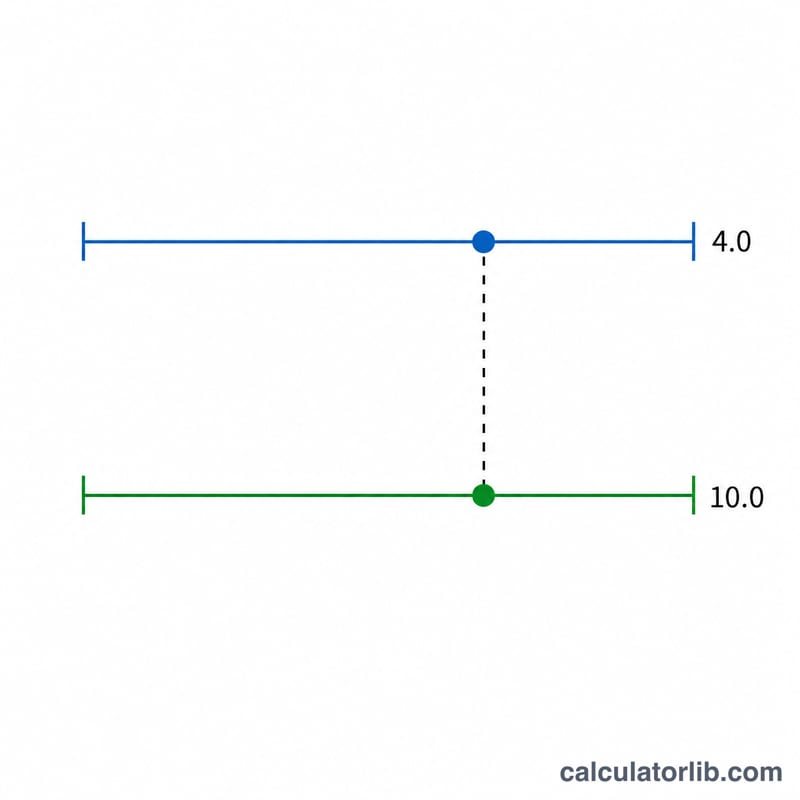
The conversion uses simple linear (proportional) scaling. First it finds the fraction of the maximum you achieved — sourceGPA ÷ sourceScaleMax — then multiplies that fraction by the target maximum: $$\text{Converted GPA} = \frac{\text{Your GPA}}{\text{Current Scale Max}} \times \text{Target Scale Max}$$ This assumes both scales are linear and start at zero, which is the standard assumption for quick GPA comparisons.
Worked Example
Suppose you have a 3.5 GPA on a 4.0 scale and need it on a 10.0 scale. The fraction is \(3.5 \div 4.0 = 0.875\). Multiplying by 10.0 gives 8.75 on the 10.0 scale, which is also 87.5%.
$$\text{Converted GPA} = \frac{3.5}{4.0} \times 10.0 = 8.75$$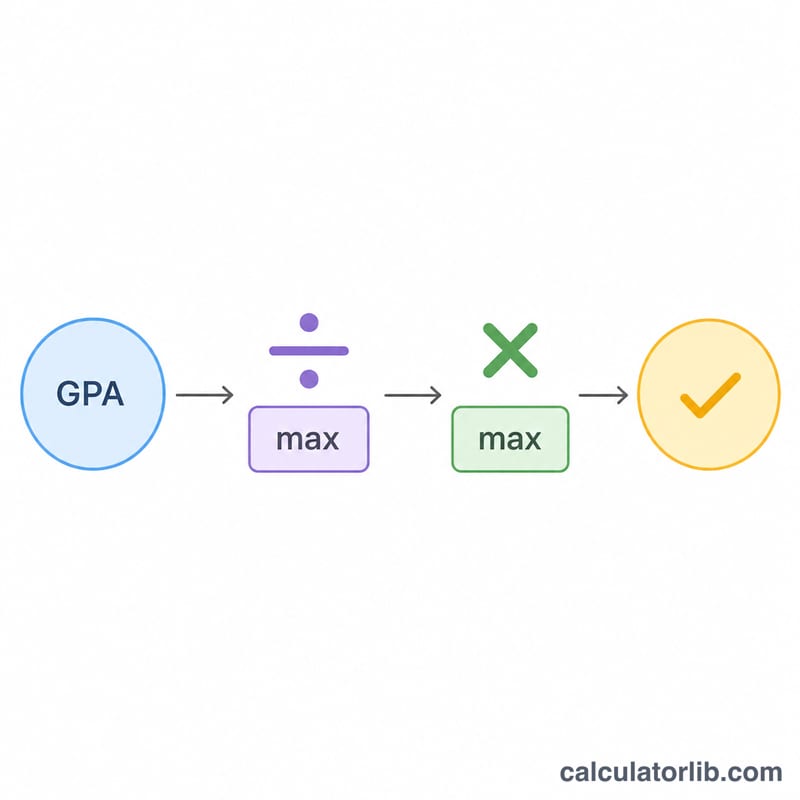
Quick GPA Conversion Table Across Scales
This table converts common 4.0-scale GPAs to other scales using the linear (proportional) formula \(\text{Converted} = \frac{\text{GPA}}{4.0} \times \text{Target Max}\).
| 4.0 Scale GPA | 5.0 Scale | 10.0 Scale | Percentage (100 scale) |
|---|---|---|---|
| 4.0 | 5.0 | 10.0 | 100 |
| 3.7 | 4.625 | 9.25 | 92.5 |
| 3.5 | 4.375 | 8.75 | 87.5 |
| 3.0 | 3.75 | 7.5 | 75 |
| 2.5 | 3.125 | 6.25 | 62.5 |
| 2.0 | 2.5 | 5.0 | 50 |
| 1.0 | 1.25 | 2.5 | 25 |
Important: these are proportional estimates only, not official institutional equivalents. Schools, universities, and credential evaluation services (such as WES) often use their own conversion tables, and many countries do not treat a 50% or 62.5% as the grade a linear formula implies. For admissions or visa applications, always check which method the receiving institution requires.
Scenario Comparison: Same Performance, Different Scales
Each row uses \(\text{Converted} = \frac{\text{GPA}}{\text{Source Max}} \times \text{Target Max}\).
| Input GPA | Source Max | Target Max | Calculation | Converted Result | Direction |
|---|---|---|---|---|---|
| 8.2 | 10.0 | 4.0 | 8.2 ÷ 10 × 4 | 3.28 | 10-point scale down to 4.0 |
| 85 | 100 | 4.0 | 85 ÷ 100 × 4 | 3.4 | Percentage down to 4.0 |
| 4.2 | 5.0 | 4.0 | 4.2 ÷ 5 × 4 | 3.36 | 5.0 scale down to 4.0 |
| 4.5 | 5.0 | 10.0 | 4.5 ÷ 5 × 10 | 9 | 5.0 scale up to 10.0 |
| 3.0 | 4.0 | 100 | 3.0 ÷ 4 × 100 | 75 | 4.0 scale up to percentage |
Converting to a larger scale stretches the number proportionally, and converting to a smaller scale compresses it. The result shows the same fraction of the maximum, which may differ from how a given school would officially translate the grade.
FAQ
Is proportional conversion always accurate? It gives a fair estimate, but some institutions use official lookup tables (e.g., WES) that are not perfectly linear. Always check the receiving school's published policy.
Can I convert a percentage to a 4.0 GPA? Yes — set the current scale max to 100 and the target scale max to 4.0.
What if my scale starts above zero? This tool assumes both scales begin at zero. Non-zero baselines require a custom formula.