
What Is wOBA?
Weighted On-Base Average (wOBA) is a modern baseball sabermetric statistic that measures a hitter's overall offensive value on the same scale as on-base percentage (OBP). Unlike OBP, which treats a walk the same as a home run, wOBA assigns each way of reaching base a coefficient proportional to its actual run value. A typical league-average wOBA sits around .320, with elite hitters exceeding .400.
How to Use the Calculator
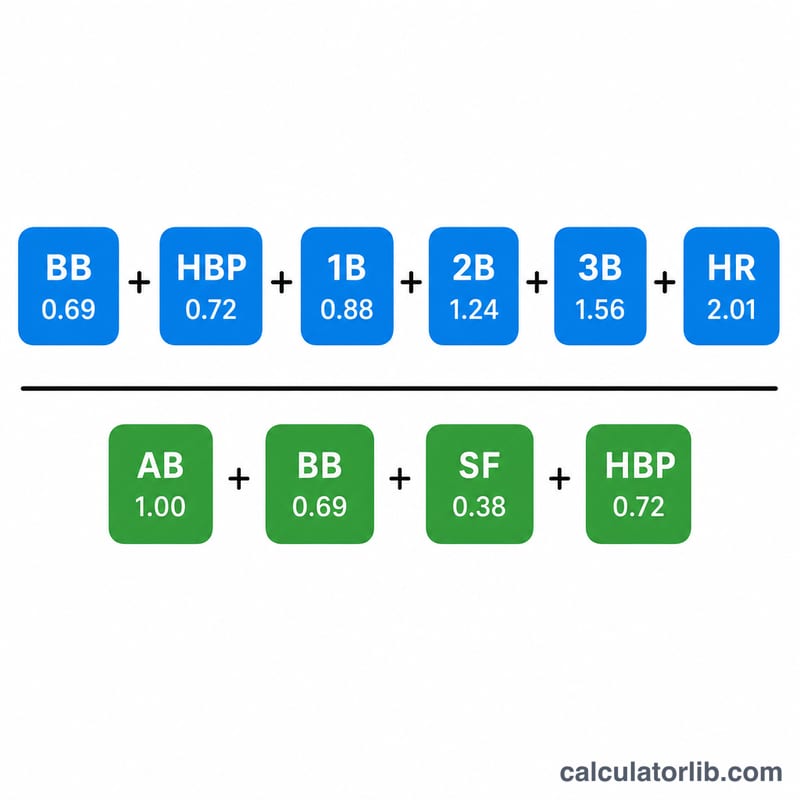
Enter the player's seasonal (or career) totals for each offensive event: unintentional walks, hit-by-pitch, singles, doubles, triples and home runs, plus the denominator components — at bats, total walks, intentional walks and sacrifice flies. The calculator multiplies each event by its linear weight, sums them, and divides by the plate-appearance denominator.
The Formula Explained
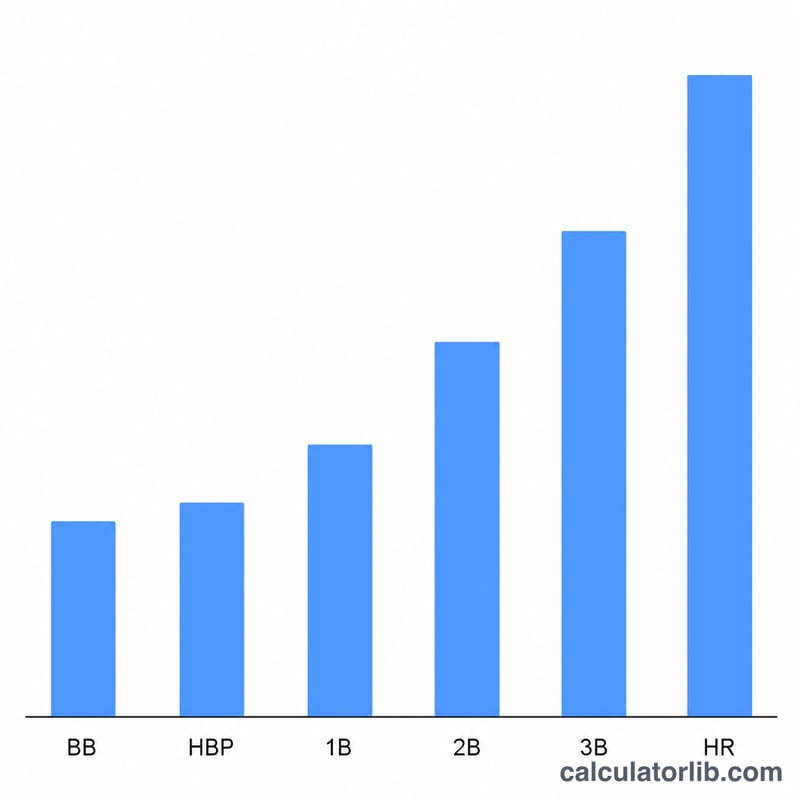
$$\text{wOBA} = \frac{0.69\,\text{uBB} + 0.72\,\text{HBP} + 0.89\,\text{1B} + 1.27\,\text{2B} + 1.62\,\text{3B} + 2.10\,\text{HR}}{\text{AB} + \text{BB} - \text{IBB} + \text{SF} + \text{HBP}}$$ The coefficients shown are representative linear weights; the exact values are recalibrated by analysts each season to keep league-average wOBA equal to league-average OBP. Intentional walks are subtracted because they reflect the situation rather than the batter's skill.
Worked Example
Suppose a hitter has 40 uBB, 5 HBP, 100 singles, 30 doubles, 3 triples, 25 HR, 550 AB, 50 BB, 10 IBB and 5 SF. $$\text{Numerator} = 0.69 \cdot 40 + 0.72 \cdot 5 + 0.89 \cdot 100 + 1.27 \cdot 30 + 1.62 \cdot 3 + 2.10 \cdot 25 = 27.6 + 3.6 + 89 + 38.1 + 4.86 + 52.5 = 215.66$$ $$\text{Denominator} = 550 + 50 - 10 + 5 + 5 = 600$$ $$\text{wOBA} = 215.66 \div 600 \approx .359$$ a clearly above-average season.
FAQ
Why is wOBA better than OBP? OBP weights every time on base equally; wOBA credits extra-base hits and home runs for the additional runs they produce.
What's a good wOBA? Roughly .320 is average, .370 is very good, and .400+ is MVP-caliber.
Do the weights change every year? Yes — they're recomputed annually from run-expectancy data, so use season-specific coefficients for the most precise figure.