
What Is the Weighted Mean?
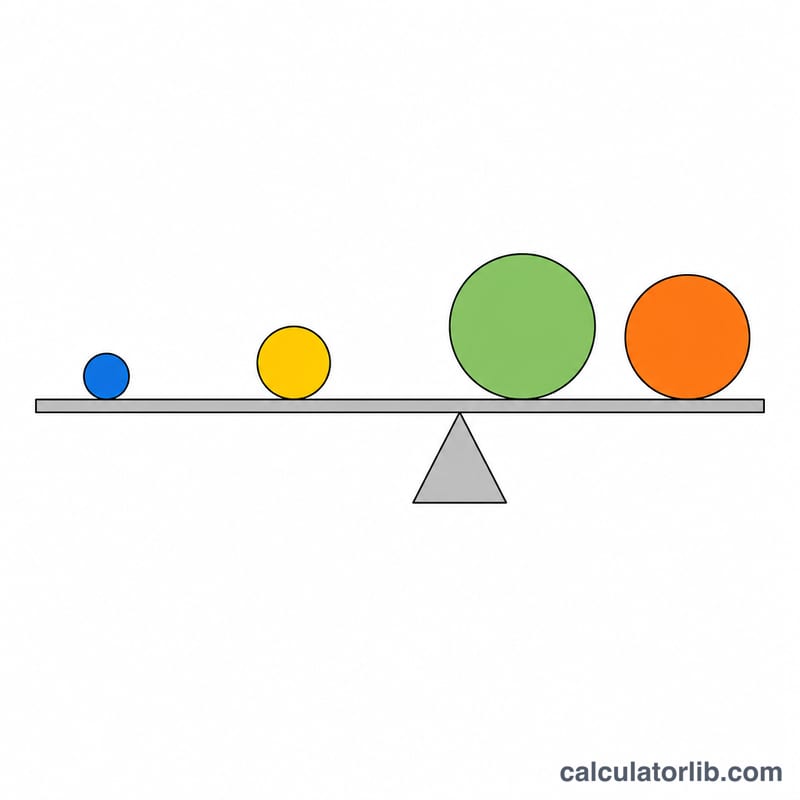
The weighted mean (or weighted average) is a type of average where some values contribute more than others to the final result. Instead of treating every data point equally as the simple arithmetic mean does, each value is multiplied by a weight that reflects its relative importance. This calculator is universal and applies to any field — grades, finance, surveys, physics, and more.
How to Use This Calculator
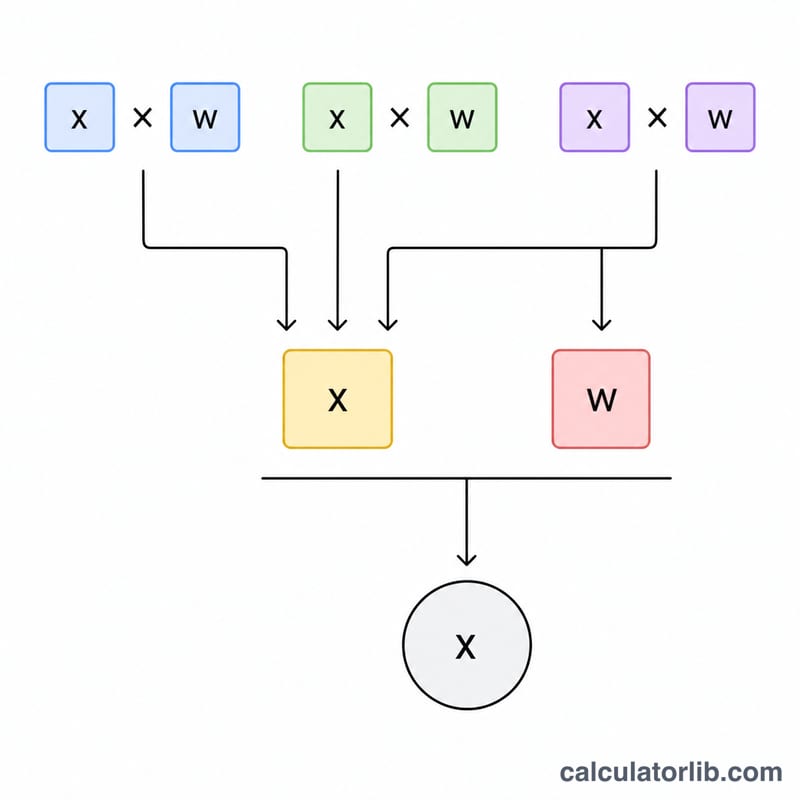
Enter your values as a comma-separated list (for example 80, 90, 70) and the matching weights in the same order (for example 2, 3, 1). The first value pairs with the first weight, the second with the second, and so on. The calculator multiplies each value by its weight, sums those products, and divides by the total of the weights.
The Formula Explained
The weighted mean is defined as:
$$\bar{x}_w = \frac{\sum_{i=1}^{n} w_i \cdot x_i}{\sum_{i=1}^{n} w_i}$$
Here \(x_i\) is each value, \(w_i\) is its weight, \(\sum(w_i x_i)\) is the sum of every weight-times-value product, and \(\sum w_i\) is the sum of all weights. When all weights are equal, the weighted mean reduces to the ordinary arithmetic mean.
Worked Example
Suppose a student scores 80, 90, and 70 on three assessments worth 2, 3, and 1 credits respectively. The weighted products are \(80 \times 2 = 160\), \(90 \times 3 = 270\), and \(70 \times 1 = 70\), summing to 500. The total weight is \(2 + 3 + 1 = 6\). So the weighted mean is $$500 \div 6 \approx 83.33$$ — higher than the simple average of 80, because the highest score carried the most weight.
FAQ
What if my values and weights lists have different lengths? The calculator pairs them in order and uses only as many pairs as the shorter list allows, ignoring extras.
Can weights be decimals or percentages? Yes. Weights can be any positive numbers — fractions, percentages, or counts. Only their relative sizes matter.
How is this different from a simple average? A simple average gives every value the same weight. The weighted mean lets you emphasize more important values, which is why it equals the simple mean only when all weights are identical.