
What Is the Harmonic Mean?
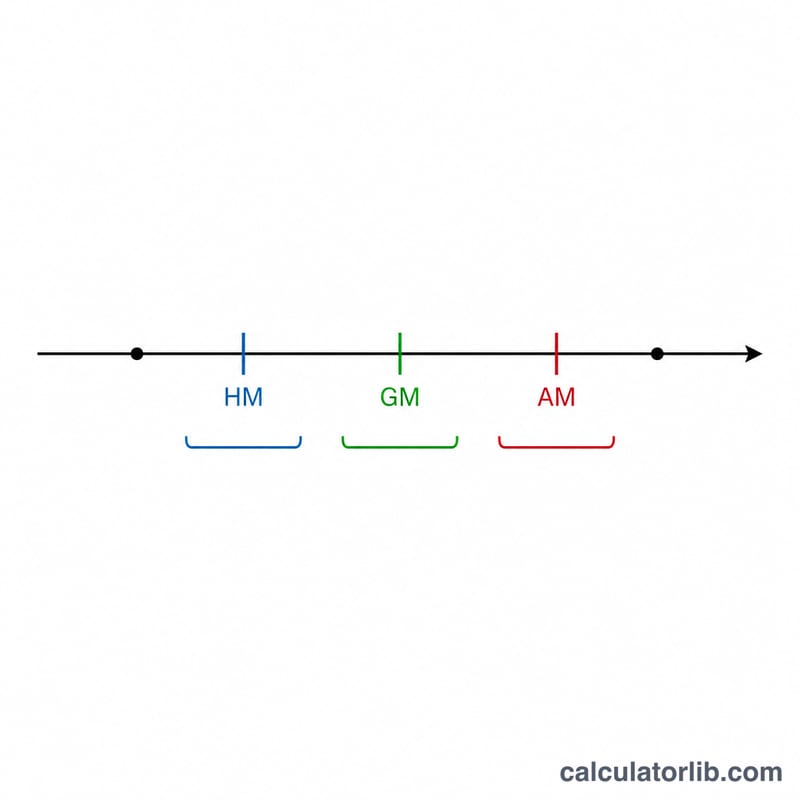
The harmonic mean is a type of average particularly suited to rates and ratios. Unlike the arithmetic mean, which sums values directly, the harmonic mean works with the reciprocals of the values. It is always the smallest of the three Pythagorean means (harmonic ≤ geometric ≤ arithmetic) and is heavily influenced by the smallest numbers in a data set.
How to Use This Calculator
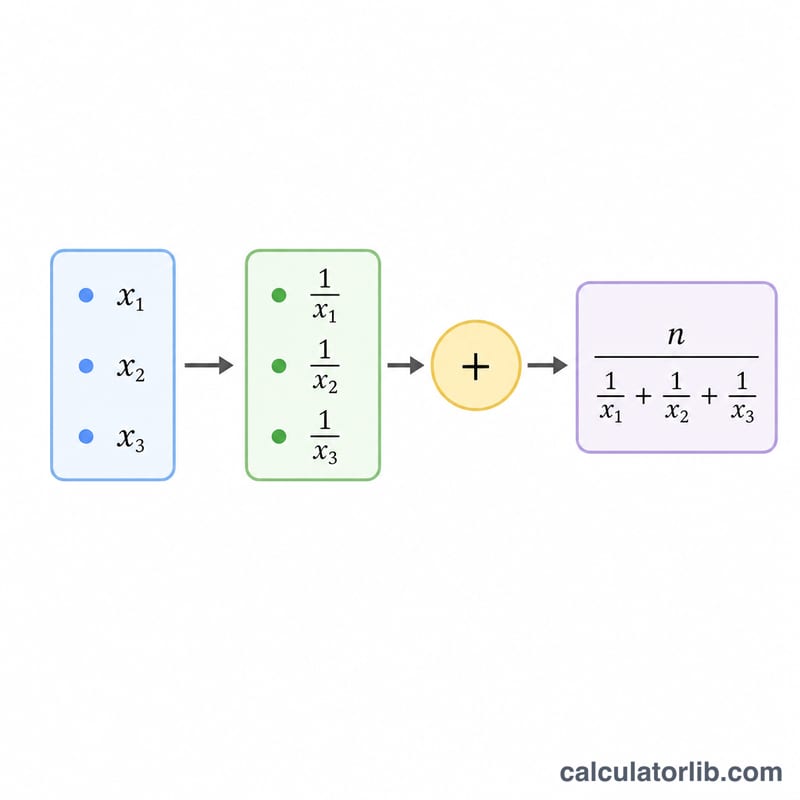
Enter your numbers separated by commas or spaces — for example 2, 4, 8. The calculator counts the values, sums their reciprocals, and divides the count by that sum. Any zero values are ignored because dividing by zero is undefined; the harmonic mean is only defined for non-zero numbers.
The Formula Explained
The harmonic mean of n values is:
$$\text{HM} = \frac{n}{\displaystyle\sum_{i=1}^{n} \frac{1}{x_i}}$$
First take the reciprocal of every value, add those reciprocals together, then divide the count of values by that total. This weighting gives smaller values more pull, which is why the harmonic mean is the right choice for averaging speeds, P/E ratios, or rates per unit.
Worked Example
For the values 2, 4 and 8 there are n = 3 numbers. The reciprocals are \(\frac{1}{2} + \frac{1}{4} + \frac{1}{8} = 0.875\). The harmonic mean is therefore $$\frac{3}{0.875} \approx 3.4286$$ Compare this to the arithmetic mean of 4.667 — the harmonic mean is lower, as expected.
FAQ
When should I use the harmonic mean? Use it for averaging rates and ratios, such as average speed over equal distances or averaging multiples like price-to-earnings.
Why must values be non-zero? The formula requires dividing 1 by each value. A zero would require dividing by zero, which is undefined, so zeros are skipped.
How does it differ from the arithmetic mean? The arithmetic mean adds the values; the harmonic mean adds their reciprocals. The harmonic mean is always less than or equal to the arithmetic mean for positive numbers.