
What Is the Mean Deviation Calculator?
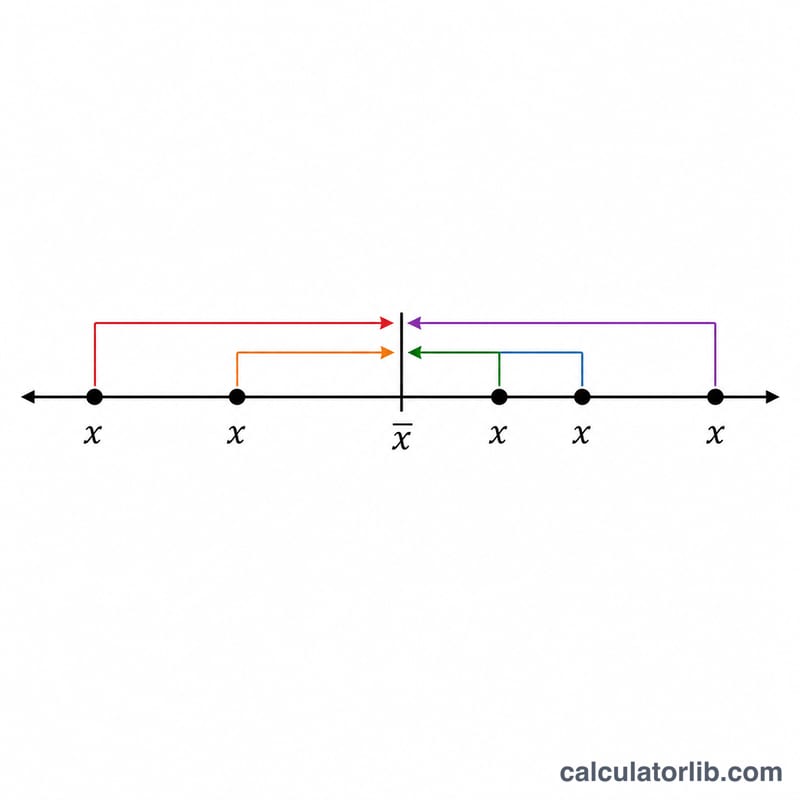
The Mean Deviation Calculator computes the average distance between each value in your dataset and a central reference point — either the mean (average) or the median. This single number, known as the absolute deviation, tells you how spread out or consistent your data is. Unlike standard deviation, which squares differences, mean and median absolute deviation use plain absolute values, making them easier to interpret and less sensitive to extreme outliers. This tool works for any numeric data and is not specific to any country or currency.
How to Use It
- Type your numbers separated by commas, for example: 4, 8, 6, 5, 12, 7.
- Choose whether to measure deviation from the mean or the median.
- Read the result instantly — the calculator returns the average absolute deviation along with the central value it used.
The Formula Explained
Mean Absolute Deviation (MAD) measures the average of the absolute differences between each data point and a central value:
$$\text{MAD} = \frac{1}{n}\sum_{i=1}^{n}\left| x_i - c \right|$$
Where \(x_i\) is each value, \(c\) is the chosen center (mean or median), and \(n\) is the number of data points. The bars indicate absolute value, so negative and positive differences are treated the same. Choosing the median as the center generally produces a smaller, more robust deviation when your data contains outliers.
Worked Example
Consider the dataset: 4, 8, 6, 5, 12, 7. The mean is \((4+8+6+5+12+7) \div 6 = 42 \div 6 = 7\). The absolute differences from 7 are: 3, 1, 1, 2, 5, 0. Their sum is 12, so the Mean Absolute Deviation $$\text{MAD} = 12 \div 6 = \mathbf{2.0}$$ This means values typically sit about 2 units away from the average.
Frequently Asked Questions
What is the difference between mean and median absolute deviation? Mean absolute deviation centers on the average, while median absolute deviation centers on the median. The median version is more resistant to extreme values and skewed data.
How does MAD differ from standard deviation? Standard deviation squares the differences and then takes a square root, which exaggerates large gaps. MAD uses raw absolute distances, so it is easier to explain and less affected by outliers.
Can MAD be zero? Yes. If every value in your dataset is identical, there is no variability, so the mean deviation equals zero.