
What It Is
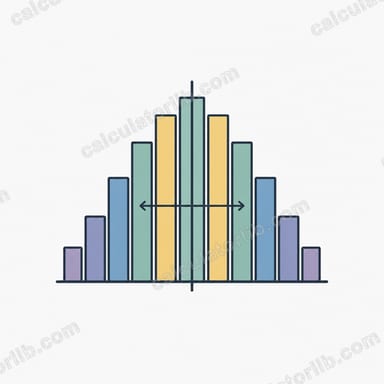
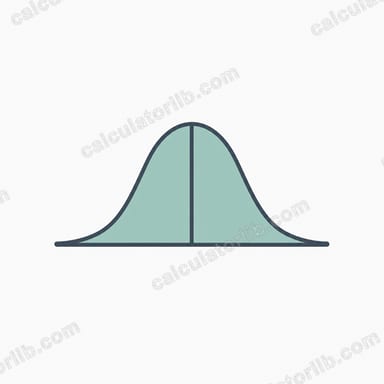
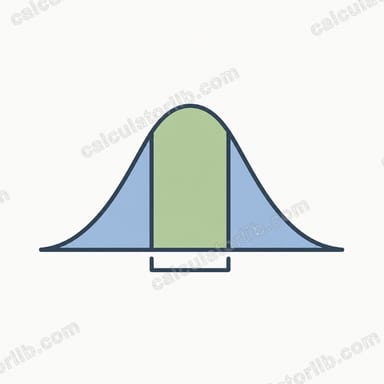
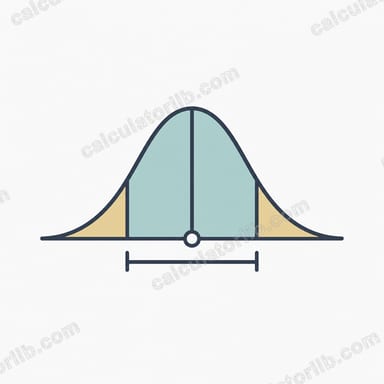
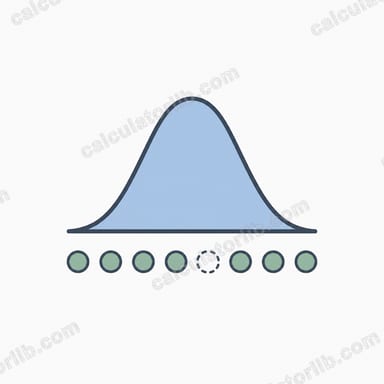
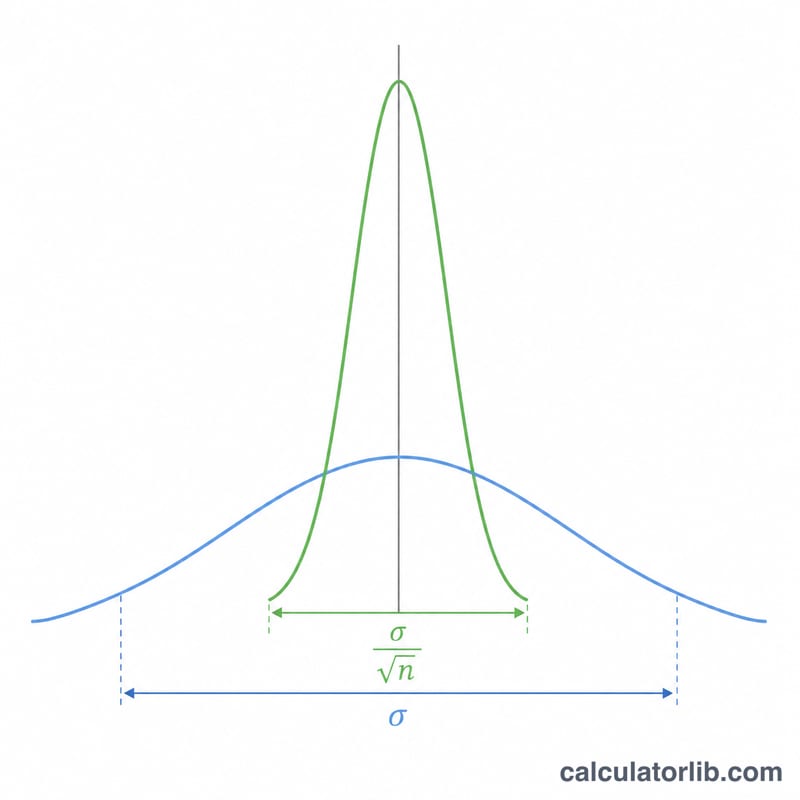
The standard deviation of the sample mean — more commonly called the standard error of the mean (SEM) — measures how much the average of a random sample is expected to vary from the true population mean. While the population standard deviation \(\sigma\) describes the spread of individual data points, the standard error describes the spread of sample means. The more observations you collect, the more tightly your sample averages cluster around the population mean.
How to Use the Calculator
Enter the population standard deviation (\(\sigma\)) and the sample size (\(n\)). The calculator divides \(\sigma\) by the square root of \(n\) to return the standard error. Use the result to build confidence intervals, run hypothesis tests, or judge how reliable an estimated mean is.
The Formula Explained
The relationship is:
$$\sigma_{\bar{x}} = \frac{\text{Population SD } (\sigma)}{\sqrt{\text{Sample size } (n)}}$$
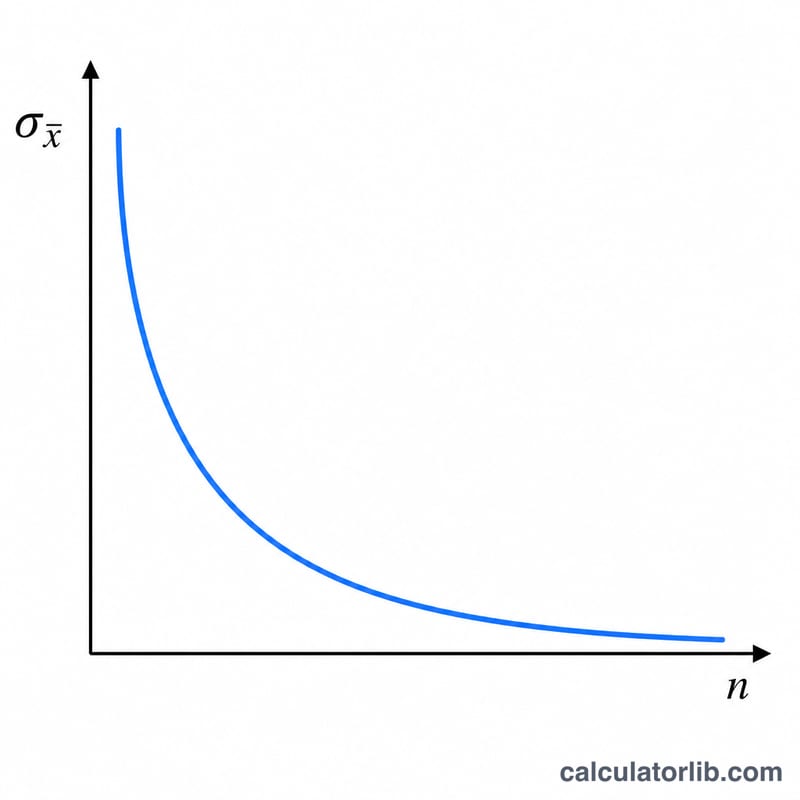
Because \(n\) sits under a square root, reducing the standard error in half requires quadrupling the sample size. This "diminishing returns" property is central to study design: large gains in precision become progressively more expensive.
Worked Example
Suppose a population has a standard deviation \(\sigma = 10\) and you draw a sample of \(n = 25\) observations. Then $$\sigma_{\bar{x}} = \frac{10}{\sqrt{25}} = \frac{10}{5} = 2.$$ So sample means will typically vary about 2 units around the true population mean.
FAQ
What's the difference between \(\sigma\) and the standard error? \(\sigma\) describes variability of individual values; the standard error describes variability of the sample mean, and it is always smaller (for \(n > 1\)).
What if I only have the sample standard deviation \(s\)? Use \(s\) in place of \(\sigma\) to get the estimated standard error, \(s / \sqrt{n}\). The formula is identical.
Why divide by \(\sqrt{n}\) and not \(n\)? The variance of the sample mean equals \(\sigma^2/n\); taking the square root to return to standard-deviation units gives \(\sigma/\sqrt{n}\).