
What is a residual?
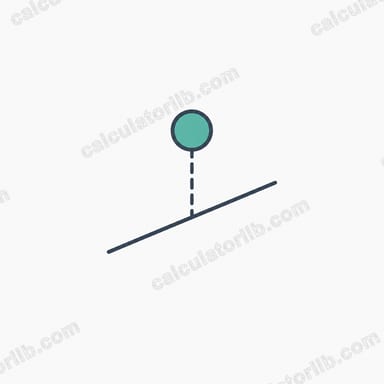
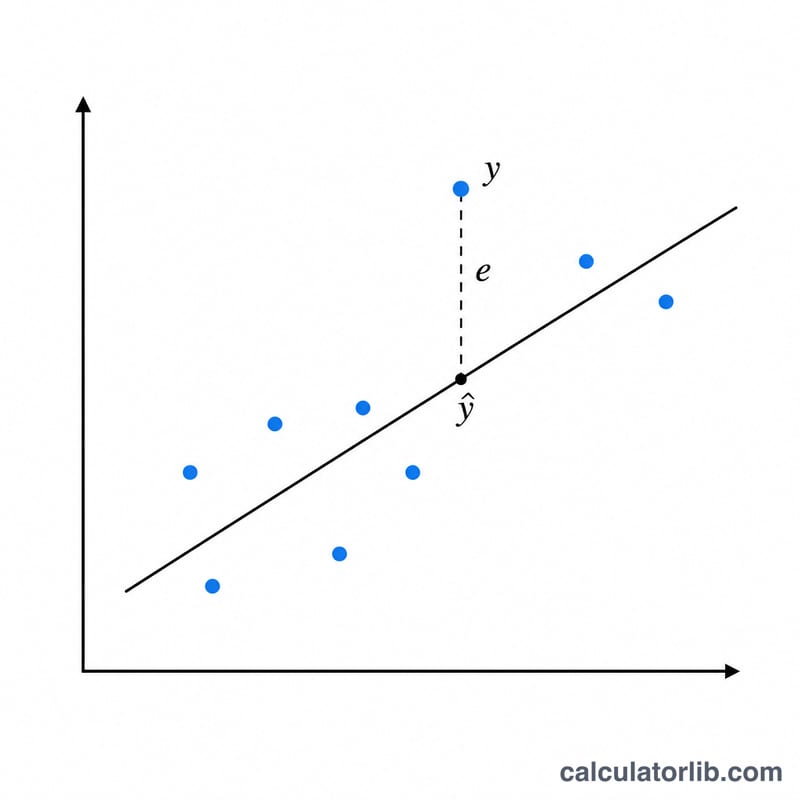
A residual is the difference between an actual observed value and the value predicted by a model or regression line. It measures how far off a prediction is for a single data point. A positive residual means the model under-predicted (the true value was higher); a negative residual means it over-predicted. Residuals are the building blocks of model-fitting techniques such as ordinary least squares, where the goal is to minimize the sum of squared residuals.
How to use this calculator
Enter the observed value (y), which is the real, measured data point, and the predicted value (ŷ), which comes from your regression line or model. The calculator returns the residual along with its absolute value, its square, and the percent error relative to the observed value.
The formula explained
The residual is defined simply as:
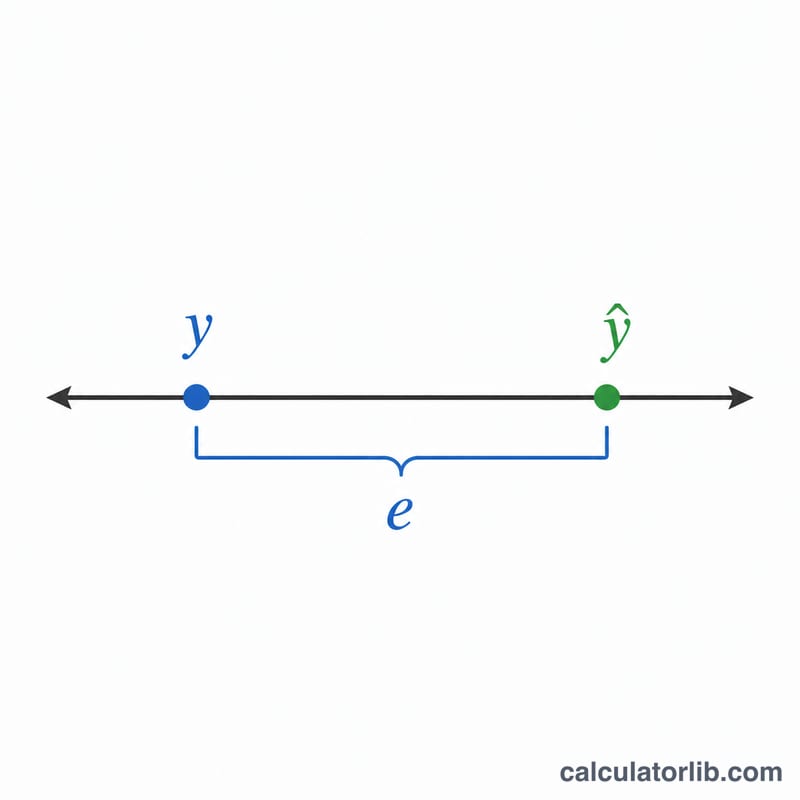
$$e = \text{Observed }(y) - \text{Predicted }(\hat{y})$$Here y is the observed value and ŷ ("y-hat") is the predicted value. The squared residual is \(e^2\), and the percent error is \((e / y) \times 100\), which expresses the error relative to the observed quantity.
Worked example
Suppose a regression model predicts a house price of \(\hat{y} = 320{,}000\) but the home actually sold for \(y = 350{,}000\). The residual is $$350{,}000 - 320{,}000 = 30{,}000.$$ The absolute residual is \(30{,}000\), the squared residual is \(900{,}000{,}000\), and the percent error is \((30{,}000 / 350{,}000) \times 100 \approx 8.57\%\). Because the residual is positive, the model under-predicted the price.
FAQ
What does a residual of zero mean? The prediction was exactly correct — the observed and predicted values are identical.
Why do we square residuals? Squaring removes the sign and penalizes large errors more heavily, which is why least-squares regression minimizes the sum of squared residuals.
Is a residual the same as an error? They are closely related. "Error" usually refers to the deviation from the true (unknown) population value, while "residual" is the deviation from the fitted model's prediction.