
What Is Relative Error?
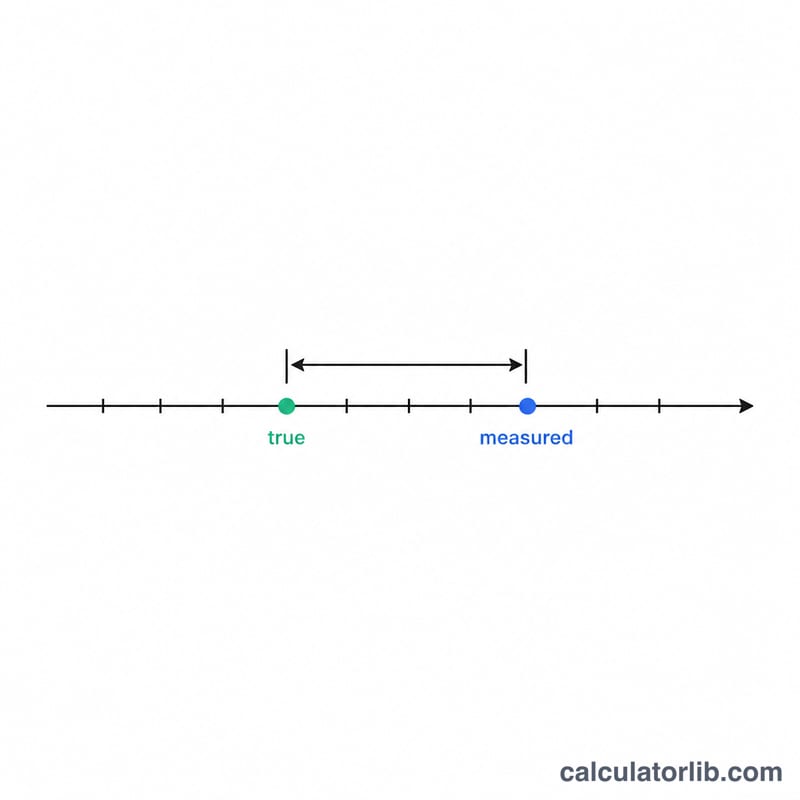
Relative error measures how large the error of a measurement is compared to the size of the true (accepted) value. Unlike absolute error, which is just the raw difference, relative error is dimensionless and lets you compare the accuracy of measurements that have very different magnitudes. It is widely used in physics, chemistry, engineering, and statistics to judge measurement quality.
How to Use This Calculator
Enter your measured value (the result you obtained) and the true value (the accepted, exact, or expected value). The calculator returns the relative error both as a fraction and as a percentage, plus the underlying absolute error. The true value cannot be zero, because relative error is undefined when dividing by zero.
The Formula Explained
The relative error is calculated as:
$$\delta = \frac{\left| \text{Measured} - \text{True Value} \right|}{\left| \text{True Value} \right|} \times 100\%$$
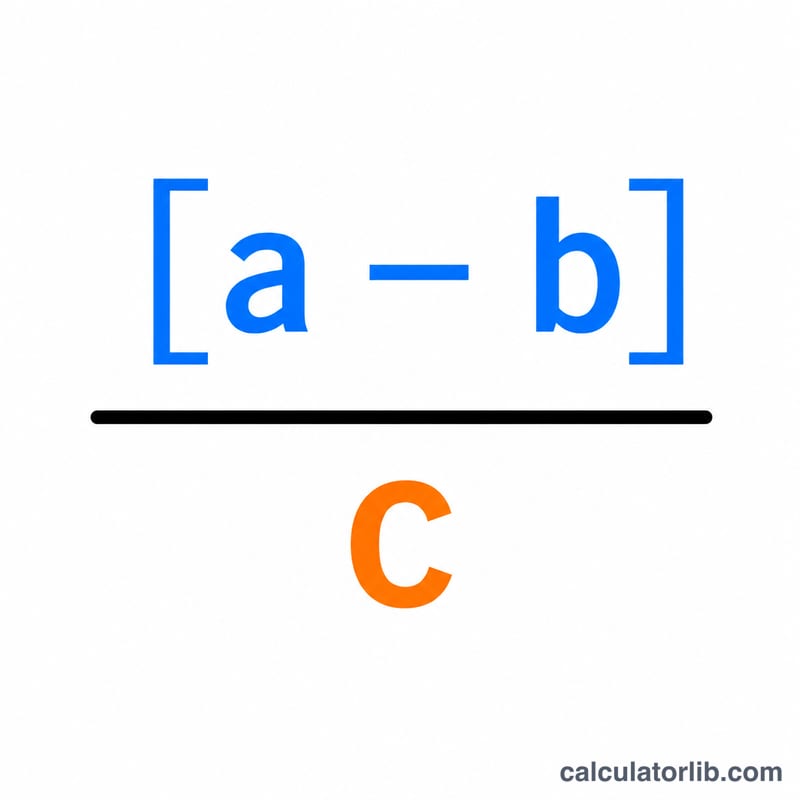
First take the absolute difference between the measured and true values (the absolute error). Then divide by the absolute value of the true value. Multiply by 100 to express the answer as a percentage.
Worked Example
Suppose you measured a length as 9.5 cm, but the true length is 10 cm. The absolute error is \(|9.5 - 10| = 0.5\) cm. The relative error is $$\frac{0.5}{10} = 0.05 = 5\%$$ So your measurement is off by 5% of the true value.
FAQ
What is the difference between absolute and relative error? Absolute error is the raw difference (in the original units), while relative error scales that difference by the true value, giving a unit-free ratio.
Why can't the true value be zero? Dividing by zero is undefined, so relative error has no meaning when the true value is exactly 0. Use absolute error instead in that case.
Is relative error always positive? Yes — because of the absolute value in the numerator, relative error is reported as a non-negative number regardless of whether the measurement was too high or too low.