
What is the standard error of a proportion?
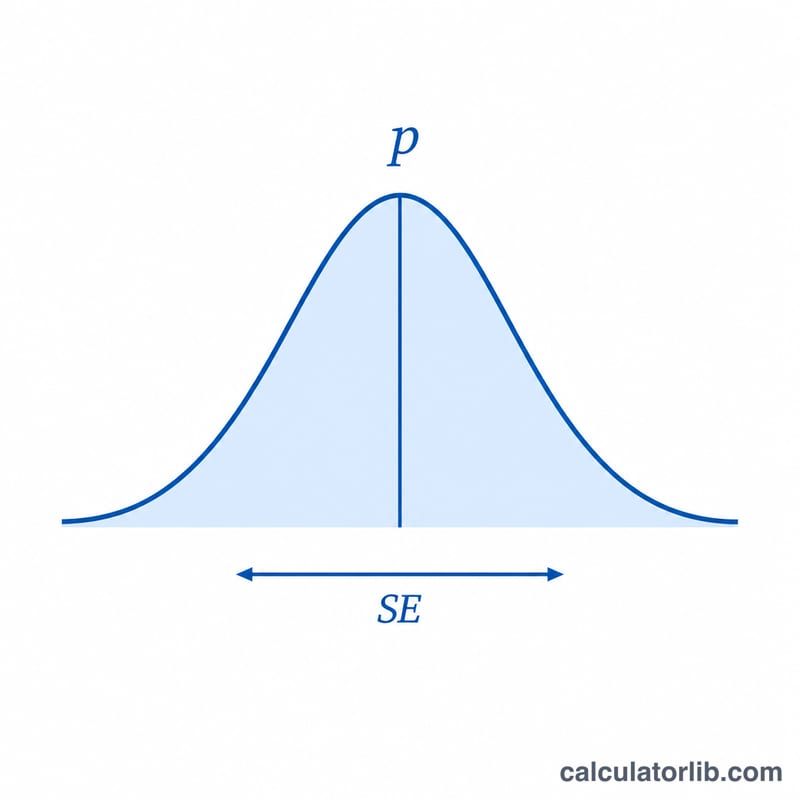
The standard error of a proportion (SE) measures how much a sample proportion is expected to vary from the true population proportion due to random sampling. It tells you the precision of an estimate such as a survey approval rate, a conversion rate, or a defect rate. A smaller standard error means the sample proportion is a more reliable estimate of the population value.
How to use this calculator
Enter the sample proportion p as a decimal between 0 and 1 (for example, 0.40 for 40%) and the sample size n (the number of observations). The calculator returns the standard error along with the sampling variance. Use these to build confidence intervals or to run hypothesis tests on proportions.
The formula explained
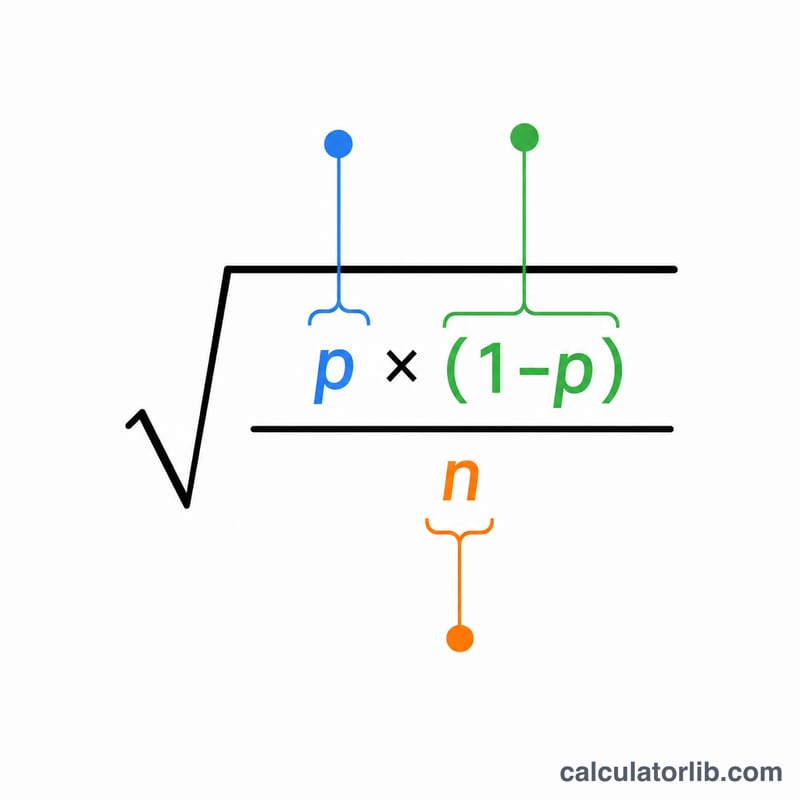
The standard error of a proportion is given by:
$$SE = \sqrt{\dfrac{\text{p}\left(1 - \text{p}\right)}{\text{n}}}$$
Here \(p(1-p)\) is the variance of a single Bernoulli trial. Dividing by \(n\) gives the variance of the sample proportion, and taking the square root converts it back to the same units as \(p\). The standard error is largest when \(p = 0.5\) (maximum uncertainty) and shrinks as the sample size \(n\) grows.
Worked example
Suppose 40 out of 100 surveyed customers prefer a product, so \(p = 0.40\) and \(n = 100\). Then $$\text{variance} = 0.40 \times 0.60 / 100 = 0.0024,$$ and $$SE = \sqrt{0.0024} \approx 0.04899.$$ A rough 95% confidence interval is \(0.40 \pm 1.96 \times 0.049\), or about 0.304 to 0.496.
FAQ
Should p be a decimal or a percentage? Use a decimal between 0 and 1. Convert a percentage by dividing by 100 (e.g., 25% = 0.25).
When is this formula valid? It assumes a large, random sample and is most accurate when both \(np\) and \(n(1-p)\) are at least about 5 to 10.
What proportion gives the largest standard error? \(p = 0.5\) produces the maximum standard error for a given sample size, which is why it is often used for conservative sample-size planning.