
What Is the Standard Error?
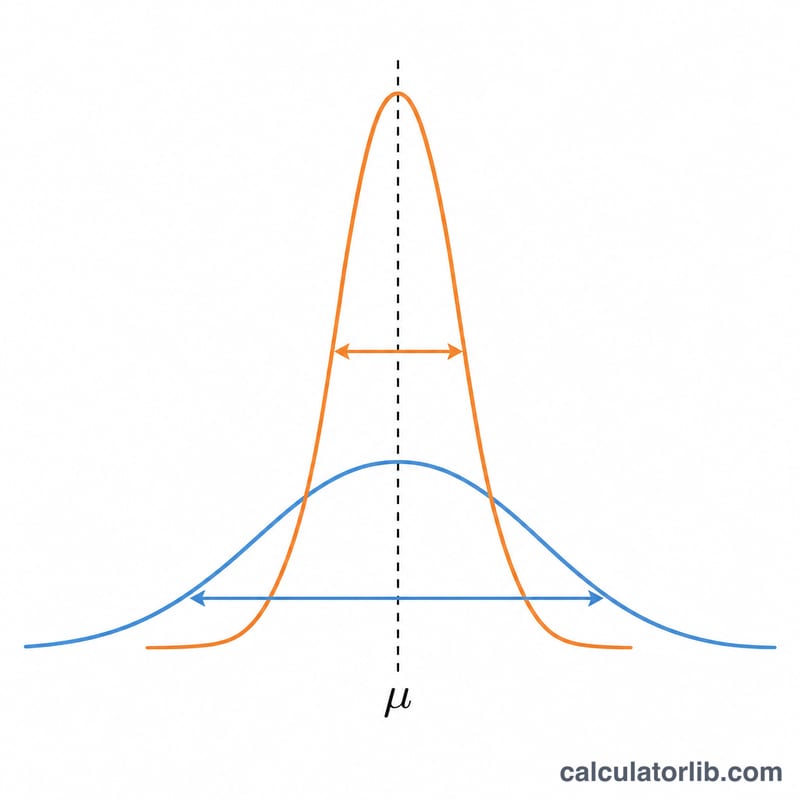
The standard error of the mean (SEM, or simply SE) measures how much the mean of a sample is expected to vary from the true population mean. While the standard deviation describes the spread of individual data points, the standard error describes the precision of your estimated average. A smaller standard error means your sample mean is a more reliable estimate of the population mean.
How to Use This Calculator
Enter two values: the sample standard deviation (s) and the sample size (n). The calculator divides the standard deviation by the square root of the sample size and instantly returns the standard error of the mean. Use it whenever you build confidence intervals, run hypothesis tests, or report margins of error.
The Formula Explained
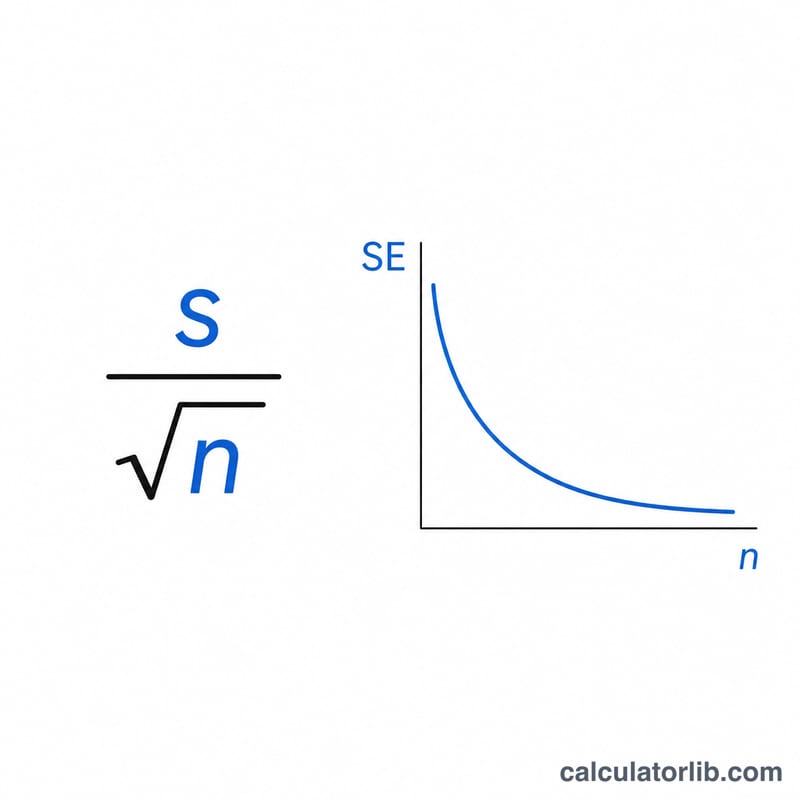
The standard error is calculated as $$\text{SE} = \frac{\text{Standard Deviation (s)}}{\sqrt{\text{Sample Size (n)}}}$$ The denominator, the square root of \(n\), is the key: as your sample size grows, the square root grows more slowly, so the standard error shrinks. To halve the standard error, you must collect four times as many observations. This is why larger samples produce more precise estimates of the population mean.
Worked Example
Suppose a sample of 25 measurements has a standard deviation of 10. Then $$\text{SE} = \frac{10}{\sqrt{25}} = \frac{10}{5} = 2$$ So the sample mean is expected to differ from the true population mean by about 2 units. If you increased the sample to 100, SE would drop to \(10 / 10 = 1\), doubling the precision.
FAQ
What is the difference between standard deviation and standard error? Standard deviation measures variability among individual data points; standard error measures variability of the sample mean as an estimate of the population mean.
Does standard error decrease with sample size? Yes. Because \(n\) appears under a square root in the denominator, increasing the sample size reduces the standard error.
Can I use this for proportions? This calculator is for the standard error of a mean. The standard error of a proportion uses a different formula, \(\sqrt{p(1-p)/n}\).