
What is percentage error?
Percentage error measures how far a measured (experimental) value deviates from a known or accepted (theoretical) value, expressed as a percentage. It is one of the most common ways scientists, students, and engineers express the accuracy of a measurement. A small percentage error means your result is close to the true value; a large one signals a meaningful discrepancy worth investigating.
How to use this calculator
Enter the experimental value you obtained from your measurement or experiment, then enter the theoretical (true or accepted) value. The calculator instantly returns the percentage error, the absolute error, and echoes both inputs so you can double-check them.
The formula explained
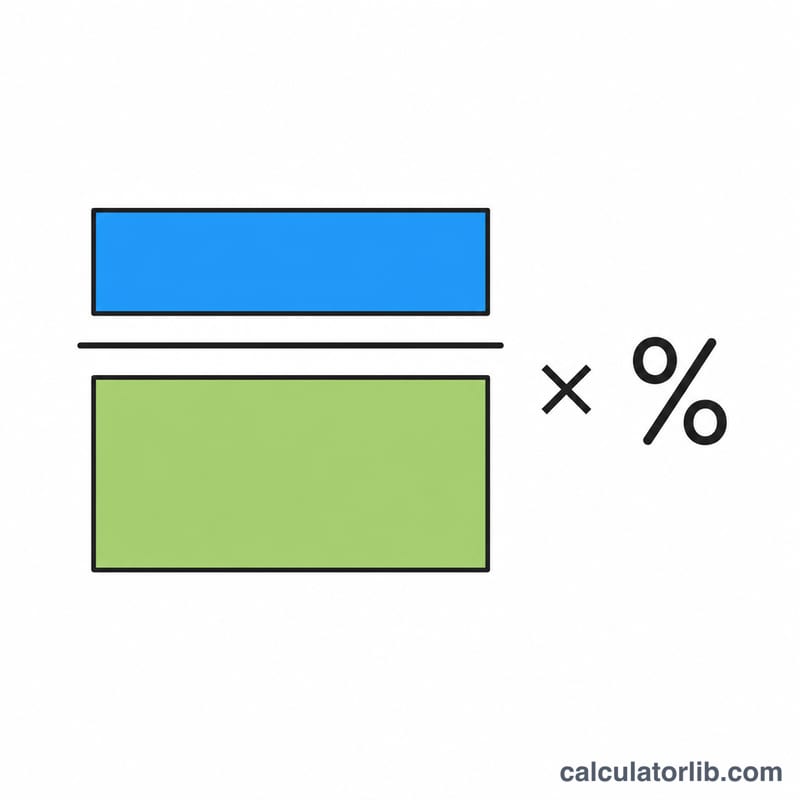
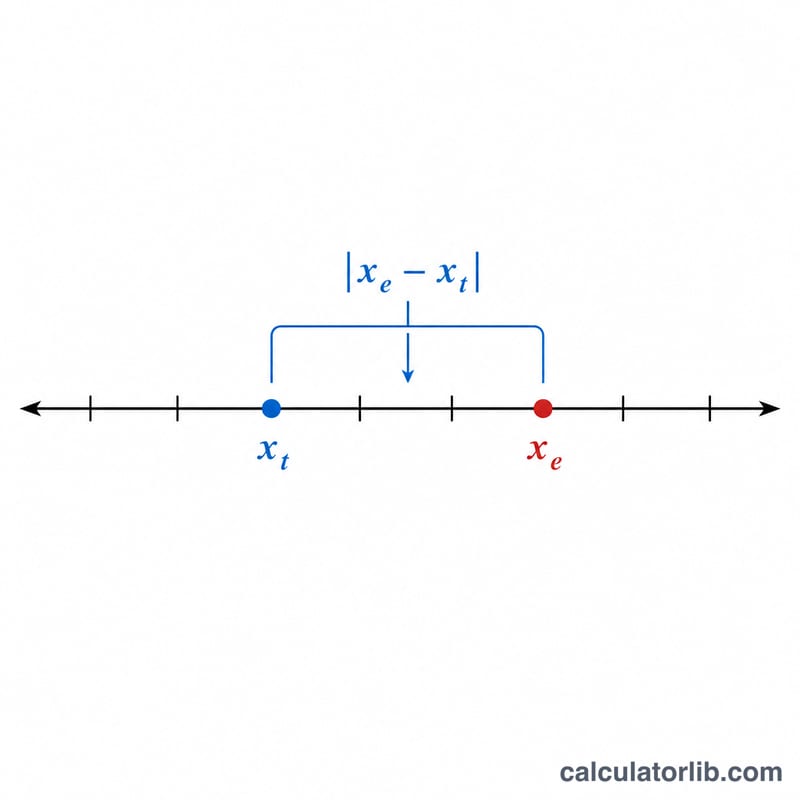
The formula is: $$\text{Percentage Error} = \frac{|\text{Experimental} - \text{Theoretical}|}{|\text{Theoretical}|} \times 100$$ The numerator is the absolute error — the size of the gap between your result and the truth, ignoring sign. Dividing by the absolute theoretical value scales that gap relative to how big the true value is, and multiplying by 100 converts the ratio into a percentage. Absolute values are used so the result is always a positive percentage regardless of whether you measured high or low.
Worked example
Suppose a lab measures the boiling point of water as 99 °C, while the accepted value is 100 °C. The absolute error is \(|99 - 100| = 1\). Dividing by \(|100|\) gives \(0.01\), and multiplying by 100 yields a percentage error of $$\frac{|99 - 100|}{|100|} \times 100 = 1\%$$ A result this small indicates a highly accurate measurement.
FAQ
Can percentage error be negative? No. Because both differences use absolute values, percentage error is always zero or positive. If you need to know the direction of the error, look at the sign of \((\text{Experimental} - \text{Theoretical})\) separately.
What if the theoretical value is zero? The formula is undefined when the true value is zero, since you cannot divide by zero. In that case percentage error is not meaningful — use absolute error instead.
What counts as a "good" percentage error? It depends on the field. In many classroom experiments under 5% is considered acceptable, while precision engineering may require errors well below 1%.