
What is MAPE?
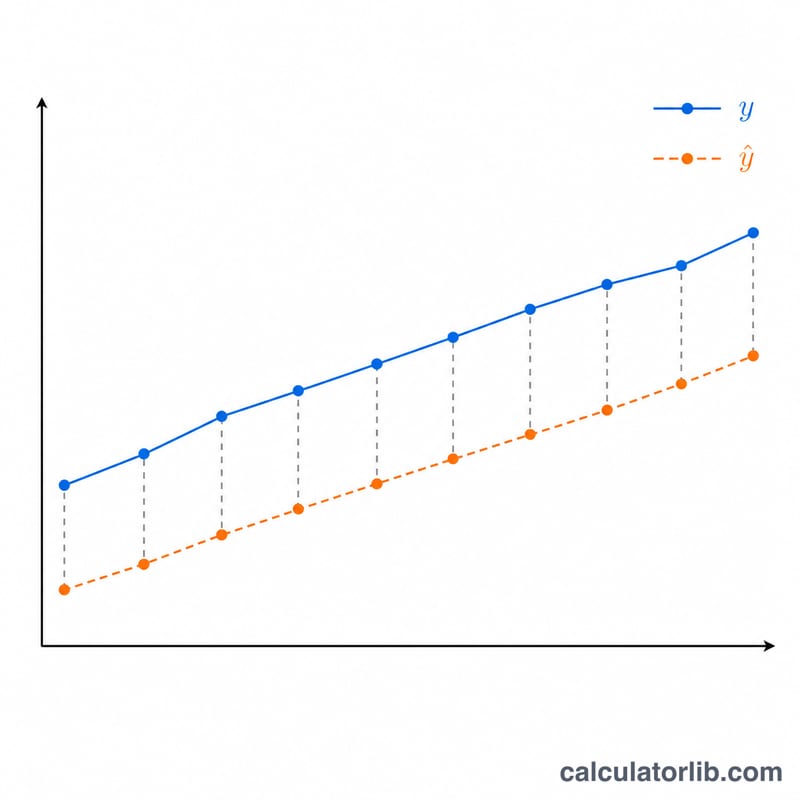
The Mean Absolute Percentage Error (MAPE) is one of the most widely used metrics for measuring forecast accuracy. It expresses the average error between predicted and actual values as a percentage, which makes it easy to interpret and compare across datasets of different scales. A MAPE of 5% means your forecasts are, on average, off by 5% of the actual value.
How to use this calculator
Enter your actual (observed) values and your forecast (predicted) values as two comma-separated lists. The lists should line up so the first actual matches the first forecast, and so on. The calculator pairs them, computes the absolute percentage error for each pair, and averages them. Any pair where the actual value is zero is skipped, because percentage error is undefined when dividing by zero.
The formula explained
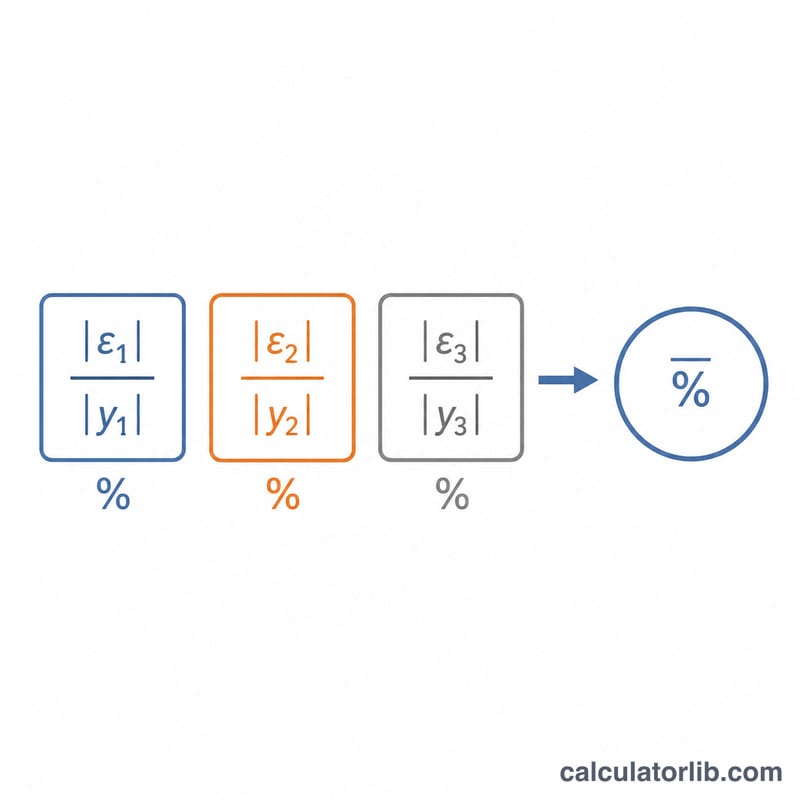
For each data point, MAPE takes the absolute difference between the actual value \(y_i\) and the forecast \(\hat{y}_i\), divides it by the actual value, and converts it to a percentage. These percentage errors are summed and divided by the number of points \(n\):
$$\text{MAPE} = \frac{100\%}{n} \sum_{i=1}^{n} \left| \frac{\text{Actual}_i - \text{Forecast}_i}{\text{Actual}_i} \right|$$
Worked example
Suppose actuals are 100, 200, 300 and forecasts are 110, 190, 320. The percentage errors are \(|100-110|/100 = 0.10\), \(|200-190|/200 = 0.05\), and \(|300-320|/300 \approx 0.0667\). Their sum is 0.21667; dividing by 3 and multiplying by 100 gives $$\text{MAPE} \approx 7.22\%$$ so the forecast is about 92.78% accurate.
FAQ
What is a good MAPE value? It depends on the field, but under 10% is often considered highly accurate and 10–20% is good for many business forecasts.
Why are zero actual values skipped? Dividing by zero is undefined, so MAPE cannot be computed for those points. Consider sMAPE if your data contains zeros.
Does the order of values matter? Yes — the actuals and forecasts are paired by position, so keep the two lists aligned.