
What Is Mean Absolute Deviation?
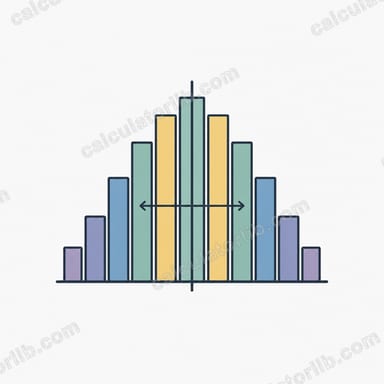
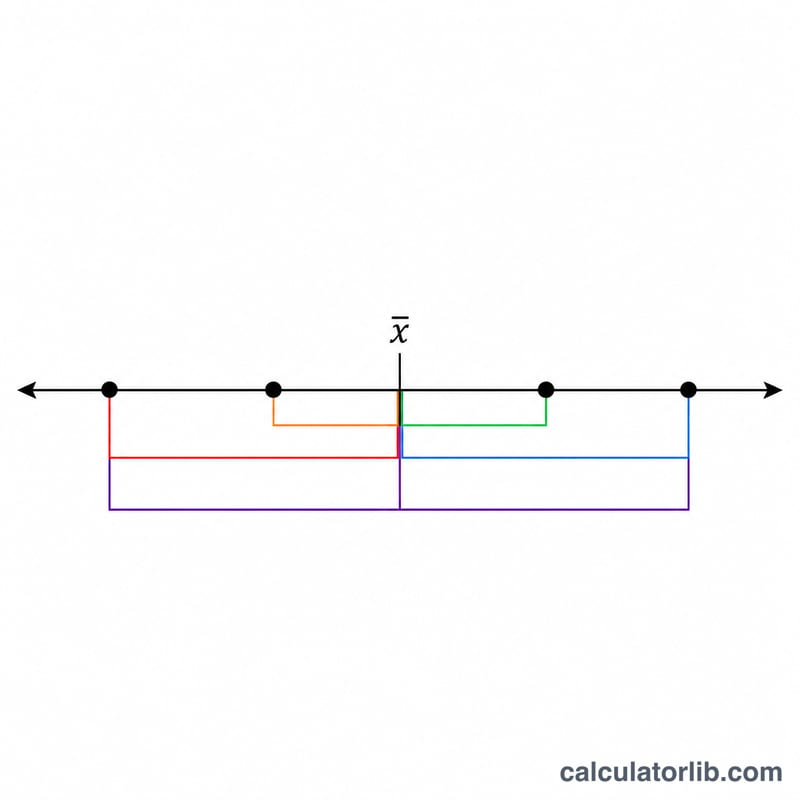
The mean absolute deviation (MAD) measures how spread out a data set is by averaging the absolute distances between each value and the mean. Unlike variance or standard deviation, MAD uses absolute values instead of squares, making it intuitive and easy to interpret: it tells you, on average, how far each data point lies from the center.
How to Use This Calculator
Type your numbers into the box, separated by commas or spaces (for example, 4, 8, 6, 5, 3, 7). The calculator computes the mean, the sum of the absolute deviations, and finally the mean absolute deviation. A smaller MAD means the values cluster tightly around the mean; a larger MAD indicates greater dispersion.
The Formula Explained
First find the mean \(\bar{x}\) by dividing the sum of all values by the count \(n\). Next, for each value subtract the mean and take the absolute value, removing any negative signs. Add these absolute deviations together, then divide by \(n\). In symbols:
$$\text{MAD} = \frac{1}{n}\sum_{i=1}^{n}\left| x_i - \bar{x} \right|$$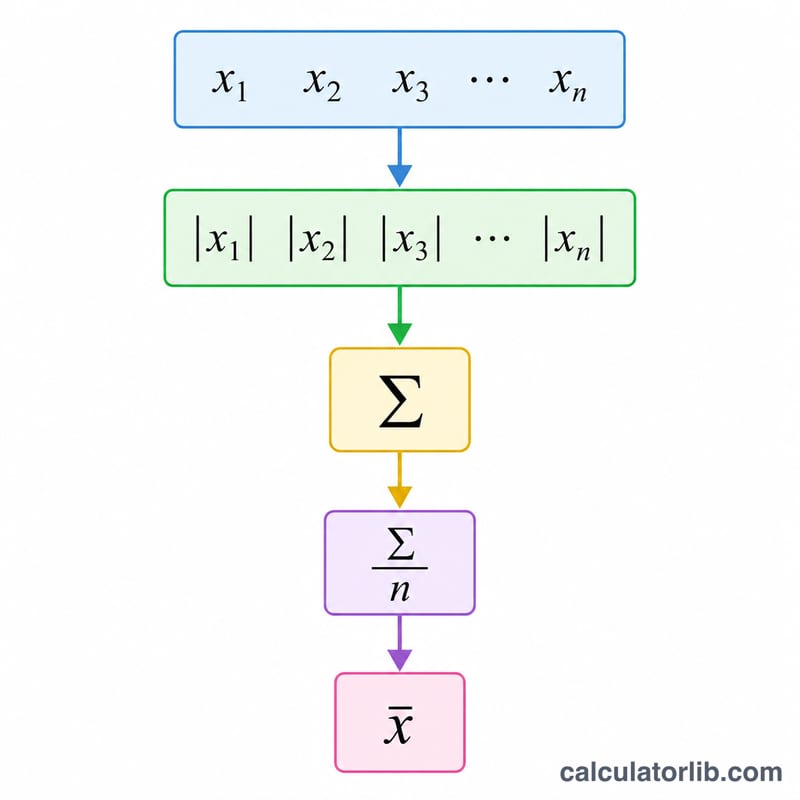
Worked Example
Consider the set 4, 8, 6, 5, 3, 7. The sum is 33 and \(n = 6\), so the mean is 5.5. The absolute deviations are
$$|4-5.5|=1.5,\quad |8-5.5|=2.5,\quad |6-5.5|=0.5,\quad |5-5.5|=0.5,\quad |3-5.5|=2.5,\quad |7-5.5|=1.5,$$which sum to 9. Dividing by 6 gives a MAD of 1.5.
FAQ
How is MAD different from standard deviation? MAD averages absolute differences, while standard deviation averages squared differences (then takes a square root). MAD is less sensitive to outliers.
Can MAD be negative? No. Because it uses absolute values, MAD is always zero or positive. It equals zero only when every value is identical.
What separators can I use? Commas, spaces, or both. The calculator ignores extra spaces automatically.