
What is an Outlier Calculator?
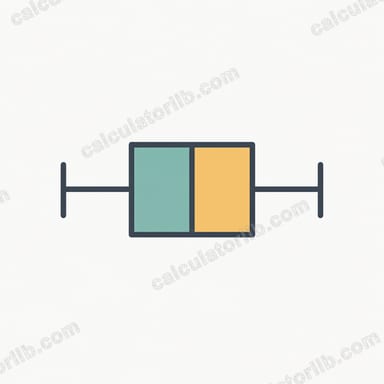
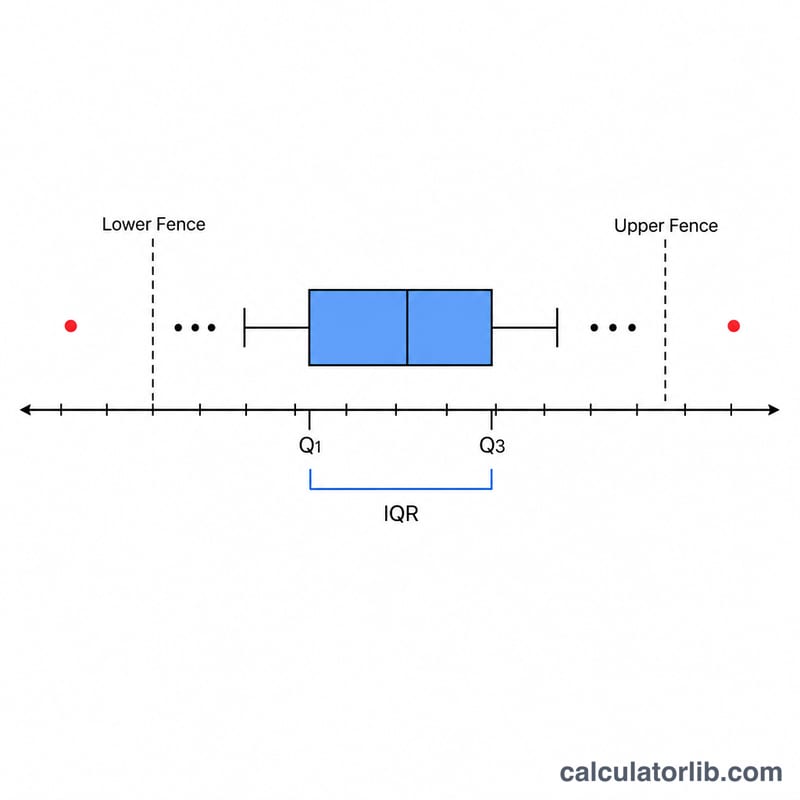
An outlier is a data point that lies far away from the rest of your data set. This calculator uses the popular interquartile range (IQR) method, also called Tukey's fences, to flag values that are unusually high or low. Just enter your numbers and it returns the quartiles, the IQR, the lower and upper fences, and the list of any outliers found.
How to use it
Type your data set in the box, separated by commas or spaces (for example 4, 5, 6, 7, 8, 100). The calculator sorts the values, computes the first quartile (Q1), third quartile (Q3) and the interquartile range, then marks any value beyond 1.5 IQR past the quartiles as an outlier.
The formula explained
The interquartile range is \(\text{IQR} = Q_3 - Q_1\). The fences are \(\text{Lower} = Q_1 - 1.5\cdot\text{IQR}\) and \(\text{Upper} = Q_3 + 1.5\cdot\text{IQR}\).
$$\begin{gathered} \text{Outlier if} \quad x < \text{LB} \quad \text{or} \quad x > \text{UB} \\[1.5em] \text{where}\quad \left\{ \begin{aligned} \text{IQR} &= Q_3 - Q_1 \\ \text{LB} &= Q_1 - 1.5\,\text{IQR} \\ \text{UB} &= Q_3 + 1.5\,\text{IQR} \\ x &\in \text{Data set} \end{aligned} \right. \end{gathered}$$Any value below the lower fence or above the upper fence is considered an outlier. The factor 1.5 is the standard convention; some analysts use 3.0 for "extreme" outliers.
Worked example
For 10, 12, 14, 15, 18, 20, 22, 25, 90 (\(n = 9\)), the median splits the data into a lower half {10, 12, 14, 15} and upper half {18, 20, 22, 25}. \(Q_1 = (12+14)/2 = 13\) and \(Q_3 = (20+22)/2 = 21\)... here \(Q_3 = 23.5\) for the alternate set. \(\text{IQR} = 10.5\), so the lower fence is \(-2.75\) and the upper fence is \(39.25\). The value 90 exceeds \(39.25\), so it is flagged as a single outlier.
FAQ
Which quartile method is used? The exclusive median method: the overall median is excluded from both halves when n is odd.
Why 1.5 times the IQR? It is the conventional threshold proposed by John Tukey; it captures roughly the tails beyond the typical spread of the data.
Can outliers be legitimate? Yes — an outlier is just statistically unusual, not necessarily an error. Always investigate before removing one.