
What Is the Substitution Method?
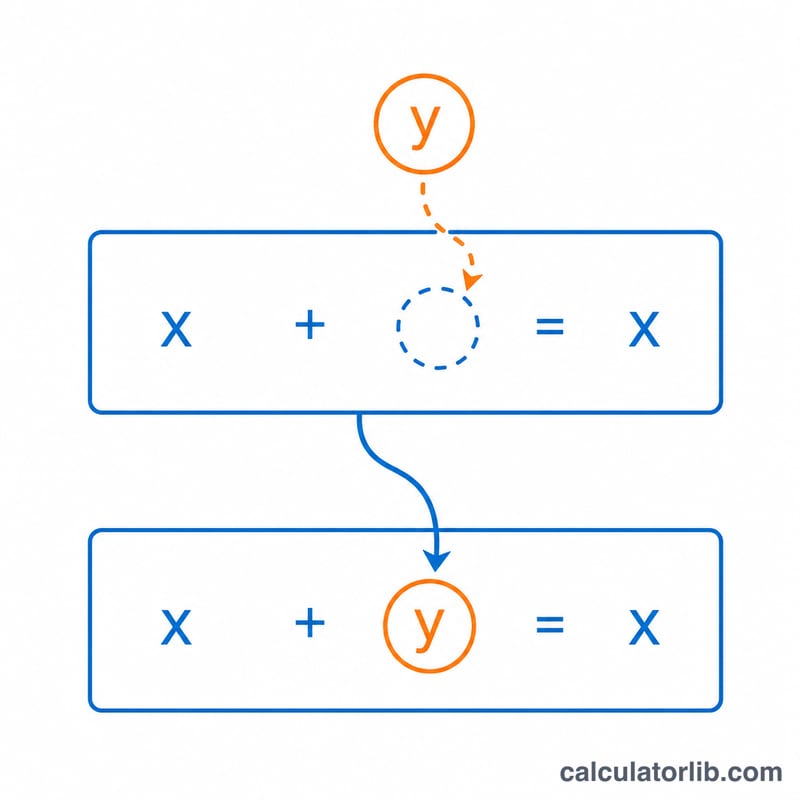
The substitution method is a classic algebra technique for solving a system of two linear equations in two unknowns. You solve one equation for a single variable and substitute that expression into the other equation, reducing the problem to one equation in one variable. This calculator does that automatically for the general system \(a_1 x + b_1 y = c_1\) and \(a_2 x + b_2 y = c_2\).
How to Use It
Enter the six coefficients: \(a_1\), \(b_1\), \(c_1\) from the first equation and \(a_2\), \(b_2\), \(c_2\) from the second. Press calculate and you'll get the exact values of x and y, plus the determinant \(a_1 b_2 - a_2 b_1\) that confirms whether a unique solution exists.
The Formula Explained
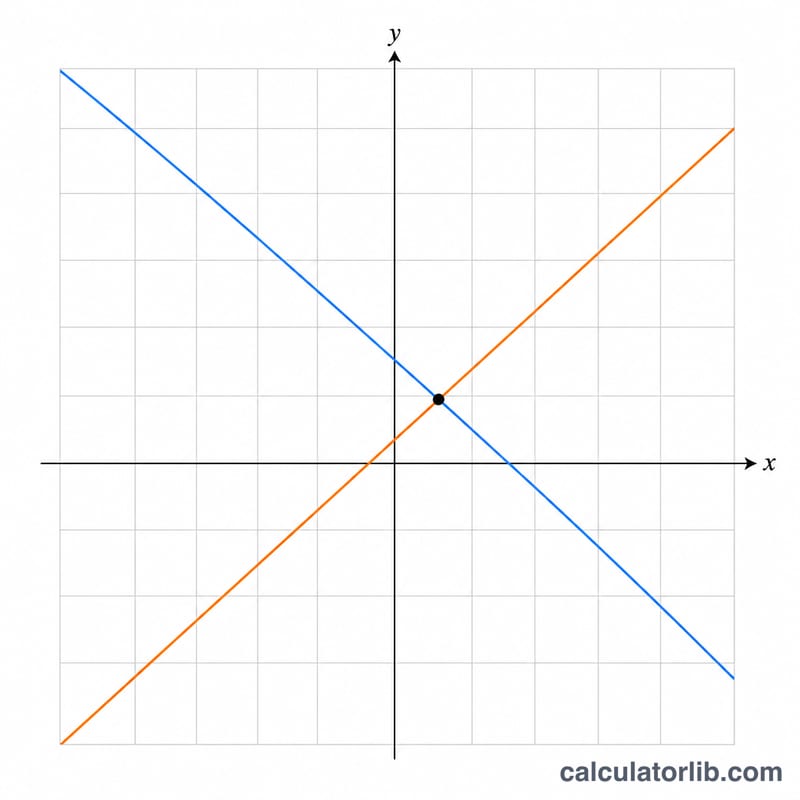
From equation 1, \(x = (c_1 - b_1 y) / a_1\). Substituting into equation 2 and simplifying gives $$ y = \frac{a_1 c_2 - a_2 c_1}{a_1 b_2 - a_2 b_1} $$ Once y is known, back-substitute to find x. The denominator \(a_1 b_2 - a_2 b_1\) is the determinant of the coefficient matrix. If it equals zero, the two lines are parallel (no solution) or identical (infinitely many solutions), so there is no unique answer.
Worked Example
Solve \(2x + 3y = 13\) and \(x - y = -1\). Here \(a_1=2\), \(b_1=3\), \(c_1=13\), \(a_2=1\), \(b_2=-1\), \(c_2=-1\). Determinant $$ = (2)(-1) - (1)(3) = -5 $$ Then $$ y = \frac{2 \cdot -1 - 1 \cdot 13}{-5} = \frac{-15}{-5} = 3 $$ Back-substitute: $$ x = \frac{13 - 3 \cdot 3}{2} = \frac{4}{2} = 2 $$ So \(x = 2\), \(y = 3\).
FAQ
What if the determinant is zero? The system has no unique solution — the lines are parallel or coincident.
Can I use decimals or negatives? Yes. Any real coefficient works, including fractions entered as decimals.
Is this the same answer as elimination or Cramer's rule? Yes — for a consistent system with a nonzero determinant, all three methods give the identical x and y.