Connect via MCP →

Enter Calculation

Formula

Advertisement

Results

Radial wavefunction R(r) at first r value
2
units of a₀−3/2 · n=1, l=0, Z=1
r · R(r) at first r value 0
Number of points 101
r (a₀) R(r) r·R(r)
0 2 0
0.2 1.637462 0.327492
0.4 1.34064 0.536256
0.6 1.097623 0.658574
0.8 0.898658 0.718926
1 0.735759 0.735759
1.2 0.602388 0.722866
1.4 0.493194 0.690471
1.6 0.403793 0.646069
1.8 0.330598 0.595076
2 0.270671 0.541341
2.2 0.221606 0.487534
2.4 0.181436 0.435446
2.6 0.148547 0.386223
2.8 0.12162 0.340536
3 0.099574 0.298722
3.2 0.081524 0.260878
3.4 0.066747 0.226938
3.6 0.054647 0.196731
3.8 0.044742 0.170018
4 0.036631 0.146525
4.2 0.029991 0.125963
4.4 0.024555 0.108041
4.6 0.020104 0.092477
4.8 0.016459 0.079006
5 0.013476 0.067379
5.2 0.011033 0.057372
5.4 0.009033 0.048779
5.6 0.007396 0.041416
5.8 0.006055 0.03512
6 0.004958 0.029745
6.2 0.004059 0.025165
6.4 0.003323 0.021268
6.6 0.002721 0.017957
6.8 0.002228 0.015147
7 0.001824 0.012766
7.2 0.001493 0.010751
7.4 0.001223 0.009047
7.6 0.001001 0.007607
7.8 0.000819 0.006392
8 0.000671 0.005367
8.2 0.000549 0.004504
8.4 0.00045 0.003778
8.6 0.000368 0.003167
8.8 0.000301 0.002653
9 0.000247 0.002221
9.2 0.000202 0.001859
9.4 0.000165 0.001555
9.6 0.000135 0.0013
9.8 0.000111 0.001087
10 0.000091 0.000908
10.2 0.000074 0.000758
10.4 0.000061 0.000633
10.6 0.00005 0.000528
10.8 0.000041 0.000441
11 0.000033 0.000367
11.2 0.000027 0.000306
11.4 0.000022 0.000255
11.6 0.000018 0.000213
11.8 0.000015 0.000177
12 0.000012 0.000147
12.2 0.00001 0.000123
12.4 0.000008 0.000102
12.6 0.000007 0.000085
12.8 0.000006 0.000071
13 0.000005 0.000059
13.2 0.000004 0.000049
13.4 0.000003 0.000041
13.6 0.000002 0.000034
13.8 0.000002 0.000028
14 0.000002 0.000023
14.2 0.000001 0.000019
14.4 0.000001 0.000016
14.6 0.000001 0.000013
14.8 0.000001 0.000011
15 0.000001 0.000009
15.2 0.000001 0.000008
15.4 0 0.000006
15.6 0 0.000005
15.8 0 0.000004
16 0 0.000004
16.2 0 0.000003
16.4 0 0.000002
16.6 0 0.000002
16.8 0 0.000002
17 0 0.000001
17.2 0 0.000001
17.4 0 0.000001
17.6 0 0.000001
17.8 0 0.000001
18 0 0.000001
18.2 0 0
18.4 0 0
18.6 0 0
18.8 0 0
19 0 0
19.2 0 0
19.4 0 0
19.6 0 0
19.8 0 0
20 0 0
Distances in Bohr radii (a = a₀ = 1). The overall sign is a phase convention; (r·R)² is sign independent.

What is the Hydrogen Radial Wavefunction Calculator?

This tool computes the normalized radial wavefunction R(r) of a hydrogen-like (one-electron) atom — the part of the electron wavefunction that depends only on the distance r from the nucleus. It also returns r·R(r), since the radial probability density is proportional to (r·R(r))². It is pure quantum mechanics and applies universally. Distances are measured in Bohr radii (\(a = a_0 = 1\)).
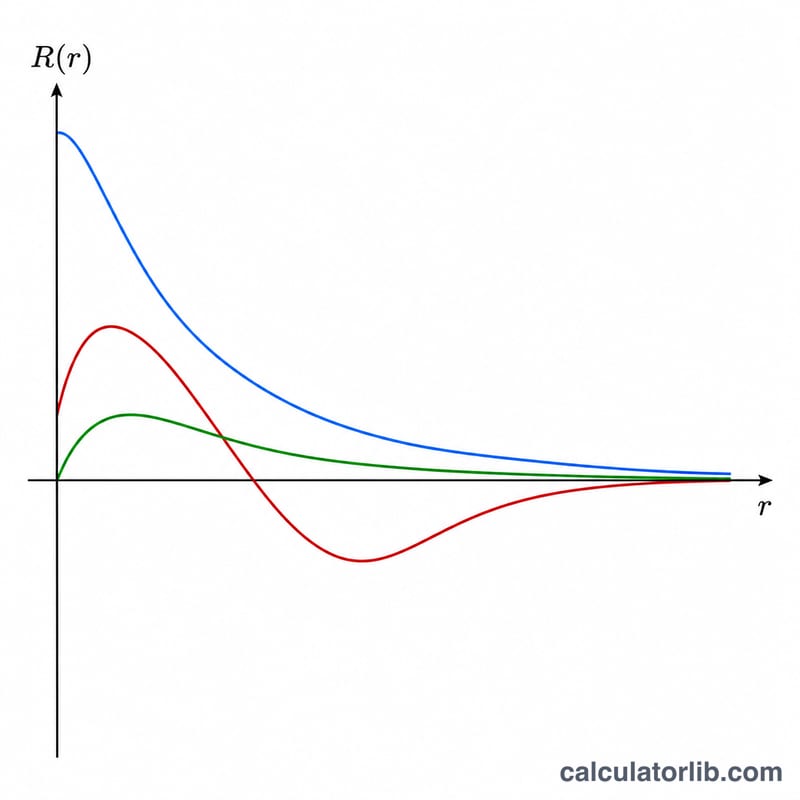
Radial wavefunction curves for 1s, 2s and 2p states versus radius
Radial wavefunctions R(r) for several states, showing how nodes increase with the quantum numbers.

How to use it

Choose the atomic number Z (Hydrogen Z=1 or the Helium ion He+ Z=2), enter the principal quantum number n (1, 2, 3, ...) and the azimuthal quantum number l (0 to n−1). Then set the starting radius, the step size, and the number of points to build a table you can plot.

The formula

With the dimensionless variable \(\rho = 2Zr/(na)\) and \(a = 1\), the normalized radial wavefunction is $$R_{n,l}(r) = N\,e^{-\rho/2}\,\rho^{\,l}\,L_{n-l-1}^{\,2l+1}(\rho),$$ where the normalization constant $$N = \sqrt{\left(\frac{2Z}{na}\right)^{3}\frac{(n-l-1)!}{2n\,(n+l)!}}.$$ The associated Laguerre polynomial uses $$L_p^q(x) = \sum (-1)^i \binom{p+q}{p-i} \frac{x^i}{i!}.$$
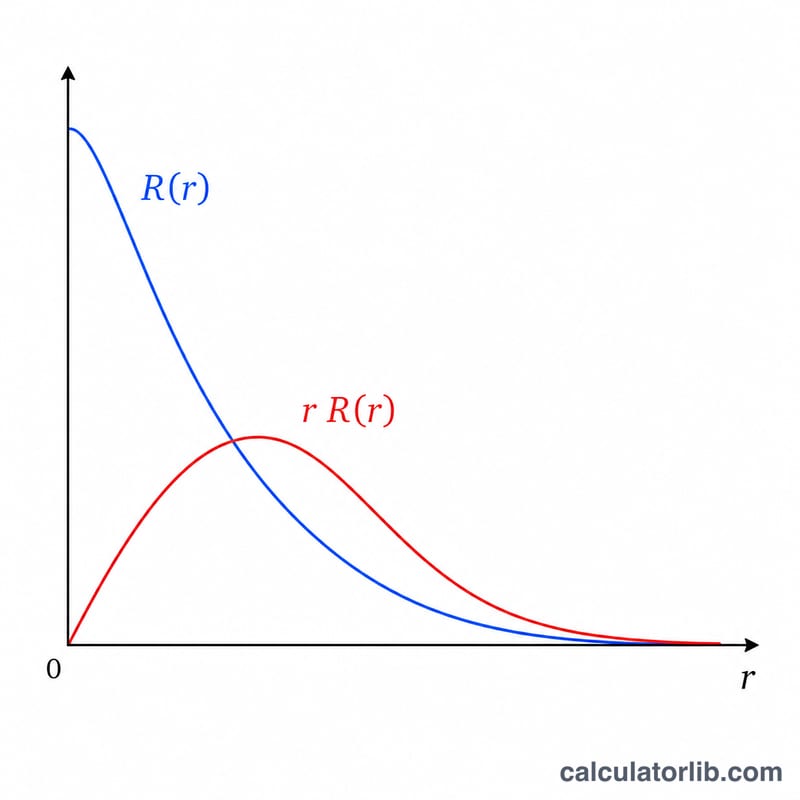
Comparison of R(r) and r times R(r) curves versus radius
R(r) versus r·R(r): the latter goes to zero at the origin and peaks at intermediate radius.

Worked example

For Z=1, n=2, l=0 (the 2s orbital): $$R_{2,0}(r) = \frac{1}{2\sqrt{2}}(2 - r)\,e^{-r/2}.$$ At r=0, \(R = \frac{1}{2.828427}\cdot 2 = 0.707107\). At r=2 there is a radial node where \(R=0\). This matches the calculator output.

FAQ

Why is there sometimes a leading minus sign? The overall sign is a phase convention with no physical meaning; (r·R)² is sign independent.

Why is R(0)=0 for l≥1? Because \(\rho^{\,l} = 0\) at r=0 when \(l\ge 1\).

What units does R(r) have? \(a_0^{-3/2}\), since the wavefunction is normalized over three-dimensional space measured in Bohr radii.


Last updated: