
What Is the Ceiling Function?
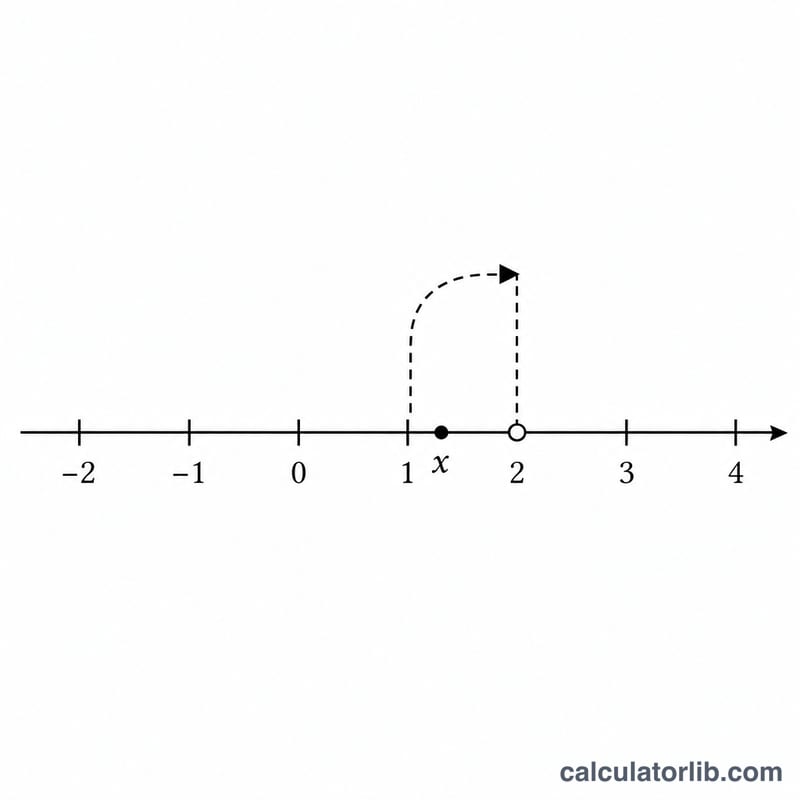
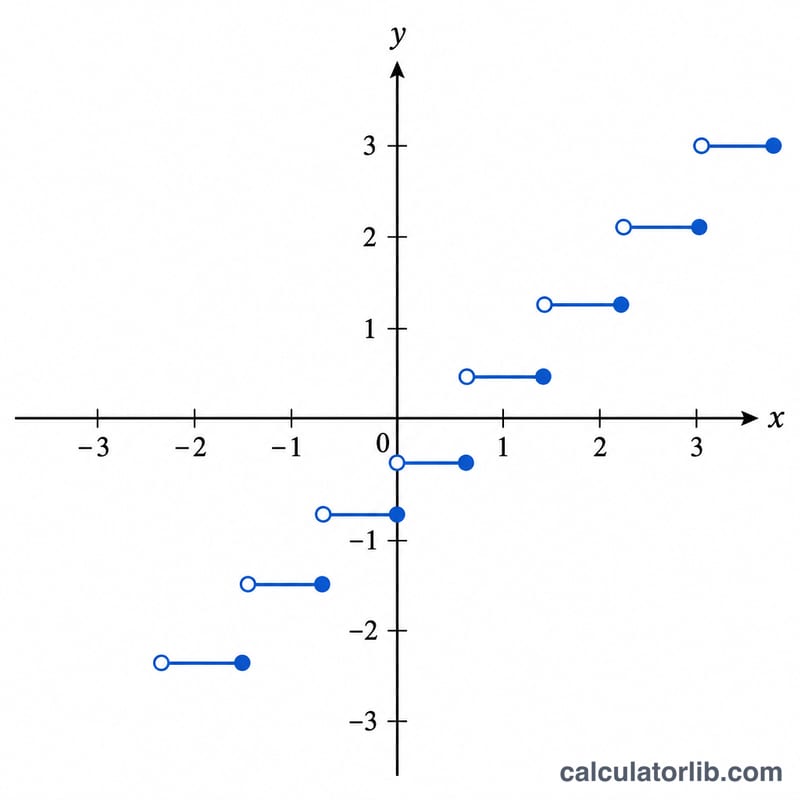
The ceiling function, written \(\lceil x \rceil\) or ceil(x), rounds a real number up to the nearest integer. Formally, \(\lceil x \rceil\) is the smallest integer that is greater than or equal to x. It is one of the most common rounding operations in mathematics, computer science, and engineering, and it pairs naturally with its counterpart, the floor function \(\lfloor x \rfloor\), which rounds down.
How to Use This Calculator
Type any number into the input box — it can be positive, negative, a whole number, or a decimal — and the calculator instantly returns its ceiling. Whole numbers stay unchanged because an integer is already greater than or equal to itself. Decimals always jump up to the next integer.
The Formula Explained
The definition is $$\lceil x \rceil = \min\{\, n \in \mathbb{Z} \mid n \ge x \,\}$$ In words, look at every integer that is at least as large as x, then keep the smallest one. For example, the integers \(\ge 4.1\) are 5, 6, 7, …; the smallest is 5, so \(\lceil 4.1 \rceil = 5\). Watch out for negative numbers: rounding "up" moves toward zero, so \(\lceil -2.3 \rceil = -2\), not \(-3\).
Worked Example
Suppose a print shop charges per full sheet and a job needs 12.4 sheets of material. Since you cannot buy a fraction of a sheet, you compute \(\lceil 12.4 \rceil = 13\) sheets. Likewise, splitting 100 items into boxes of 30 requires $$\lceil 100 \div 30 \rceil = \lceil 3.33\ldots \rceil = 4 \text{ boxes}$$
FAQ
What is the ceiling of a negative number? Ceiling rounds toward positive infinity, so \(\lceil -2.3 \rceil = -2\) and \(\lceil -5 \rceil = -5\).
Is ceiling the same as rounding up? Yes — ceiling always rounds up to the next integer, unlike standard rounding which goes to the nearest integer.
What is the ceiling of a whole number? It is the number itself, since every integer already satisfies \(n \ge n\).