
What this calculator does
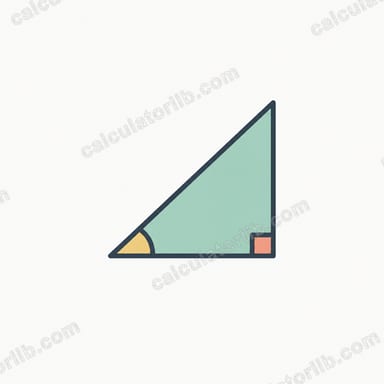
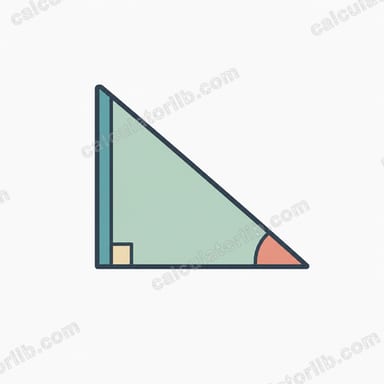
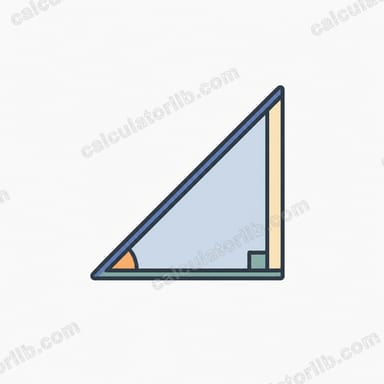
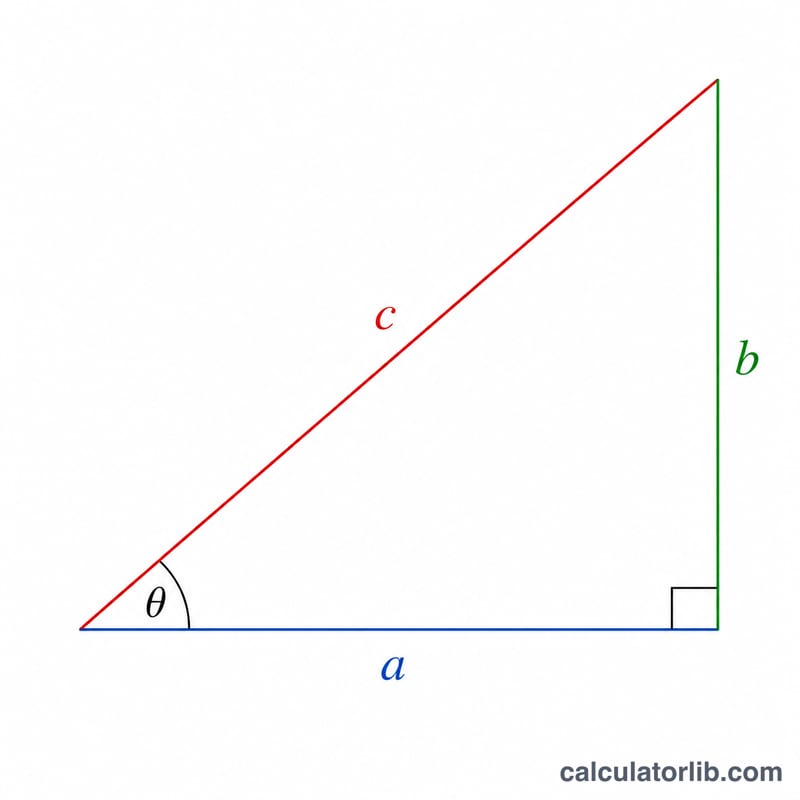
This tool solves a right triangle for its two legs when you know the hypotenuse and the inclination angle. Picture a right triangle whose longest side (the hypotenuse, \(c\)) makes an angle theta with the horizontal base. The base \(a\) sits adjacent to theta, the height \(b\) is opposite to theta, and the right angle is between \(a\) and \(b\). Given \(c\) and theta, the calculator returns both legs in the same length unit you used for the hypotenuse.
How to use it
Enter the hypotenuse \(c\) as a plain number (any length unit). Enter the angle in decimal degrees, for example 30. If your angle is given in degrees-minutes-seconds, fill the optional Minutes and Seconds fields too; the calculator converts them with \(\text{degDecimal} = \text{degrees} + \frac{\text{minutes}}{60} + \frac{\text{seconds}}{3600}\). For a standard right triangle keep theta between 0 and 90 degrees.
The formula explained
The defining trigonometric ratios are \(\cos\theta = a / c\) and \(\sin\theta = b / c\). Rearranging gives the two outputs directly:
$$a = c \cdot \cos\theta, \quad b = c \cdot \sin\theta$$The angle is first converted to radians (\(\text{thetaRad} = \text{degDecimal} \cdot \pi / 180\)) before the trig functions are applied. At theta = 0 the triangle flattens so \(a = c\) and \(b = 0\); at theta = 90 it stands up so \(a = 0\) and \(b = c\).
Worked example
Take \(c = 10\) and theta = 30 degrees. In radians that is \(0.5235987756\). Then
$$a = 10 \cdot \cos(30°) = 10 \cdot 0.8660254038 = 8.660254038$$$$b = 10 \cdot \sin(30°) = 10 \cdot 0.5 = 5.0$$So the base is about 8.66 and the height is exactly 5, in the same unit as the hypotenuse.
FAQ
Can I use any length unit? Yes. No conversion is done, so if \(c\) is in meters the outputs are in meters; if it is in feet they are in feet.
What if I only have decimal degrees? Leave Minutes and Seconds at 0 and just enter the decimal value, such as 5.25.
What happens outside 0 to 90 degrees? The math still runs through cosine and sine, but \(a\) or \(b\) may become negative and the right-triangle leg interpretation is lost, so keep the angle within 0 to 90 degrees for meaningful sides.