
What this calculator does
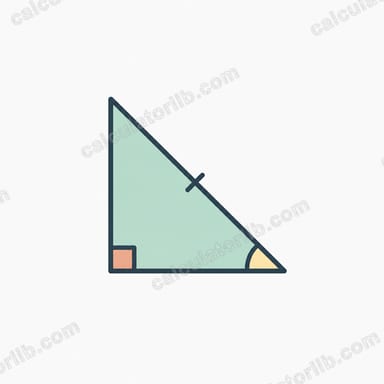
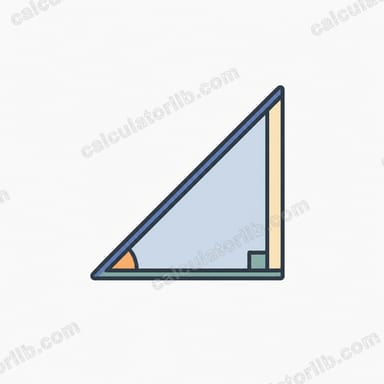
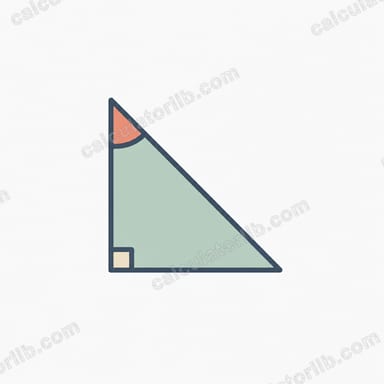
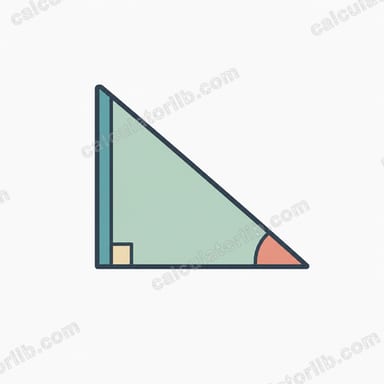
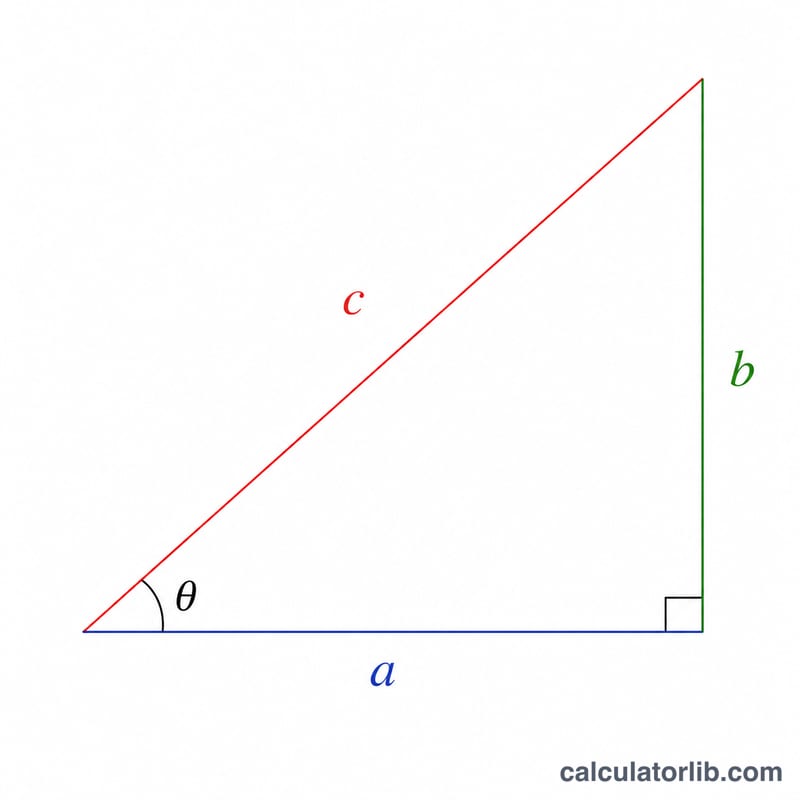
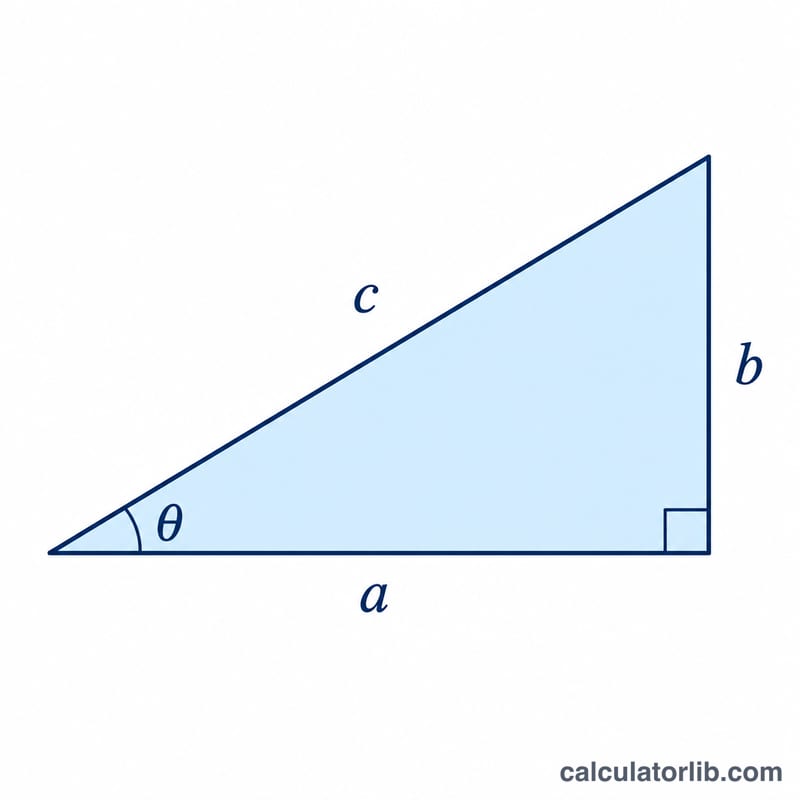
This tool solves a right triangle when you know its base a (the side adjacent to the angle) and its hypotenuse c (the longest side, opposite the right angle). It returns the inclination angle theta in both decimal degrees and degrees-minutes-seconds (D M S), plus the height b (the side opposite theta). It is handy for DIY stair and lattice angles, crane sling and lifting angles, rebar layout, and tilt-clearance checks.
How to use it
Enter the base a and the hypotenuse c using the same length unit (any unit works since the result is unitless in angle, and b comes back in that same unit). The base must be greater than zero, and the hypotenuse must be at least as large as the base. Press calculate to read off the angle and height.
The formula explained
In a right triangle, the cosine of the angle equals the adjacent side over the hypotenuse: \(\cos(\theta) = a / c\), so $$\theta = \arccos\!\left(\frac{a}{c}\right).$$ Multiply by \(180/\pi\) to convert radians to degrees. The height comes straight from the Pythagorean theorem, \(a^{2} + b^{2} = c^{2}\), giving $$b = \sqrt{c^{2} - a^{2}}.$$ To express the angle in D M S, the whole degrees are taken first, the fractional part times 60 gives arc-minutes, and the leftover times 60 gives arc-seconds (shown to two decimals).
Worked example
With \(a = 1\) and \(c = 2\): \(\cos(\theta) = 1/2 = 0.5\), so \(\theta = \arccos(0.5) = 60\) degrees exactly, written 60° 0' 0.00". The height is $$b = \sqrt{2^{2} - 1^{2}} = \sqrt{3} \approx 1.7320508.$$ For a 3-4-5 triangle with \(a = 3\) and \(c = 5\): \(\cos(\theta) = 0.6\), \(\theta \approx 53.130102°\), or 53° 7' 48.37", and \(b = \sqrt{25 - 9} = 4\).
FAQ
Why must the hypotenuse be at least the base? The hypotenuse is always the longest side. If a exceeds c, the ratio \(a/c\) is greater than 1 and arccos is undefined, so the inputs do not form a valid right triangle.
What happens at the limits? If a equals c the angle is 0 degrees and the height is 0 (a flat, degenerate triangle). If a is 0 the angle is 90 degrees and the height equals the hypotenuse.
Which side is the height? Height b is the side opposite the angle theta, perpendicular to the base a.