
What Is the FEV1/FVC Ratio?
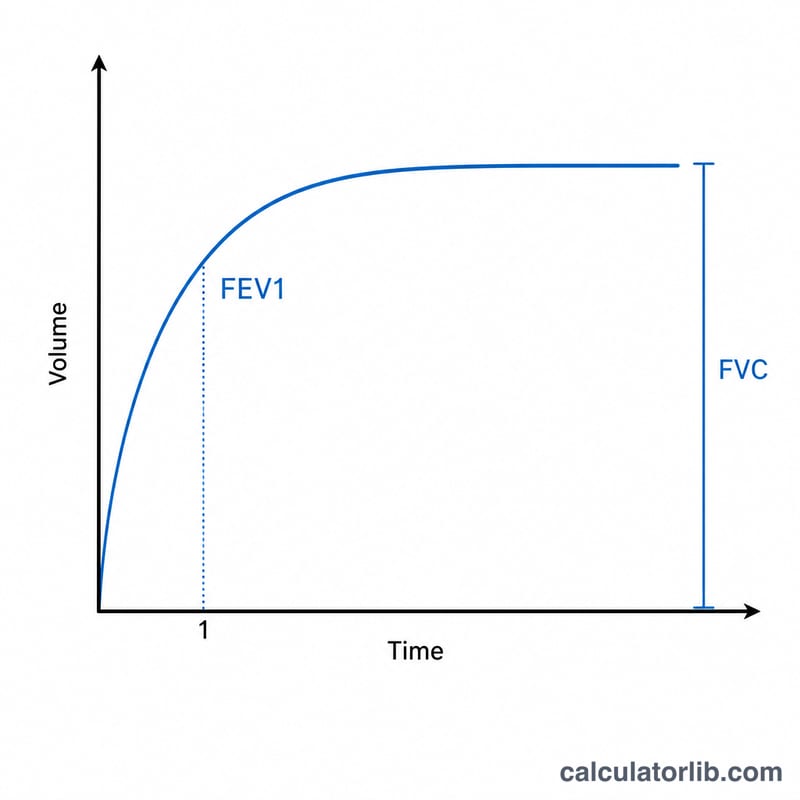
The FEV1/FVC ratio is a key spirometry measurement used to assess lung function. FEV1 (Forced Expiratory Volume in one second) is the amount of air you can forcibly exhale in the first second of a breath, while FVC (Forced Vital Capacity) is the total amount of air you can exhale after taking the deepest breath possible. Dividing FEV1 by FVC and multiplying by 100 gives the ratio as a percentage. This calculator is a general educational tool and is not a substitute for professional medical interpretation.
How to Use This Calculator
Enter your FEV1 value in liters and your FVC value in liters, both taken from your spirometry report. The calculator divides FEV1 by FVC and multiplies by 100 to give your ratio. For example, if FEV1 is 3.0 L and FVC is 4.0 L, the ratio is $$(3.0 / 4.0) \times 100 = 75\%.$$
The Formula Explained
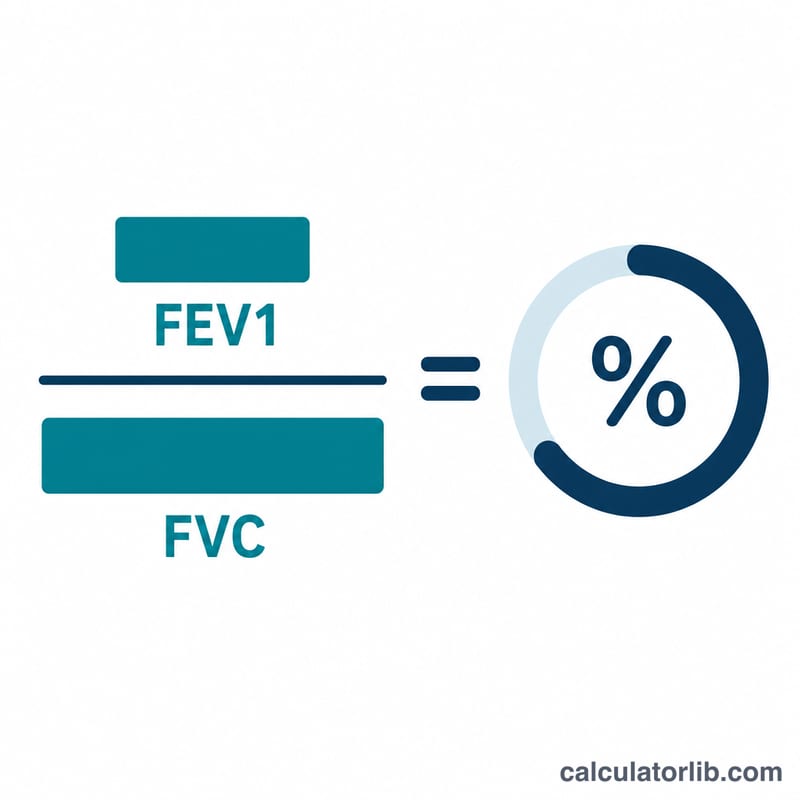
The equation is simply $$\text{Ratio (\%)} = (\text{FEV1} \div \text{FVC}) \times 100.$$ Because FEV1 is always a portion of the total FVC, the ratio is always 100% or less. A normal ratio in healthy adults is generally above 70–75%. A reduced ratio can indicate an obstructive pattern (such as asthma or COPD), where airflow is limited. Restrictive patterns, by contrast, often show a normal or even high ratio because both values fall together.
Worked Example
Suppose a patient has an FEV1 of 2.4 L and an FVC of 3.2 L. The ratio is $$(2.4 / 3.2) \times 100 = 75\%.$$ This is at the lower edge of the normal range and would typically prompt a clinician to compare it against predicted values based on age, sex, height, and ethnicity.
FAQ
What is a normal FEV1/FVC ratio? In most healthy adults it is above 70%, though clinicians increasingly use the lower limit of normal (LLN) which adjusts for age.
What does a low ratio mean? A ratio below the normal threshold suggests an obstructive airway disease such as COPD or asthma.
Can the ratio be over 100%? No. Since FEV1 is part of FVC, the ratio cannot exceed 100%. Values near or above 100% usually point to a restrictive pattern or measurement issues.