
What is the parallelogram area formula?
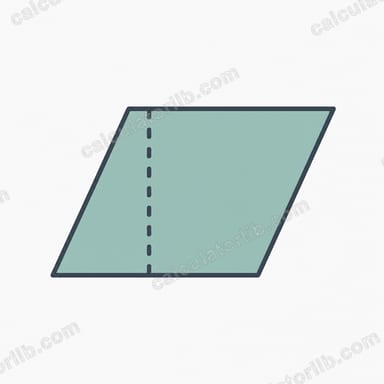
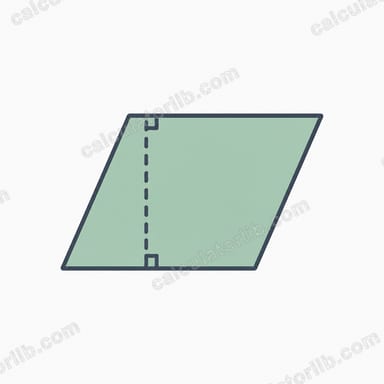
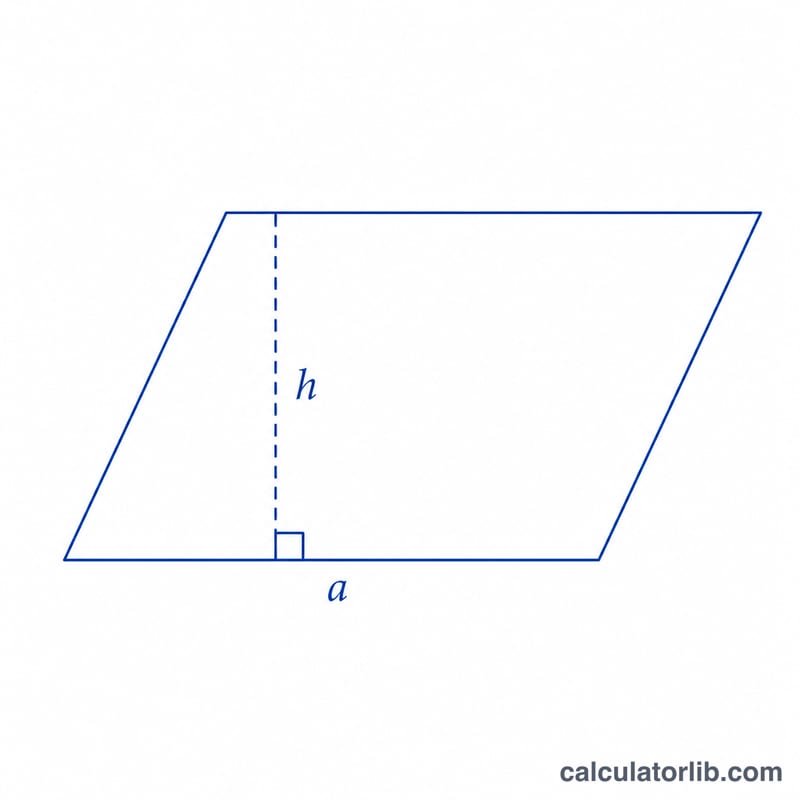
A parallelogram is a four-sided shape with two pairs of parallel sides. Its area equals the base length multiplied by the perpendicular height: \(S = a \times h\). The key point is that h is the perpendicular (straight-line) distance between the two parallel base sides, not the length of the slanted side. This calculator is unit-agnostic: enter both numbers in the same unit and the area comes out in that unit squared.
How to use the calculator
Enter the base length a and the perpendicular height h in matching units (both in cm, both in m, both in inches, and so on). The result is the area in the square of that unit. For example, base and height in centimeters give an area in square centimeters.
Why the formula works
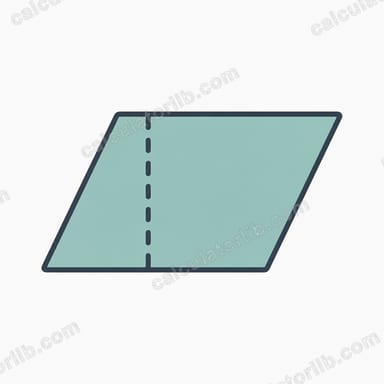
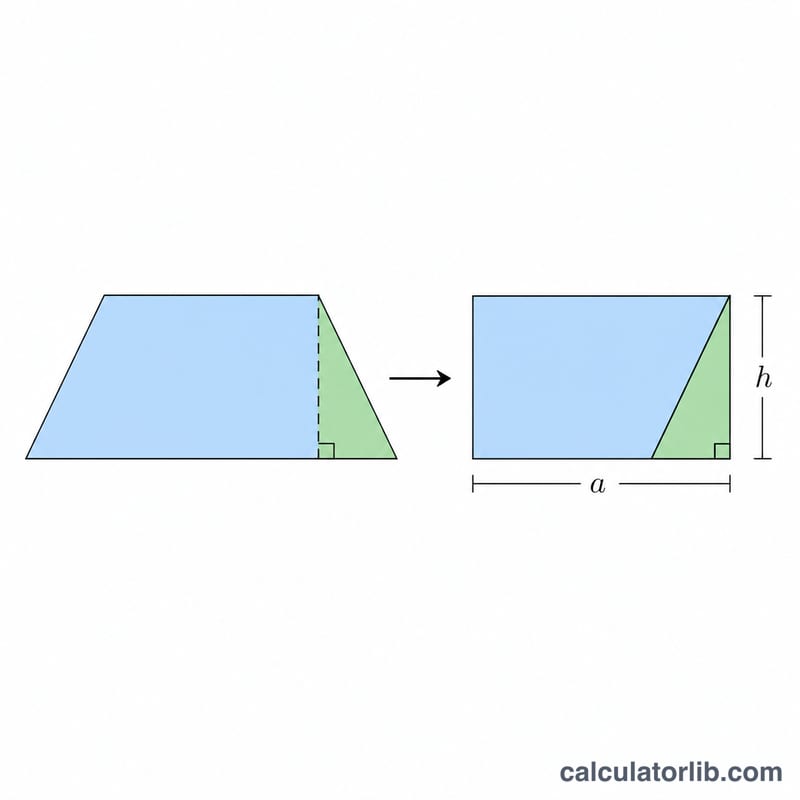
Imagine slicing a right triangle off one end of the parallelogram and sliding it to the other end. This rearranges the shape into a rectangle with width a and height h. Since a rectangle's area is width times height, the parallelogram's area is also \(a \times h\).
Worked example
Suppose the base a = 6.5 cm and the perpendicular height h = 4 cm. Then $$S = 6.5 \times 4 = 26 \text{ cm}^2.$$ With the default values a = 2 and h = 1, the area is $$S = 2 \times 1 = 2 \text{ square units}.$$
FAQ
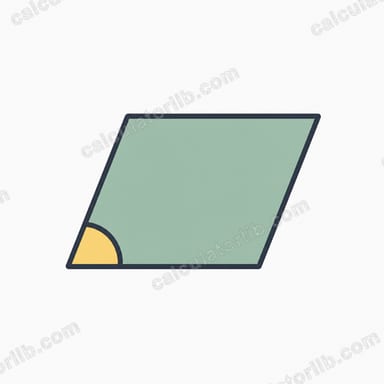
Is the height the slanted side? No. The height is the perpendicular distance between the two parallel bases. If you only know the slant side s and the angle theta between the sides, compute \(h = s \times \sin(\theta)\), giving \(\text{area} = a \times s \times \sin(\theta)\).
What if I enter zero? If either the base or the height is zero, the area is zero, which represents a degenerate (flat) parallelogram.
Do units matter? Both inputs must share the same length unit. The output is automatically in that unit squared. Negative entries are treated as their absolute values since lengths cannot be negative.