
What Is Mean Airway Pressure?
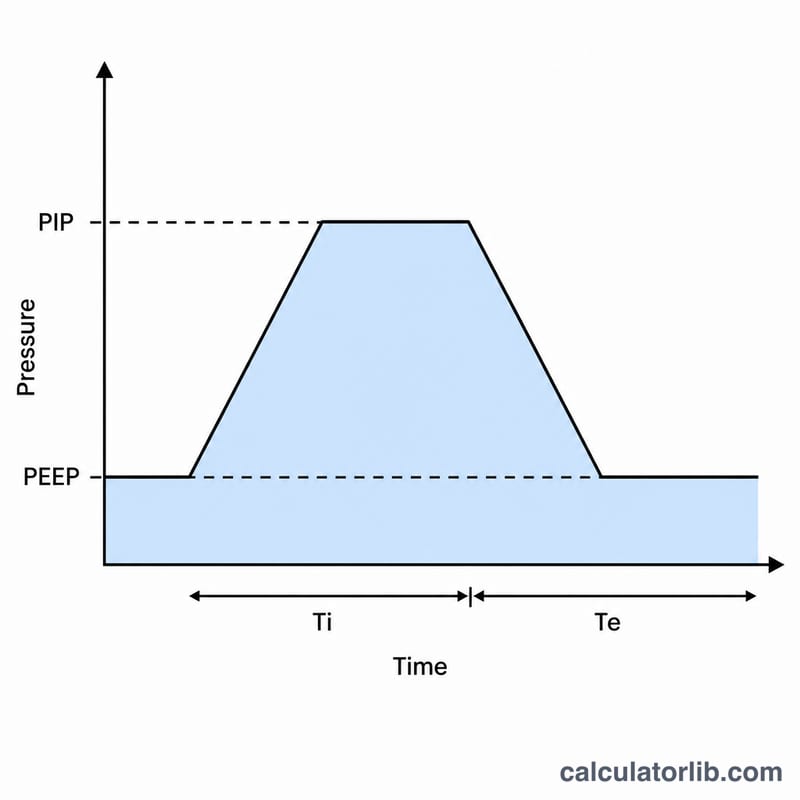
Mean Airway Pressure (MAP, or P̄aw) is the average pressure applied to the airways and lungs across a complete ventilatory cycle. It is an important bedside parameter in mechanical ventilation because it correlates with mean alveolar pressure, oxygenation, and the risk of barotrauma and hemodynamic compromise. This calculator estimates MAP from four common ventilator values using a simplified square-wave approximation.
How to Use This Calculator
Enter the Peak Inspiratory Pressure (PIP) and PEEP in cmH₂O, then enter the inspiratory time (Ti) and expiratory time (Te) in seconds. The tool computes the inspiratory time fraction and applies it to the pressure difference above PEEP. Results update instantly so you can compare different ventilator settings.
The Formula Explained
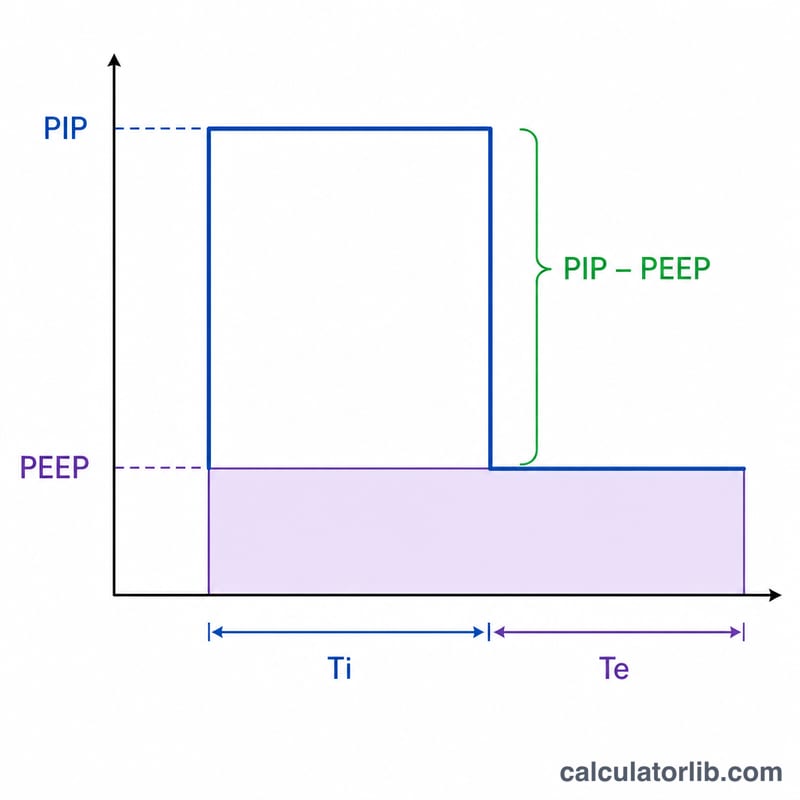
$$\text{MAP} = \frac{\text{Ti}}{\text{Ti} + \text{Te}} \left( \text{PIP} - \text{PEEP} \right) + \text{PEEP}$$ The term \(\frac{\text{Ti}}{\text{Ti} + \text{Te}}\) is the inspiratory fraction of the breath cycle (the I-fraction). Multiplying it by the driving pressure (\(\text{PIP} - \text{PEEP}\)) gives the average pressure contribution during inspiration, and adding PEEP restores the baseline pressure that is present throughout the entire cycle. This is a rectangular-waveform estimate; a true ventilator integrates the actual pressure waveform and may report a slightly different value.
Worked Example
Suppose PIP = 25 cmH₂O, PEEP = 5 cmH₂O, Ti = 1 s and Te = 2 s. The inspiratory fraction is \(1 / (1 + 2) = 0.333\). Then $$\text{MAP} = 0.333 \times (25 - 5) + 5 = 0.333 \times 20 + 5 = 6.67 + 5 = 11.67 \text{ cmH}_2\text{O}.$$
FAQ
Is this the same as the ventilator's displayed MAP? Not exactly. Modern ventilators integrate the measured pressure waveform, so this square-wave formula is an approximation that is usually close for pressure-control and conventional modes.
Why does increasing Ti raise MAP? A longer inspiratory time increases the fraction of the cycle spent at the higher inspiratory pressure, raising the average.
Can MAP be lower than PEEP? No. Because PEEP is the baseline and PIP is at least PEEP, MAP always lies between PEEP and PIP.