
What this calculator does
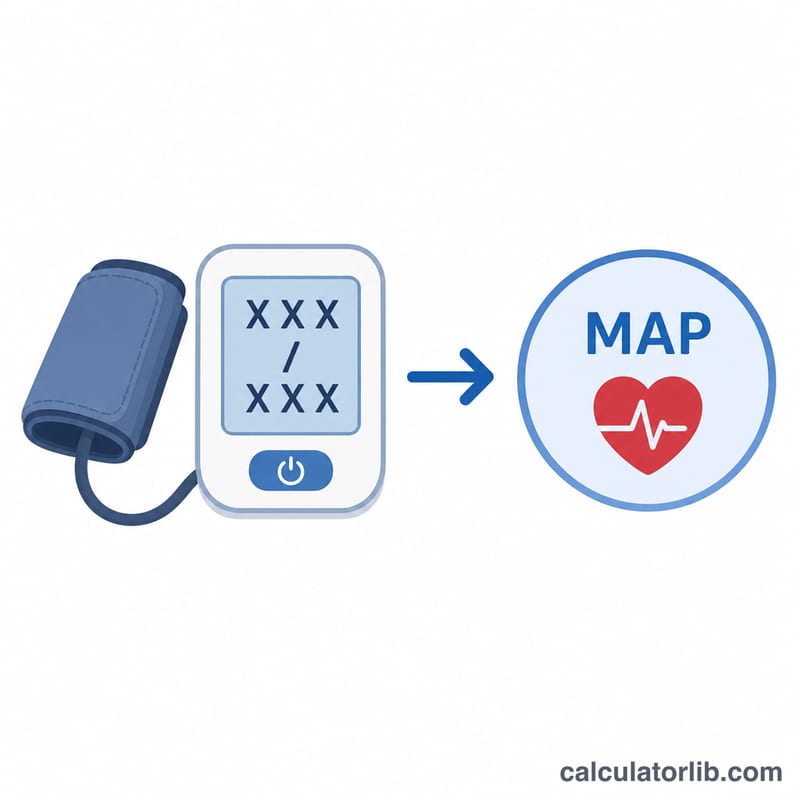
This tool turns a single blood pressure reading into two useful derived numbers: the Mean Arterial Pressure (MAP) and the Pulse Pressure (PP). Enter your systolic (the higher number) and diastolic (the lower number) pressures in mmHg, and it returns both values instantly. The formula is universal physiology — it works identically anywhere in the world and is not tied to any country's guidelines.
How to use it
Read your blood pressure as two numbers, for example 125/80. The first number is systolic blood pressure (SBP), the pressure during the heart's contraction phase. The second is diastolic blood pressure (DBP), the pressure during the relaxation phase. Type both into the form and read the results. Pulse pressure is normally positive; if the calculator warns you that systolic is below diastolic, you probably entered the numbers in the wrong order.
The formula explained
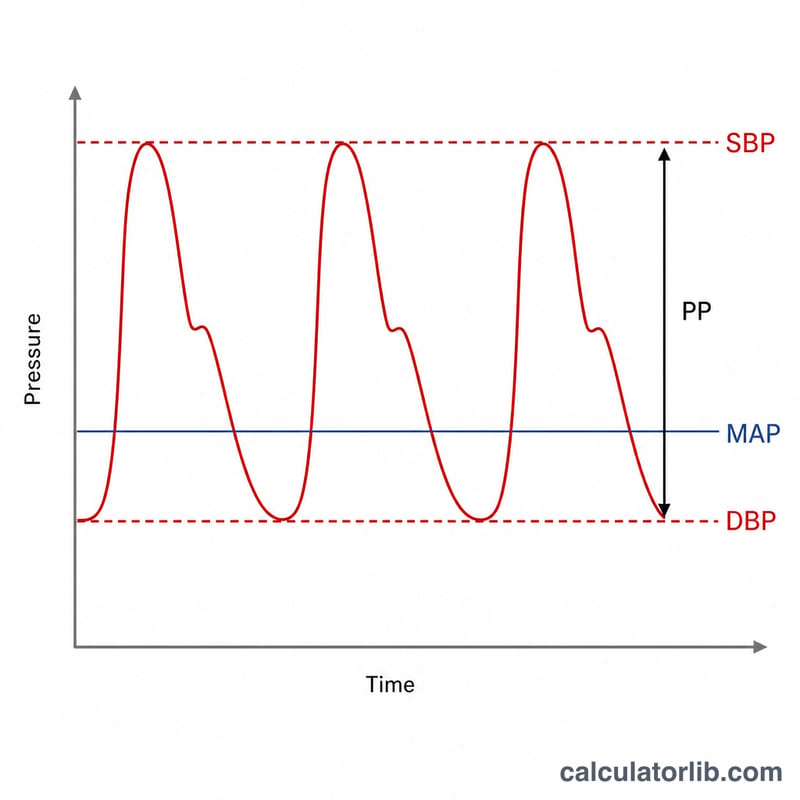
Pulse pressure is simply the gap between the two readings: \(\text{PP} = \text{SBP} - \text{DBP}\). Mean arterial pressure is the average pressure pushing blood through your body across a full heartbeat. Because the heart spends more time relaxed than contracting, MAP is weighted toward the diastolic value. The standard bedside estimate is $$\text{MAP} = \text{DBP} + \frac{\text{SBP} - \text{DBP}}{3}$$ which is equivalent to \(\frac{\text{SBP} + 2\times\text{DBP}}{3}\). This approximation is most accurate at normal resting heart rates of roughly 60–80 beats per minute.
Worked example
For a reading of 125/80 mmHg: $$\text{PP} = 125 - 80 = 45 \text{ mmHg}$$ $$\text{MAP} = 80 + \frac{125 - 80}{3} = 80 + \frac{45}{3} = 80 + 15 = \textbf{95 mmHg}$$ So the result is a MAP of 95 mmHg and a pulse pressure of 45 mmHg.
FAQ
What is a normal MAP? A MAP at or below about 90 mmHg is commonly considered normal; an elevated MAP is associated with stiffening of the small arteries.
What is a normal pulse pressure? Roughly 40–60 mmHg. A widened pulse pressure can reflect stiffening of the large arteries.
Is this medical advice? No. These figures are informational and should not replace evaluation by a qualified healthcare professional.