
What is rounding to the nearest hundred?
Rounding to the nearest hundred replaces a number with the closest multiple of 100 — such as 0, 100, 200, 300, and so on. It is a common way to simplify numbers for estimation, mental math, budgeting, and reporting where exact figures are unnecessary.
How to use this calculator
Type any number into the field — it can be positive, negative, or a decimal — and the calculator instantly returns the nearest multiple of 100. There is nothing else to configure.
The formula explained
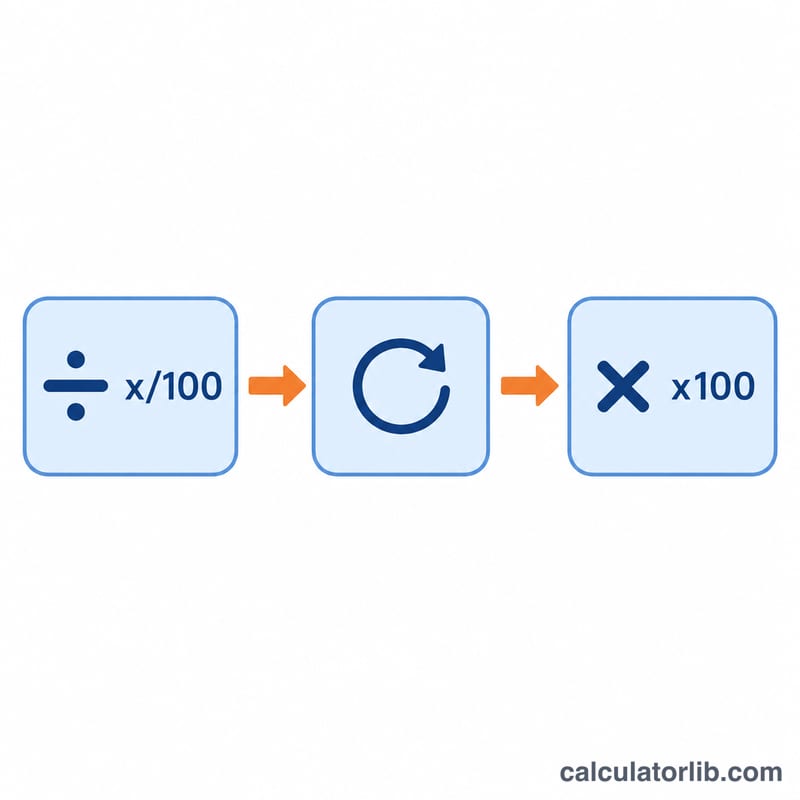
The rule is $$\text{Rounded} = \left\lfloor \frac{\text{Number}}{100} \right\rceil \times 100$$ First divide the value by 100 to scale it down, then round that result to the nearest whole number, and finally multiply by 100 to scale it back. Standard rounding sends a digit of 5 (in the tens place) upward, so \(150\) rounds up to \(200\).
Worked example
Take 1,234. Divide by 100 to get \(12.34\). Rounding \(12.34\) to the nearest whole number gives \(12\). Multiply by 100 to get 1,200. Because the tens digit (3) is below 5, the number rounds down.
FAQ
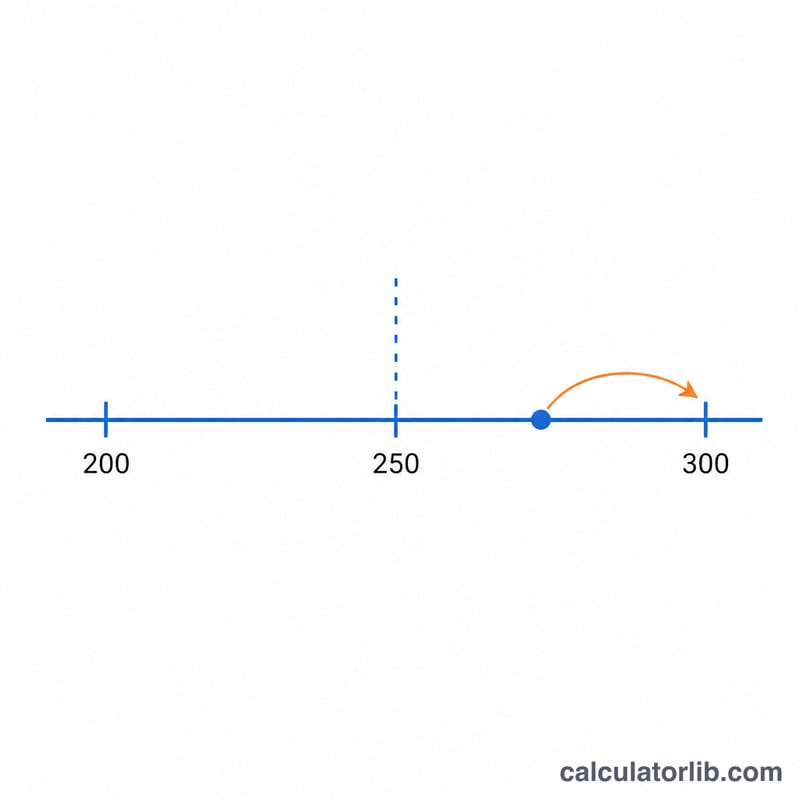
What happens at the halfway point, like 250? \(250 \div 100 = 2.5\), which rounds up to \(3\), giving \(300\). This calculator uses standard "round half up" behavior.
Can I round negative numbers? Yes. For example, \(-1{,}260\) becomes \(-1{,}300\), since \(-12.6\) rounds to \(-13\).
Does it handle decimals? Yes. The tens and ones digits (and any decimals) are absorbed into the rounding, so \(1{,}049.9\) rounds to \(1{,}000\).