
What is rounding to the nearest hundredth?
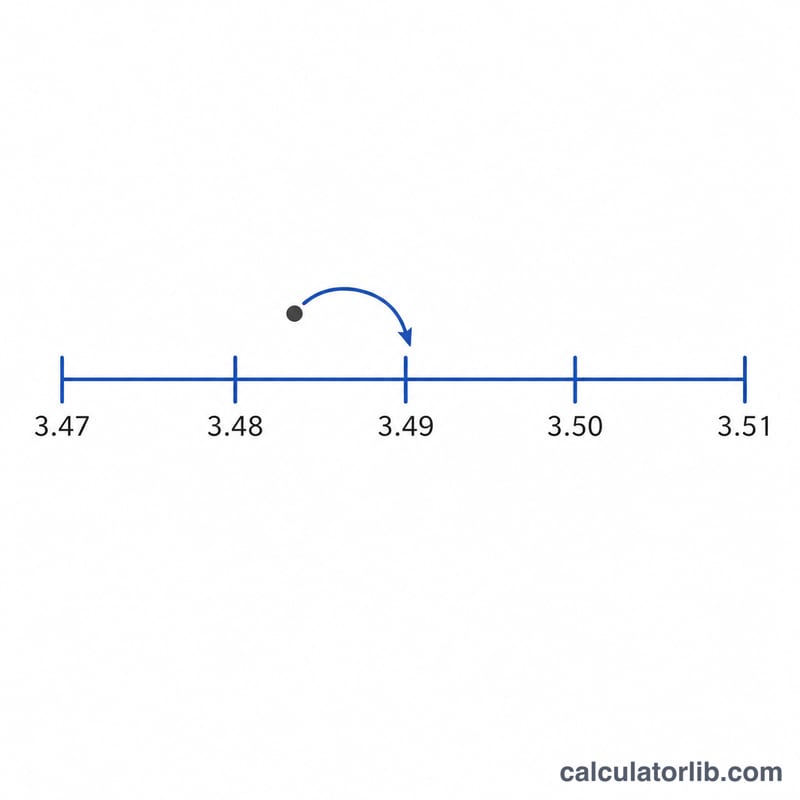
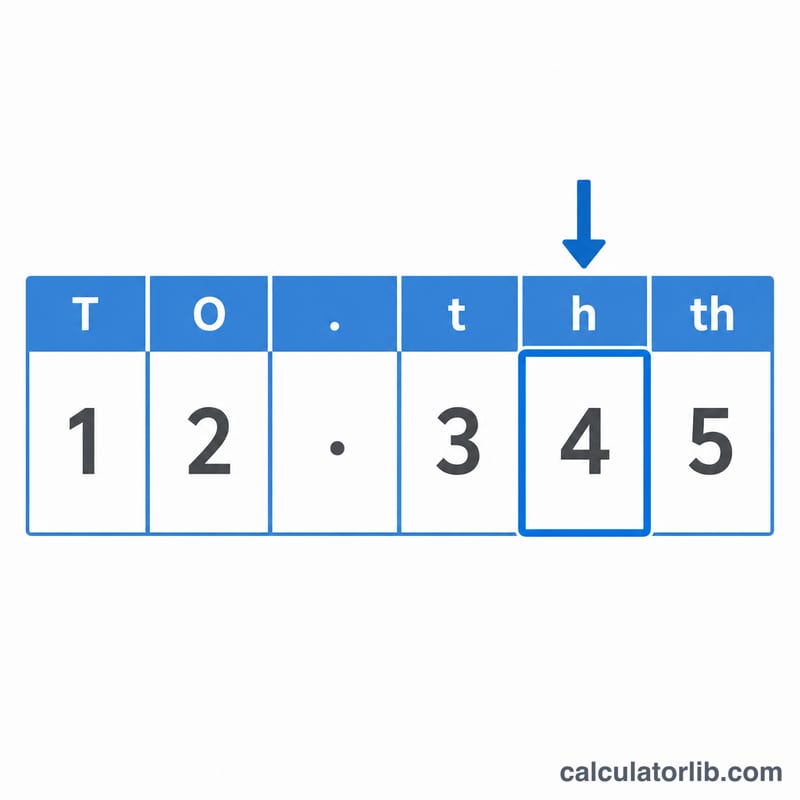
The hundredths place is the second digit to the right of the decimal point. Rounding to the nearest hundredth means keeping two decimal places and adjusting that second digit based on the digit immediately after it (the thousandths place). This calculator does it instantly for any number you enter.
How to use this calculator
Type any number — positive, negative, or with many decimal places — into the input box and the calculator returns the value rounded to two decimal places. It works for everyday numbers like prices, measurements, and test scores.
The formula explained
The rule is \( \text{result} = \text{round}(x \times 100) / 100 \). By multiplying by 100 you shift the hundredths digit into the ones place, round to the nearest whole number, then divide by 100 to shift it back. The deciding rule is "5 or more rounds up, 4 or less rounds down": look at the thousandths digit and, if it is 5–9, increase the hundredths digit by one.
$$\text{Rounded} = \frac{\left\lfloor \text{Number} \times 100 + 0.5 \right\rfloor}{100}$$
Worked example
Round 3.14159 to the nearest hundredth. The hundredths digit is 4 and the next digit is 1 (less than 5), so it stays: 3.14. Now round 2.675 → 2.675 × 100 = 267.5 → rounds to 268 → 268 / 100 = 2.68.
$$2.675 \times 100 = 267.5 \rightarrow 268 \rightarrow \frac{268}{100} = 2.68$$
FAQ
What digit decides the rounding? The thousandths digit (third after the decimal). If it is 5 or greater, round the hundredths up; otherwise leave it.
Does it work with negative numbers? Yes. \(-4.567\) rounds to \(-4.57\).
What if there are fewer than two decimals? The value is returned unchanged, e.g. 8.5 stays 8.5 (or 8.50 displayed).