
What this calculator does
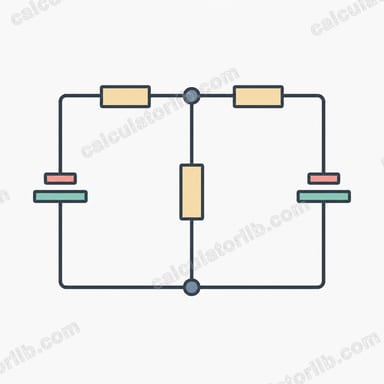
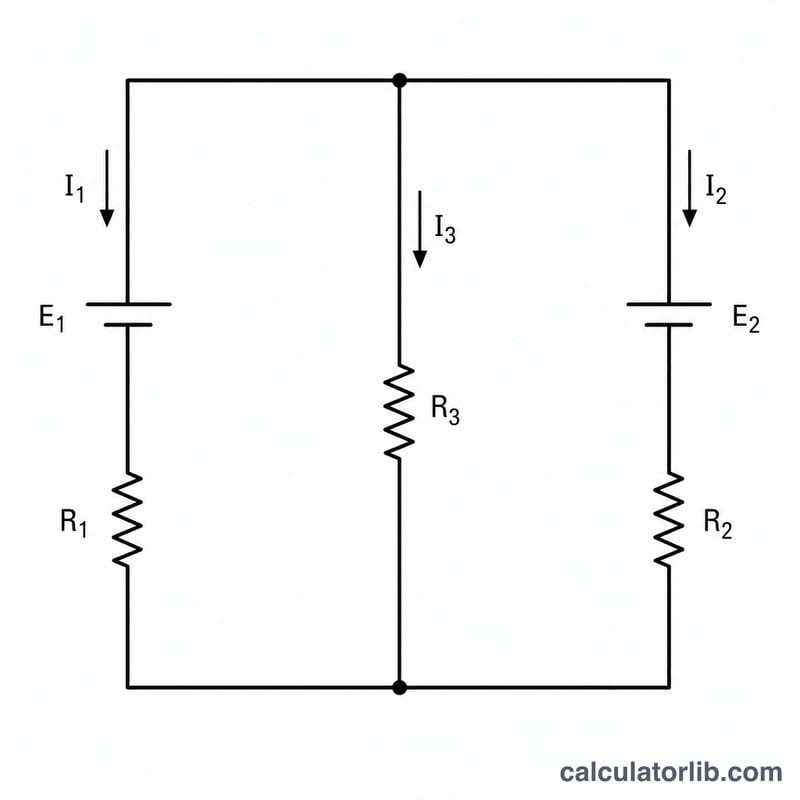
This tool solves the classic two-source, three-resistor DC network using Kirchhoff's circuit laws. Two voltage sources \(E_1\) and \(E_2\) (each in series with \(R_1\) and \(R_2\) respectively) connect to a shared middle branch containing \(R_3\). The calculator returns the three branch currents \(I_1\), \(I_2\) and \(I_3\), where \(I_3 = I_1 + I_2\). It is universal physics and applies anywhere.
How to use it
Enter the two source voltages and the three resistances, choosing a unit (volts/millivolts, ohms/kiloohms, etc.) for each. The values are converted to SI volts and ohms before solving. Press calculate to read off \(I_1\), \(I_2\) and \(I_3\) in amperes. A negative current simply means the real current flows opposite to the assumed reference direction.
The formula explained
Kirchhoff's Current Law at the junction gives \(I_1 + I_2 = I_3\). Kirchhoff's Voltage Law for the two loops gives \(E_1 = I_1 R_1 + I_3 R_3\) and \(E_2 = I_2 R_2 + I_3 R_3\). Substituting \(I_3\) and solving the 2x2 system with Cramer's rule yields the closed form, with determinant \(D = R_1 R_2 + R_1 R_3 + R_2 R_3\), which is always positive for positive resistances.
$$ I_1 = \frac{E_1\,(R_2+R_3) - E_2\,R_3}{D}, \quad I_2 = \frac{E_2\,(R_1+R_3) - E_1\,R_3}{D}, \quad I_3 = I_1 + I_2 $$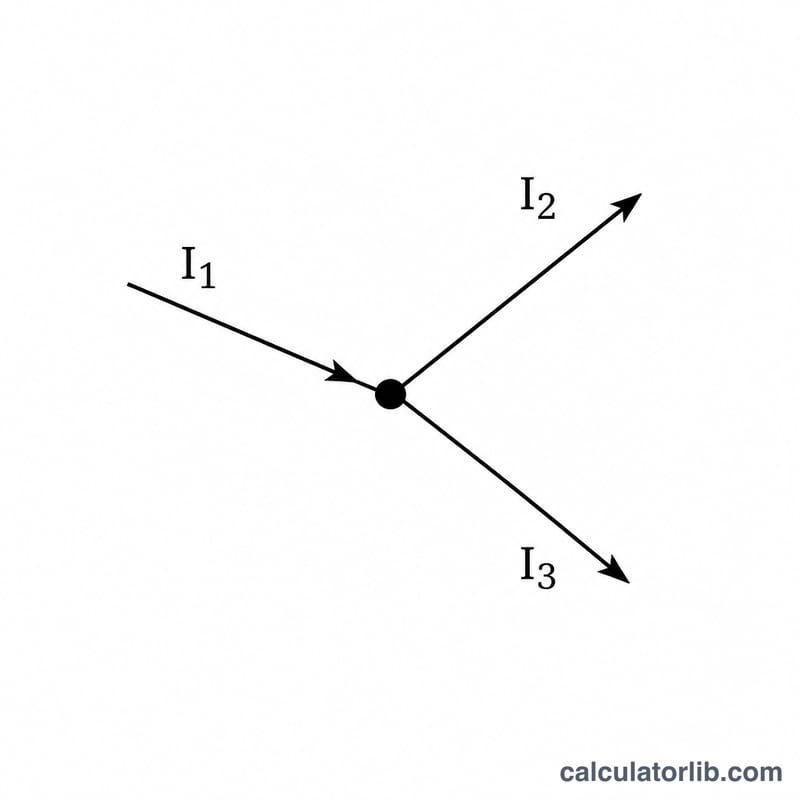
Worked example
With \(E_1 = 12\ \text{V}\), \(E_2 = 8\ \text{V}\), \(R_1 = 8\), \(R_2 = 4\), \(R_3 = 2\):
$$ D = 32 + 16 + 8 = 56 $$$$ I_1 = \frac{12 \cdot 6 - 8 \cdot 2}{56} = \frac{56}{56} = 1.0\ \text{A} $$$$ I_2 = \frac{8 \cdot 10 - 12 \cdot 2}{56} = \frac{56}{56} = 1.0\ \text{A} $$$$ I_3 = 2.0\ \text{A} $$Check KVL loop 1: \(1 \cdot 8 + 2 \cdot 2 = 12\ \text{V} = E_1\).
FAQ
Why is a current negative? The result keeps the sign relative to the assumed direction; a minus sign means the current actually flows the other way.
What if a resistor is zero? A single zero resistor is fine as long as the determinant stays positive. If the determinant becomes zero (an ideal short across both sources) the result is undefined and the tool reports an error.
Can I mix units? Yes, each input has its own unit selector and everything is normalized to SI volts and ohms before solving.