What Is a Scalene Triangle?
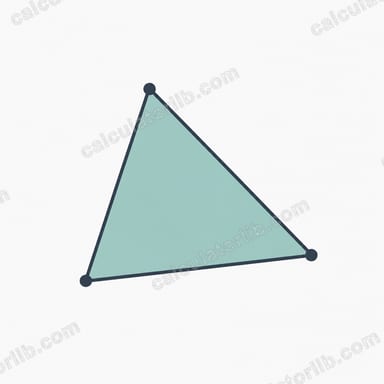
A scalene triangle is a triangle in which all three sides have different lengths, and consequently all three interior angles differ. Because no side or angle is equal, you cannot use the simple base × height ÷ 2 shortcut unless you happen to know a base and its perpendicular height. When you only know the three side lengths, Heron's formula is the cleanest way to find the area — and this calculator does it for you instantly.

How to Use This Calculator
Enter the three side lengths a, b and c in any consistent unit (cm, m, inches, etc.). The calculator first checks the triangle inequality — the sum of any two sides must be greater than the third — to ensure the triangle is valid. It then computes the semi-perimeter and applies Heron's formula. The result is the area in square units, along with the perimeter and semi-perimeter for reference.
The Formula Explained
Heron's formula computes area directly from the side lengths. First find the semi-perimeter: \(s = (a + b + c) / 2\). Then the area is \(\sqrt{s(s-a)(s-b)(s-c)}\). This works for any triangle — scalene, isosceles or equilateral — making it a versatile tool whenever the three sides are known but the height is not.
$$A = \sqrt{s\,(s-a)\,(s-b)\,(s-c)}$$
Worked Example
Suppose a triangle has sides a = 7, b = 8 and c = 9. The semi-perimeter is \(s = (7 + 8 + 9) / 2 = 12\). Then the area
$$A = \sqrt{12 \times (12-7) \times (12-8) \times (12-9)} = \sqrt{12 \times 5 \times 4 \times 3} = \sqrt{720} \approx 26.83 \text{ square units.}$$More Worked Examples
Heron's formula needs nothing but the three side lengths. In every example below the sides are called \(a\), \(b\) and \(c\), the semi-perimeter is \(s = (a+b+c)/2\), and the area is
$$A = \sqrt{s\,(s-a)\,(s-b)\,(s-c)}$$All three sides must be expressed in the same unit before you start; the answer then comes out in that unit squared.
Example 1 — Decimal sides (a general scalene triangle)
Sides: \(a = 5.2\ \text{cm}\), \(b = 6.8\ \text{cm}\), \(c = 9.4\ \text{cm}\). Triangle inequality check: \(5.2 + 6.8 = 12.0 > 9.4\), so the triangle exists.
- Perimeter: \(P = 5.2 + 6.8 + 9.4 = 21.4\ \text{cm}\)
- Semi-perimeter: \(s = 21.4 / 2 = 10.7\ \text{cm}\)
- The four factors: \(s = 10.7\), \(s-a = 10.7-5.2 = 5.5\), \(s-b = 10.7-6.8 = 3.9\), \(s-c = 10.7-9.4 = 1.3\) (all positive — good)
- Product, taken in pairs: \(10.7 \times 5.5 = 58.85\) and \(3.9 \times 1.3 = 5.07\), so \(58.85 \times 5.07 = 298.3695\)
- Square root: \(\sqrt{298.3695} \approx 17.2734\)
Area \(\approx\) 17.27 cm². Note the unit: centimetres squared, because area is a two-dimensional quantity, while the perimeter 21.4 cm stays linear.
Example 2 — A right scalene triangle (3-4-5), cross-checked against base × height ÷ 2
Sides: \(a = 3\), \(b = 4\), \(c = 5\) units. All three sides differ, so the triangle is scalene, and because \(3^2 + 4^2 = 9 + 16 = 25 = 5^2\) it is also right-angled.
- Perimeter: \(P = 3 + 4 + 5 = 12\)
- Semi-perimeter: \(s = 12 / 2 = 6\)
- The four factors: \(s = 6\), \(s-a = 6-3 = 3\), \(s-b = 6-4 = 2\), \(s-c = 6-5 = 1\)
- Product: \(6 \times 3 \times 2 \times 1 = 36\)
- Square root: \(\sqrt{36} = 6\)
Area = 6 square units — exactly a whole number here. Cross-check with the elementary rule: in a right triangle the two legs are the base and the height, so
$$A = \tfrac{1}{2} \times 3 \times 4 = \tfrac{12}{2} = 6$$The two methods agree perfectly, which is a useful sanity test: whenever you happen to know a base and its perpendicular height, \(\frac{1}{2}bh\) and Heron's formula must give the same number.
Example 3 — A very "thin", near-degenerate triangle
Sides: \(a = 10\), \(b = 11\), \(c = 20.9\ \text{m}\). The triangle inequality only just holds: \(10 + 11 = 21 > 20.9\), with a margin of merely 0.1 m.
- Perimeter: \(P = 10 + 11 + 20.9 = 41.9\ \text{m}\)
- Semi-perimeter: \(s = 41.9 / 2 = 20.95\ \text{m}\)
- The four factors: \(s = 20.95\), \(s-a = 10.95\), \(s-b = 9.95\), \(s-c = 20.95 - 20.9 = 0.05\) — the last one is tiny
- Product: \(20.95 \times 10.95 = 229.4025\) and \(9.95 \times 0.05 = 0.4975\), so \(229.4025 \times 0.4975 \approx 114.1277\)
- Square root: \(\sqrt{114.1277} \approx 10.6831\)
Area \(\approx\) 10.68 m². For comparison, a triangle with the same 41.9 m perimeter but three equal sides of about 13.97 m would enclose roughly 84.5 m² — nearly eight times more. The single factor \(s-c = 0.05\) is what crushes the area: as \(c\) grows toward \(a+b = 21\), that factor goes to zero, the area goes to zero, and the "triangle" flattens into a straight line (a degenerate triangle). Push \(c\) past 21 and the product under the root turns negative, which is the algebra's way of telling you no such triangle exists.
How to Calculate It by Hand, Step by Step
Follow the same eight steps every time and Heron's formula is almost impossible to get wrong.
- Label the three sides \(a\), \(b\) and \(c\) in one common unit. If the measurements are mixed (say 1.2 m, 85 cm and 940 mm), convert them all first — to centimetres, for instance: 120 cm, 85 cm and 94 cm. The labels are interchangeable; Heron's formula is symmetric, so which side you call \(a\) makes no difference to the result.
- Validate with the triangle inequality. Check all three conditions: \(a+b>c\), \(a+c>b\) and \(b+c>a\). In practice it is enough to compare the longest side with the sum of the other two: if the longest side is shorter than that sum, a triangle exists. If it equals the sum, the triangle is degenerate (zero area); if it exceeds it, no triangle can be built from those lengths.
- Add the sides to get the perimeter: \(P = a + b + c\).
- Halve the perimeter to get the semi-perimeter: \(s = P/2\).
- Compute the three differences \(s-a\), \(s-b\) and \(s-c\). Every one of them must come out positive — a zero or negative difference means step 2 was violated (or mis-measured), not that the area is zero-ish by accident.
- Multiply the four quantities: \(s(s-a)(s-b)(s-c)\). Multiplying in pairs, e.g. \(\left[s \cdot (s-a)\right] \times \left[(s-b)(s-c)\right]\), keeps the intermediate numbers manageable on paper.
- Take the square root of that product: \(A = \sqrt{s(s-a)(s-b)(s-c)}\).
- Label and round. The answer is in squared units (cm², m², in², ft² — whatever unit you chose in step 1), and two decimal places is usually a sensible level of detail for a measured triangle.
Quick walkthrough: a 7-8-9 triangle
Sides \(a = 7\), \(b = 8\), \(c = 9\) cm. Check: \(7+8 = 15 > 9\). Perimeter \(P = 24\) cm, so \(s = 12\) cm. Differences: \(12-7 = 5\), \(12-8 = 4\), \(12-9 = 3\). Then
$$A = \sqrt{12 \cdot 5 \cdot 4 \cdot 3} = \sqrt{720} \approx 26.8328$$which rounds to 26.83 cm².
Two things that trip people up
- Round only at the very end. Keep \(s\) and the three differences at full precision (or as exact fractions — \(s\) is a half-integer whenever the perimeter is odd, e.g. \(s = 10.5\)) and round only after the square root. Rounding \(s\) early is especially damaging for thin triangles, where one of the differences is a small number and a rounding error of 0.05 can change the area by several percent.
- The result is an area, not a perimeter. \(P = a+b+c\) is the distance around the triangle (linear units); \(A\) is the surface it encloses (squared units). If you need fencing or edging, use \(P\); if you need paint, turf, fabric or material, use \(A\). Heron's formula is pure geometry — it holds for any triangle anywhere, with no country-specific or standards-specific assumptions — so the only thing you must declare is which length unit you used.
FAQ
Does this only work for scalene triangles? No — Heron's formula works for any valid triangle. It is simply most useful for scalene triangles where no shortcut applies.
What if the sides don't form a triangle? If the longest side is greater than or equal to the sum of the other two, the triangle inequality fails and the area is reported as 0, since no such triangle exists.
What units does the answer use? The area is in square units of whatever length unit you entered. If you used centimetres, the area is in square centimetres.