What is an Oval Circumference Calculator?
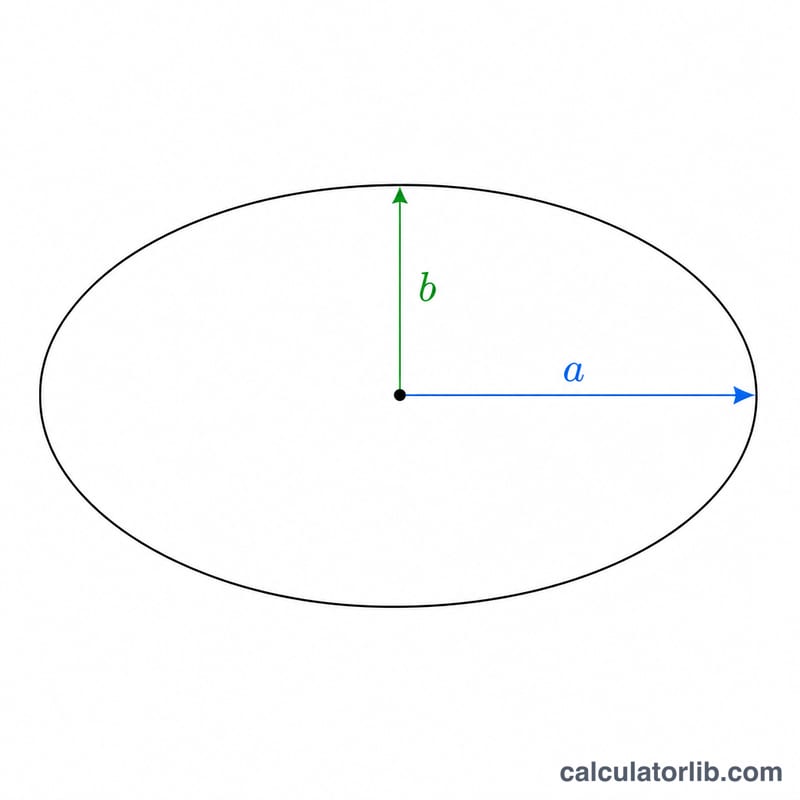
An oval circumference calculator is a tool that helps you determine the perimeter (circumference) of an oval or elliptical shape. An oval is a closed curve that resembles a stretched circle, technically known as an ellipse in mathematics. It has two axes: a major axis (longer) and a minor axis (shorter), which determine its shape and size.
When to Use an Oval Circumference Calculator
You might find this calculator useful in several scenarios:
- Architecture and construction projects involving elliptical designs or structures
- Landscaping when planning oval-shaped gardens, pools, or pathways
- Manufacturing when working with oval-shaped components or materials
How to Calculate Oval Circumference
The perimeter of an oval (ellipse) has no simple closed formula. This calculator computes the exact value, C = 4a·E(e), where E is the complete elliptic integral of the second kind, evaluated with the arithmetic–geometric mean. For a calculation by hand, Ramanujan’s approximation is accurate to a few parts per million for most ovals:
C ≈ π × [3(a+b) - √((3a+b)(a+3b))]
Where:
- C = circumference of the oval
- a = semi-major axis (half of the longest diameter)
- b = semi-minor axis (half of the shortest diameter)
- π = pi (approximately 3.14159)
The calculator also provides related calculations:
Area = π × a × b
Eccentricity = √(1 - (b²/a²)) where a > b
Examples
Example 1: Regular Ellipse
Calculate the circumference of an oval with semi-major axis 10 units and semi-minor axis 6 units.
| Parameter | Value |
|---|---|
| Semi-major axis (a) | 10 units |
| Semi-minor axis (b) | 6 units |
| Circumference | 51.05 units |
| Area | 188.50 square units |
| Eccentricity | 0.80 |
| Classification | Ellipse |
Example 2: Nearly Circular Oval
Calculate the circumference of an oval with semi-major axis 8 units and semi-minor axis 7.5 units.
| Parameter | Value |
|---|---|
| Semi-major axis (a) | 8 units |
| Semi-minor axis (b) | 7.5 units |
| Circumference | 48.71 units |
| Area | 188.50 square units |
| Eccentricity | 0.34 |
| Classification | Ellipse |
Example 3: Perfect Circle
Calculate the circumference when both semi-axes are equal at 5 units (which forms a circle).
| Parameter | Value |
|---|---|
| Semi-major axis (a) | 5 units |
| Semi-minor axis (b) | 5 units |
| Circumference | 31.42 units |
| Area | 78.54 square units |
| Eccentricity | 0.00 |
| Classification | Circle |
Shape Classification Table
| Condition | Classification | Properties |
|---|---|---|
| a = b | Circle | Perfect circle with radius = a = b, eccentricity = 0 |
| a > b | Ellipse | Oval shape with eccentricity between 0 and 1 |
| a ≫ b | Highly Eccentric Ellipse | Very elongated oval with eccentricity approaching 1 |
For other geometric calculations, you might find these tools useful: Circle Area Calculator, Circle Perimeter Calculator, or Ellipse Area Calculator.
Step-by-Step: Calculating Oval Circumference by Hand
Ramanujan's second approximation gives the perimeter of an ellipse to within a few parts per million for moderately elongated shapes, and it needs nothing more than a square root. The formula is
$$C \approx \pi\left[3(a+b) - \sqrt{(3a+b)(a+3b)}\right]$$where \(a\) is the semi-major axis (half the long axis) and \(b\) is the semi-minor axis (half the short axis). Work through the case \(a = 10\), \(b = 6\):
- Identify \(a\) and \(b\). If you measured the full axes across the oval (say 20 by 12), halve each one: \(a = 20/2 = 10\) and \(b = 12/2 = 6\). Both must be in the same unit — mixing centimetres and inches, or a full axis with a semi-axis, is the most common source of error.
- Compute \(3(a+b)\). \(a+b = 10+6 = 16\), so \(3 \times 16 = 48\).
- Compute the two bracketed factors. \(3a+b = 3(10)+6 = 36\), and \(a+3b = 10+3(6) = 28\). Note that these are different expressions — do not swap the coefficient onto the wrong variable.
- Multiply them. \(36 \times 28 = 1008\).
- Take the square root of the whole product. \(\sqrt{1008} \approx 31.749\). The radical covers the entire product, not just one factor: \(\sqrt{36}\times\sqrt{28} = 6 \times 5.2915 = 31.749\) happens to agree here because \(\sqrt{xy}=\sqrt{x}\sqrt{y}\), but \(\sqrt{36+28}\) would be wrong.
- Subtract. \(48 - 31.749 = 16.251\).
- Multiply by \(\pi\). \(16.251 \times 3.14159 \approx 51.05\).
Substituting everything at once:
$$C \approx \pi\left[3(10+6) - \sqrt{(30+6)(10+18)}\right] = \pi\left[48 - \sqrt{1008}\right] \approx 51.054$$So an oval with axes 20 × 12 has a perimeter of about 51.05 units — centimetres in, centimetres out.
Order-of-operations pitfalls to avoid: keep \(\pi\) outside the bracket and apply it only after the subtraction; resolve the square root before subtracting; and never simplify \(3(a+b)\) to \(3a+b\). A quick sanity check: the answer must always sit between the circle-perimeter bounds \(2\pi b\) and \(2\pi a\) — here between \(37.70\) and \(62.83\), which \(51.05\) satisfies. Another check is the crude average-radius estimate \(\pi(a+b) = 16\pi \approx 50.27\), which always slightly underestimates the true perimeter.
Key Terms and Variables Explained
| Term / symbol | Meaning | Units |
|---|---|---|
| Ellipse | The precise mathematical curve: the set of points whose distances to two fixed points (the foci) sum to a constant. This is the shape the formula on this page describes. | — |
| Oval | An informal term for any smooth, closed, egg- or ellipse-like convex curve. Many real ovals (a running track, an egg outline, a stadium shape) are not true ellipses, so treat the result as an estimate unless the shape is genuinely elliptical. | — |
| Major axis | The full longest chord through the centre, length \(2a\). | Linear (mm, cm, m, in, ft) |
| Minor axis | The full shortest chord through the centre, length \(2b\), perpendicular to the major axis. | Linear |
| Semi-major axis \(a\) | Half the major axis — the calculator input. Always \(a \ge b\) by convention. | Linear |
| Semi-minor axis \(b\) | Half the minor axis — the second calculator input, in the same unit as \(a\). | Linear |
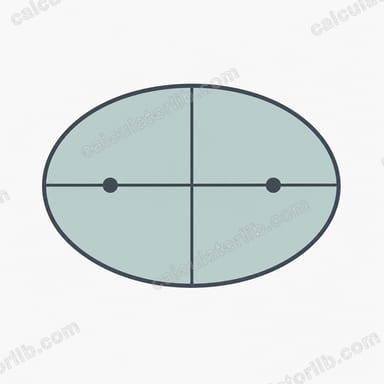
| Foci | Two points on the major axis at distance \(c = \sqrt{a^2-b^2}\) from the centre. The reflective "whispering gallery" property and planetary orbits both stem from them. | Linear (for \(c\)) |
| Eccentricity \(e\) | \(e = \sqrt{1 - b^2/a^2}\), how far the ellipse departs from round. Ranges from \(0\) (circle) toward \(1\) (an infinitely flattened sliver). | Dimensionless |
| Perimeter / circumference \(C\) | The distance once around the curve — what this calculator returns. | Linear |
| Area \(A\) | \(A = \pi a b\). Unlike the perimeter, this one is exact and elementary. | Square (cm², m², in²) |
| Aspect ratio \(a/b\) | Elongation. \(1\) is a circle; \(2\) means twice as long as it is wide. | Dimensionless |
Worked values for the 20 × 12 oval above (\(a = 10\), \(b = 6\)): eccentricity \(e = \sqrt{1 - 36/100} = \sqrt{0.64} = 0.8\); aspect ratio \(10/6 \approx 1.67\); area \(A = \pi(10)(6) = 60\pi \approx 188.50\) square units; focal distance \(c = \sqrt{100-36} = 8\).
Degenerate case \(a = b\). When the two semi-axes are equal the ellipse is a circle, and Ramanujan's expression collapses to the exact answer. For \(a = b = 7\): \(3(7+7) = 42\) and \(\sqrt{(28)(28)} = 28\), so \(C = \pi(42-28) = 14\pi \approx\) 43.98 — identical to \(2\pi r\) with \(r = 7\).
Why it is an approximation. The exact perimeter has no closed form in elementary functions; it is written with the complete elliptic integral of the second kind,
$$C = 4a\,E(e) = 4a\int_0^{\pi/2}\sqrt{1 - e^2\sin^2\theta}\;d\theta$$Ramanujan's 1914 expression approximates that integral algebraically. Its relative error is under about \(10^{-5}\%\) for near-circular ovals and stays below roughly 0.04% even at an aspect ratio near 10, so for drafting, gardening, sewing, machining and most engineering layout it is far more accurate than the measurement itself. Only for extremely flattened ellipses (\(e\) approaching 1) does a series expansion or numerical integration become worthwhile.
Frequently Asked Questions
How do you calculate the circumference of an oval?
This calculator computes the exact perimeter C = 4a·E(e), where E is the complete elliptic integral of the second kind, evaluated with the arithmetic–geometric mean. By hand, use Ramanujan’s approximation C ≈ π [ 3(a+b) − √((3a+b)(a+3b)) ], where a is the semi-major axis and b is the semi-minor axis; for most ovals it agrees with the exact value to a few parts per million.
What are the semi-major axis a and semi-minor axis b?
The semi-major axis a is half the longest diameter of the oval, and the semi-minor axis b is half the shortest diameter. If you know the full lengths, divide each by two before entering them. Both values must use the same unit, and a should be greater than or equal to b.
How accurate is Ramanujan's approximation?
Very accurate. For most ovals the error is far less than 0.01%, and it stays below about 0.04% even for extremely elongated ellipses. The approximation is exact when a equals b, which gives a perfect circle. For everyday measurements the result is effectively precise.
Why isn't there an exact formula for an ellipse perimeter?
Unlike a circle, an ellipse perimeter requires a complete elliptic integral of the second kind, which has no closed-form solution in elementary functions. This calculator evaluates that integral with the arithmetic–geometric mean, which reaches the exact value in a few steps; by hand, Ramanujan’s formula is the usual close approximation.
What happens if a and b are equal?
When the semi-major and semi-minor axes are equal, the oval is a perfect circle with radius a. The formula then reduces to the familiar C = 2πa, and Ramanujan's approximation returns the exact circumference with no error. This is the limiting case of an ellipse.
Can I work out the circumference from the full diameters?
Yes. Measure the longest diameter and the shortest diameter of the oval, then halve each to get a and b. For example, a 10 cm by 6 cm oval gives a = 5 and b = 3, producing a circumference of about 25.53 cm using the calculator.