
What This Calculator Does
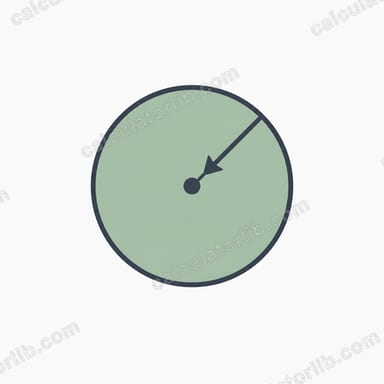
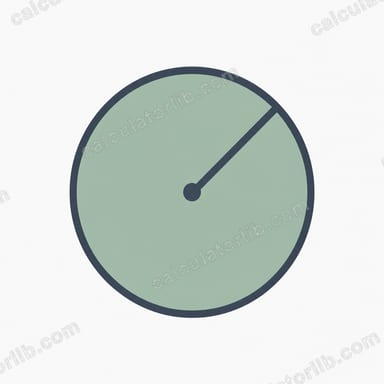
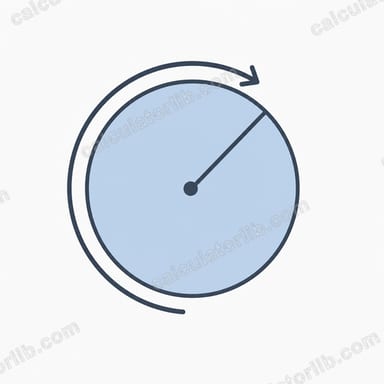
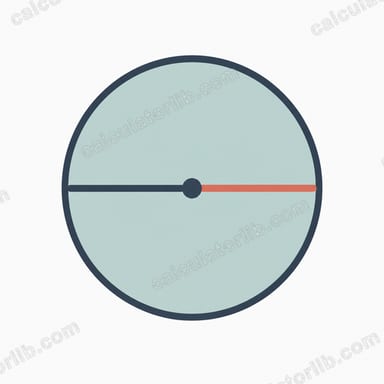
This tool finds the radius of a circle when you already know its circumference (the distance around the circle). It applies the rearranged circle formula \(r = C / (2\pi)\) and, as a bonus, also reports the diameter and area so you have a complete picture of the circle from a single measurement.
How to Use It
Enter the circumference in whatever unit you have (centimeters, inches, meters — the result will be in the same unit). Click calculate and the radius appears instantly, along with the diameter (\(2r\)) and area (\(\pi r^2\)). Because \(\pi\) is a constant, the unit you put in is the unit you get back out for radius and diameter; area comes out in square units.
The Formula Explained
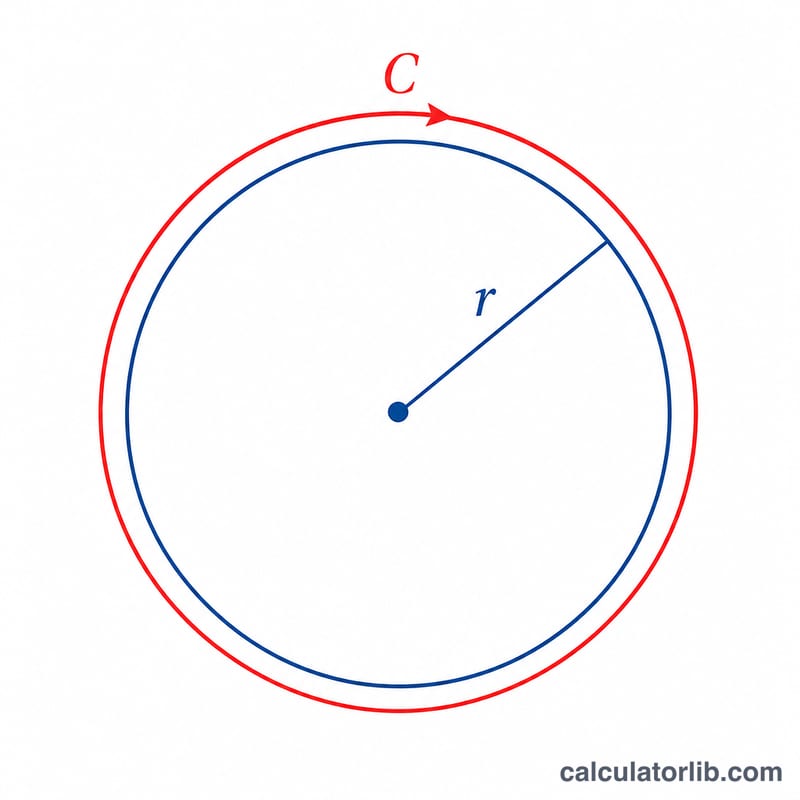
The circumference of a circle is \(C = 2\pi r\). To solve for the radius, divide both sides by \(2\pi\), giving the following.
$$r = \frac{\text{Circumference (C)}}{2\pi}$$
Here \(\pi\) (pi) \(\approx 3.14159\). The factor \(2\pi\) represents how many radius-lengths fit around the circle's edge — roughly 6.283 of them.
Worked Example
Suppose a circle has a circumference of 31.4159. Then $$r = \frac{31.4159}{2 \times 3.14159} = \frac{31.4159}{6.28318} \approx 5.0000.$$ The diameter is \(2 \times 5 = 10\), and the area is \(\pi \times 5^2 \approx 78.54\) square units.
FAQ
What units does the answer use? The radius and diameter share the same unit you entered for circumference. Area is in those units squared.
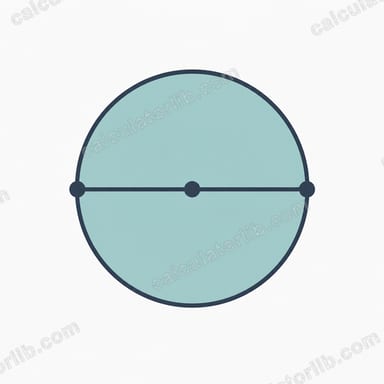
Can I go from circumference to diameter directly? Yes — \(\text{diameter} = C / \pi\), which is simply twice the radius.
Why divide by \(2\pi\) and not just \(\pi\)? Because the circumference equals \(\pi\) times the diameter, and the diameter is twice the radius, so \(C = 2\pi r\). Solving for \(r\) requires dividing by \(2\pi\).