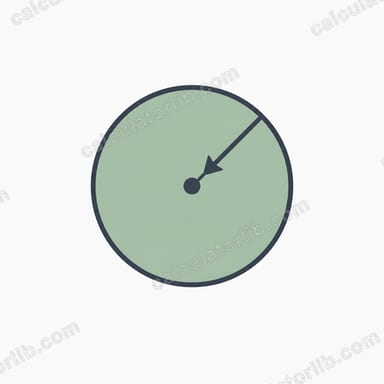

What Is the Circumference to Area Calculator?
This calculator finds the area of a circle when you only know its circumference — the distance around the edge. Instead of first solving for the radius, it goes straight from circumference to area using a single tidy formula. It's perfect for geometry homework, engineering checks, fencing and landscaping estimates, or any time you have measured around a circular object with a tape measure.
How to Use It
Enter the circumference value in the input box and press calculate. The tool returns the area in square units, plus the matching radius and diameter so you can sanity-check the result. The units are whatever you used for the circumference: a circumference in centimeters yields an area in square centimeters.
The Formula Explained
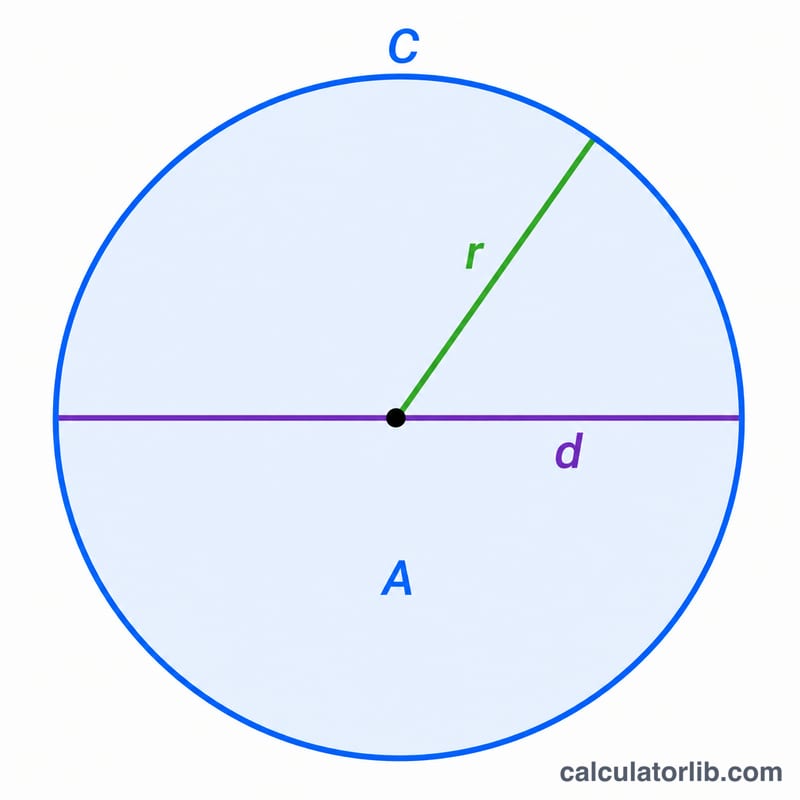
Start from the two standard circle relationships: circumference \(C = 2\pi r\) and area \(A = \pi r^2\). Solving the first for the radius gives \(r = C / (2\pi)\). Substitute that into the area formula:
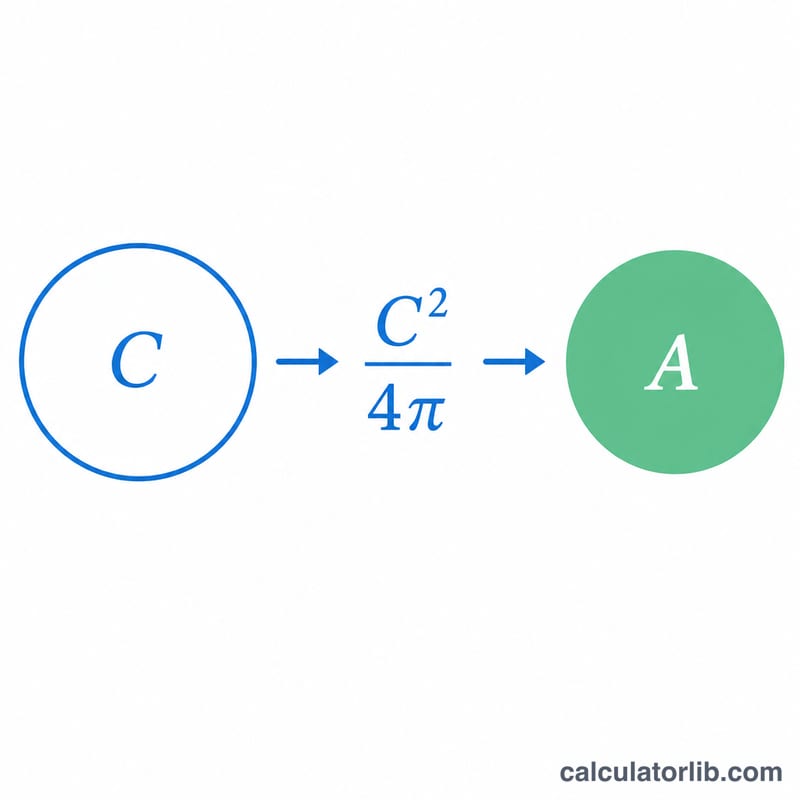
$$A = \pi \cdot \left(\frac{C}{2\pi}\right)^2 = \frac{C^2}{4\pi}$$
This means the area grows with the square of the circumference — doubling the circumference quadruples the area.
Worked Example
Suppose a circular pond has a circumference of 31.4159 meters. Then:
$$A = \frac{31.4159^2}{4 \times 3.14159} = \frac{986.96}{12.5664} \approx 78.54 \text{ m}^2$$ The radius is \(31.4159 / (2\pi) \approx 5\) m and the diameter \(\approx 10\) m — exactly a circle of radius 5, confirming the answer.
FAQ
Do the units matter? The area unit is always the square of your input unit. Inches in → square inches out.
Can I go the other way? Yes — rearrange to \(C = \sqrt{4\pi A}\) to get circumference from area.
Why divide by 4π? It comes from substituting \(r = C/(2\pi)\) into \(A = \pi r^2\), which collapses neatly to \(C^2/(4\pi)\).