
What This Calculator Does
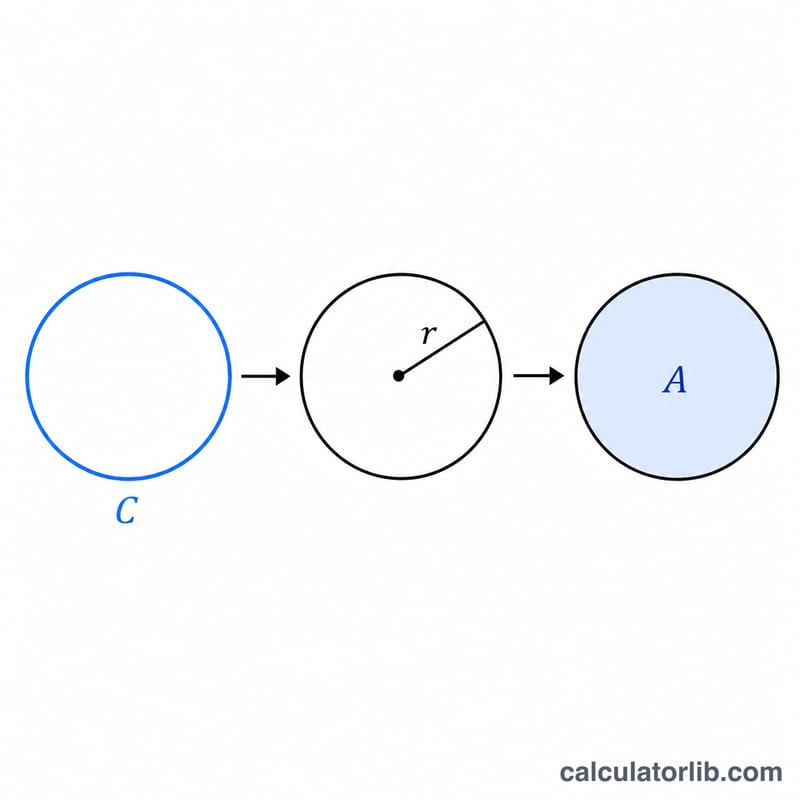
This tool calculates the area of a circle when you only know its circumference. Instead of measuring the radius directly, you can enter the distance around the circle and instantly get the enclosed area, along with the radius and diameter. It works for any consistent unit — centimeters, meters, inches, or feet — and the area is returned in the corresponding square units.
The Formula Explained
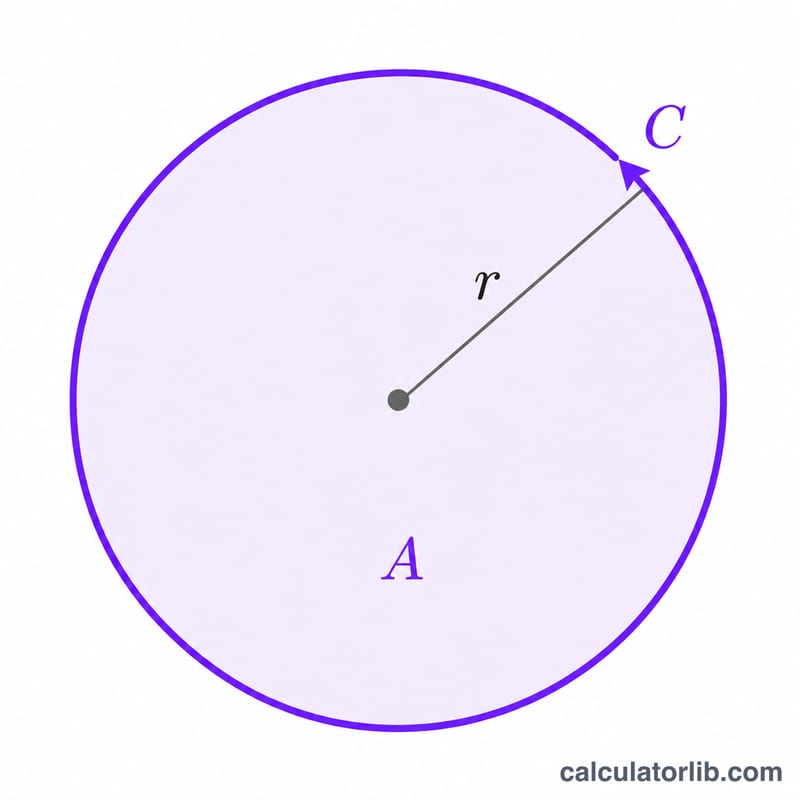
The area of a circle is normally written as \(A = \pi r^2\). The circumference is \(C = 2\pi r\), which rearranges to \(r = C / (2\pi)\). Substituting this radius back into the area formula gives:
$$A = \frac{\text{Circumference}^{2}}{4\pi}$$
This single equation skips the need to compute the radius first, though we still show it for reference. The constant \(4\pi \approx 12.566\).
How To Use It
Enter the circumference of your circle in the input box and submit. The calculator returns the area as the headline number, plus the radius \((C / 2\pi)\) and diameter \((C / \pi)\) in the details table. Make sure your circumference is measured in a single unit so the area unit stays meaningful.
Worked Example
Suppose a circle has a circumference of 31.4159 units. Then $$A = \frac{(31.4159)^2}{4\pi} = \frac{986.96}{12.566} \approx 78.54 \text{ square units}.$$ The radius is \(31.4159 / (2\pi) \approx 5\), confirming a circle of radius 5 whose area is \(\pi \cdot 25 \approx 78.54\). The two methods agree.
FAQ
Why divide by 4π? Because squaring the circumference introduces an extra factor of \((2\pi)^2 = 4\pi^2\) compared to the radius, and the area formula only needs one \(\pi\), so you divide by \(4\pi\).
What units does the result use? If circumference is in meters, area is in square meters. The result always uses the square of your input unit.
Can I find diameter too? Yes — diameter equals \(C / \pi\), which is shown alongside the radius in the results.