
What This Calculator Does
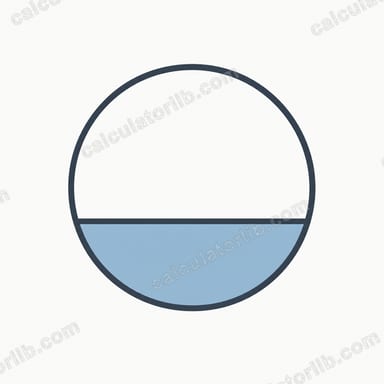
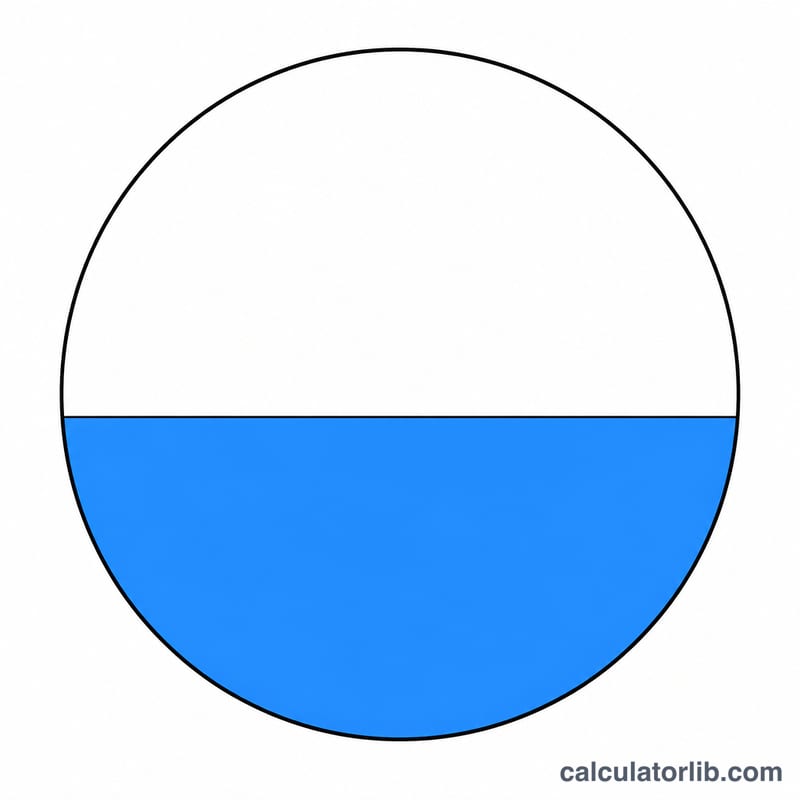
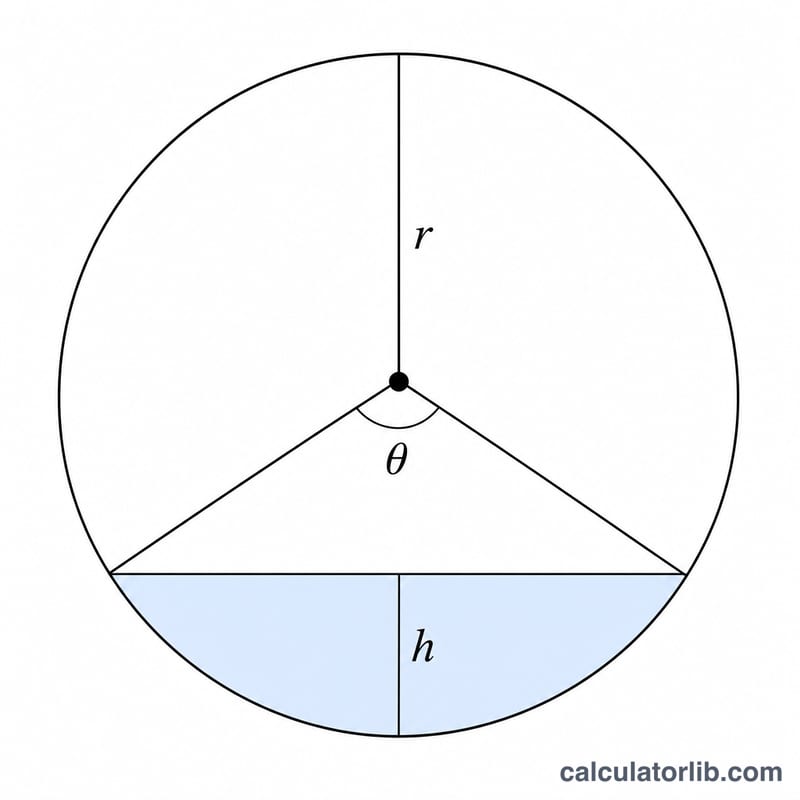
This tool computes the cross-sectional area of liquid in a partially filled circle — exactly the situation you face with a horizontal cylindrical tank viewed from the end. Given the circle's radius (\(r\)) and the depth of fill measured from the bottom (\(h\)), it returns the filled (circular segment) area, the empty area, the total area, and the fill percentage.
How to Use It
Enter the radius of the circle or tank and the fill depth in the same units (meters, inches, cm — anything, as long as both match). The depth \(h\) should range from 0 (empty) to \(2r\) (completely full). The result is given in square units of whatever length unit you used. For a horizontal cylinder, multiply the filled area by the tank length to get the liquid volume.
The Formula Explained
The filled region is a circular segment. Its area is:
$$A_{\text{fill}} = r^{2}\cos^{-1}\!\left(\frac{r-h}{r}\right) - (r-h)\sqrt{2rh - h^{2}}$$The first term is the area of the circular sector spanning the chord at the liquid surface; the second term subtracts the triangular wedge above the chord, leaving just the segment below. The inverse cosine returns radians. When \(h = r\) the surface is at the centerline and the area equals exactly half the circle.
Worked Example
Take a tank of radius \(r = 10\) filled to depth \(h = 5\). Then \((r-h)/r = 0.5\), and \(\cos^{-1}(0.5) = 1.047198\) rad. So \(r^{2}\cdot\cos^{-1} = 100 \times 1.047198 = 104.7198\). The second term: \(2rh - h^{2} = 100 - 25 = 75\), \(\sqrt{75} = 8.660254\), times \((r-h)=5\) gives \(43.30127\). Filled area $$= 104.7198 - 43.30127 = 61.4185 \text{ square units}.$$ Total area \(= \pi\cdot 100 = 314.159\), so fill \(\approx 19.55\%\).
FAQ
Does this give volume? No — it gives the 2D cross-sectional area. Multiply by the cylinder length for horizontal tank volume.
What if h equals 2r? The circle is completely full and the area equals \(\pi r^{2}\).
What units should I use? Any length unit, as long as radius and depth share it; the area is in those units squared.