
What is the Circle Area from Diameter Calculator?
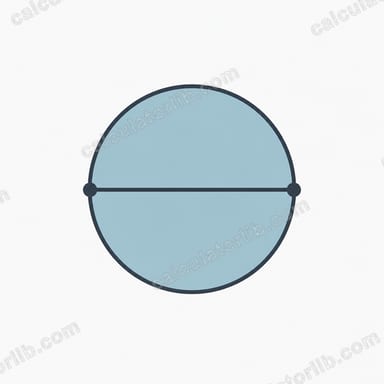
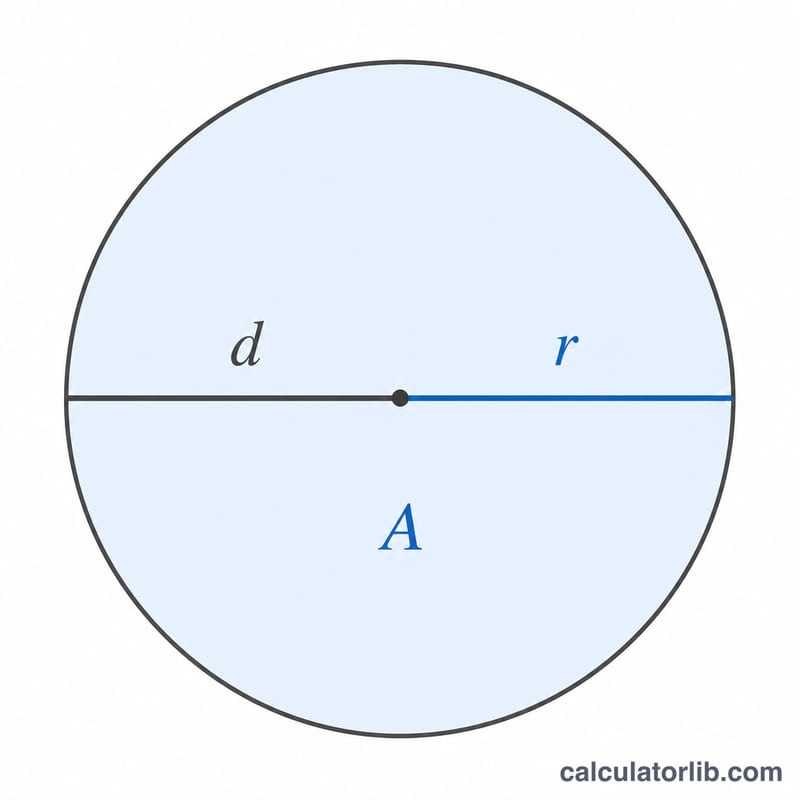
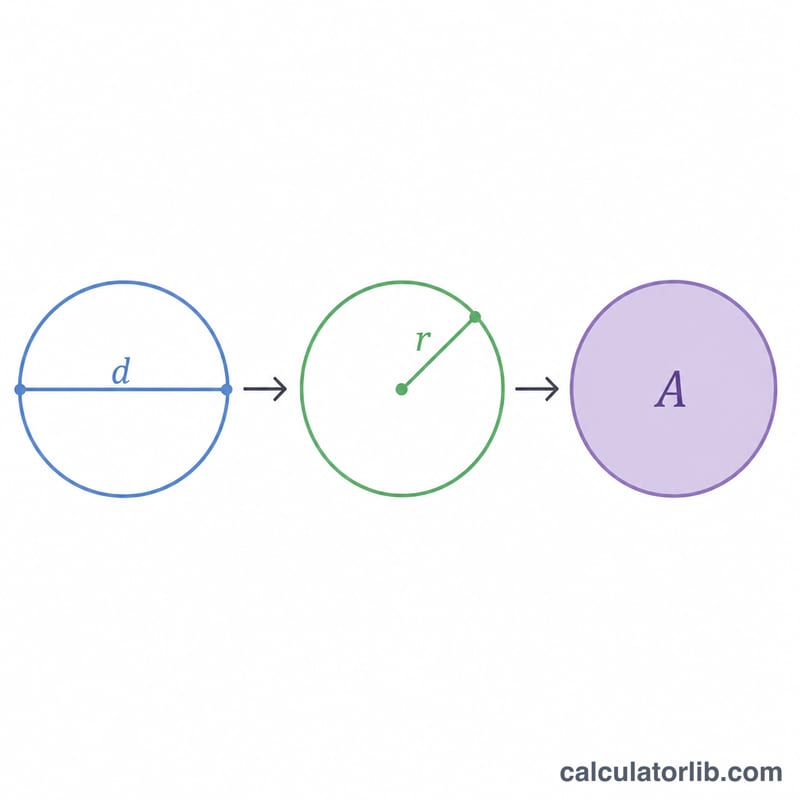
This calculator finds the area of a circle when you know its diameter — the straight-line distance across the circle through its center. Instead of first halving the diameter to get the radius, the tool applies the diameter-based formula directly, saving you a step. It also reports the radius and circumference so you have the full picture in one place. This is a universal geometry tool that works with any consistent unit (cm, m, inches, feet) — the area is simply returned in those units squared.
How to use it
Enter the diameter of your circle and press calculate. The result hero shows the area in square units, and the table below lists the radius (half the diameter) and the circumference. Make sure your diameter uses the unit you want your answer in: a diameter in centimeters gives an area in square centimeters.
The formula explained
The classic area formula is \(A = \pi r^2\), where \(r\) is the radius. Because the radius is half the diameter (\(r = d/2\)), substituting gives $$A = \pi \left(\frac{d}{2}\right)^2 = \frac{\pi d^2}{4}.$$ Here \(\pi\) (pi) \(\approx 3.14159\). Squaring the diameter and multiplying by \(\pi/4\) (\(\approx 0.7854\)) gives the area directly.
Worked example
Suppose a circle has a diameter of 10 units. Then $$A = \pi \times \frac{10^2}{4} = \pi \times \frac{100}{4} = 25\pi \approx 78.54 \text{ square units}.$$ The radius is 5 units and the circumference is \(\pi \times 10 \approx 31.42\) units.
FAQ
Can I use this with inches or meters? Yes. The formula is unit-agnostic; the area comes out in the square of whatever unit you entered.
What if I only know the radius? Double it to get the diameter, or just enter twice the radius as the diameter — the math is identical to \(A = \pi r^2\).
How accurate is the result? It uses the full double-precision value of \(\pi\), so results are accurate to many decimal places; only the display is rounded.