
What this calculator does
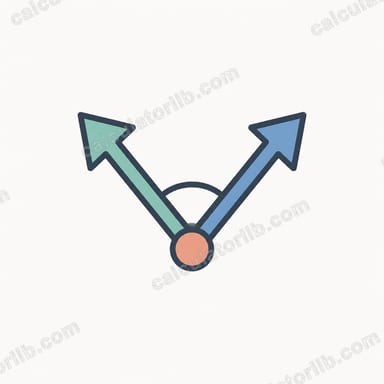
This tool finds the angle between two vectors in 2D or 3D space using the dot product. Enter the components of vector a and vector b, and it returns the angle in both degrees and radians, along with the dot product, each vector's magnitude, and the cosine of the angle. It works for pure mathematics, physics, engineering, computer graphics, and machine-learning similarity problems.
How to use it
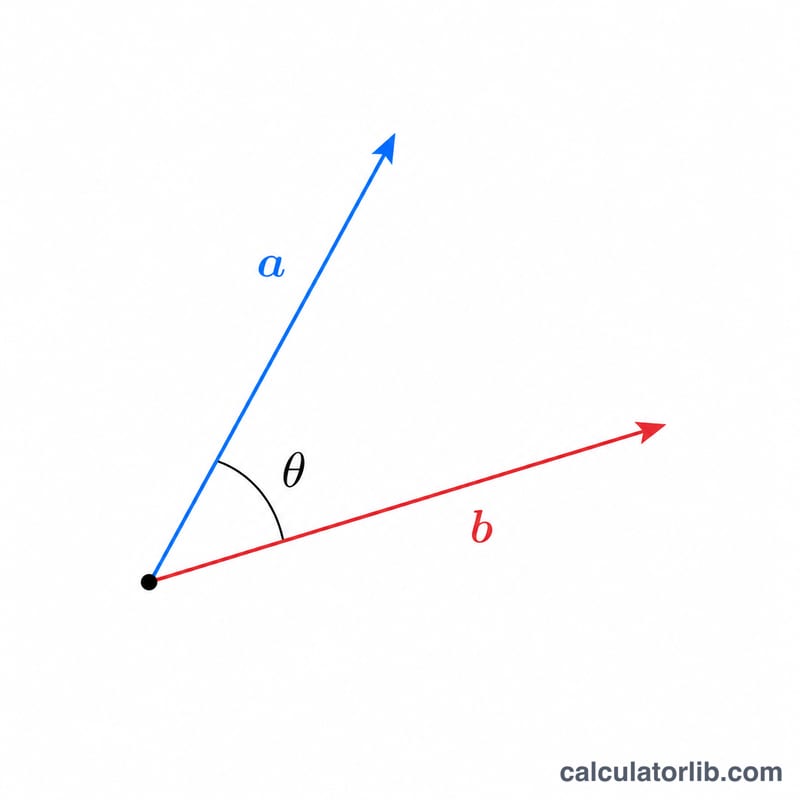
Type the x, y (and optional z) components of each vector. For 2D vectors, simply leave the z fields blank or set them to 0. Press calculate to see the angle. The angle returned is always between 0° and 180°, the geometric (smallest) angle between the two directions.
The formula explained
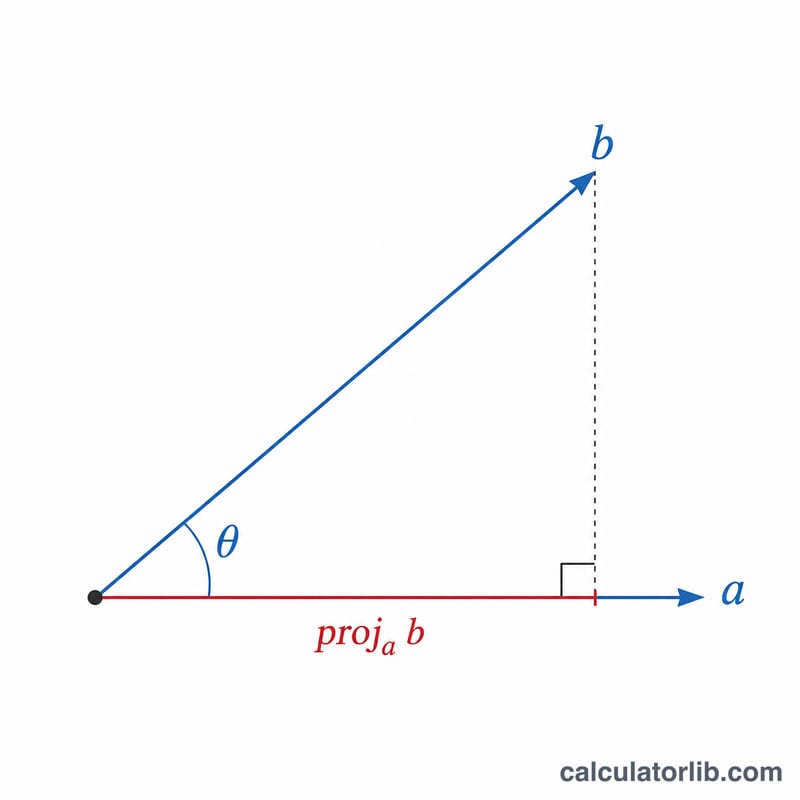
The dot product relates to the angle by \(\mathbf{a}\cdot\mathbf{b} = |\mathbf{a}||\mathbf{b}|\cos\theta\). Solving for θ gives
$$\theta = \arccos\!\left( \frac{\mathbf{a}\cdot\mathbf{b}}{|\mathbf{a}||\mathbf{b}|} \right).$$The dot product is computed component-wise:
$$\mathbf{a}\cdot\mathbf{b} = a_x b_x + a_y b_y + a_z b_z.$$Each magnitude is the square root of the sum of its squared components:
$$|\mathbf{a}| = \sqrt{a_x^2 + a_y^2 + a_z^2}.$$The result of the division is clamped to the range \([-1, 1]\) before taking arccosine to avoid rounding errors.
Worked example
Let \(\mathbf{a} = (1, 0, 0)\) and \(\mathbf{b} = (1, 1, 0)\). The dot product is
$$1\cdot 1 + 0\cdot 1 + 0\cdot 0 = 1.$$The magnitudes are \(|\mathbf{a}| = 1\) and \(|\mathbf{b}| = \sqrt{2} \approx 1.4142\). So
$$\cos\theta = \frac{1}{1 \times 1.4142} \approx 0.7071,$$giving \(\theta = \arccos(0.7071) = 45°\), or about \(0.7854\) radians.
Interpreting Your Result
The angle \(\theta\) returned by the calculator describes how two vectors are oriented relative to each other, independent of their lengths. The sign and size of \(\cos\theta\) tell you the geometric relationship at a glance.
- \(\theta = 0^\circ\) (\(\cos\theta = 1\)) — parallel / same direction. The vectors point exactly the same way; one is a positive scalar multiple of the other.
- \(0^\circ < \theta < 90^\circ\) (\(\cos\theta > 0\)) — acute angle. The dot product is positive and the vectors point in broadly similar directions.
- \(\theta = 90^\circ\) (\(\cos\theta = 0\)) — orthogonal (perpendicular). The dot product is exactly zero. This is the defining test for perpendicularity.
- \(90^\circ < \theta < 180^\circ\) (\(\cos\theta < 0\)) — obtuse angle. The dot product is negative; the vectors point in generally opposing directions.
- \(\theta = 180^\circ\) (\(\cos\theta = -1\)) — antiparallel / opposite direction. One vector is a negative scalar multiple of the other.
In machine learning and text analysis, the quantity \(\cos\theta\) itself is called cosine similarity. Interpreted directly: a value of 1 means identical direction (maximally similar), 0 means orthogonal/unrelated, and −1 means opposite. Because it ignores magnitude, two documents or embeddings with the same orientation but different lengths score as identical. The angle and the similarity carry the same information — the angle is simply \(\arccos\) of the similarity.
Common Angle Reference Values
These standard angles and their exact cosine values are useful for checking results and recognizing common orientations. The angle is found from \(\theta = \arccos(\cos\theta)\).
| Angle (degrees) | Angle (radians) | \(\cos\theta\) | Relationship |
|---|---|---|---|
| 0° | \(0\) | 1.0000 | Parallel (same direction) |
| 30° | \(\pi/6\) | 0.8660 | Acute |
| 45° | \(\pi/4\) | 0.7071 | Acute |
| 60° | \(\pi/3\) | 0.5000 | Acute |
| 90° | \(\pi/2\) | 0.0000 | Orthogonal (perpendicular) |
| 120° | \(2\pi/3\) | −0.5000 | Obtuse |
| 135° | \(3\pi/4\) | −0.7071 | Obtuse |
| 150° | \(5\pi/6\) | −0.8660 | Obtuse |
| 180° | \(\pi\) | −1.0000 | Antiparallel (opposite) |
To convert a decimal-degree result such as 60° into degrees, minutes and seconds, you can use a 60° conversion.
FAQ
Can I use 2D vectors? Yes — leave the z components as 0 and the formula reduces to the 2D case.
Why is the angle never more than 180°? The arccosine function returns values from 0 to π (180°), which represents the smallest angle between the two directions regardless of orientation.
What if a vector is zero? A zero vector has no direction, so the angle is undefined; this calculator returns 0° when a magnitude is zero to avoid division by zero.