
What Is a Quadratic Equation?
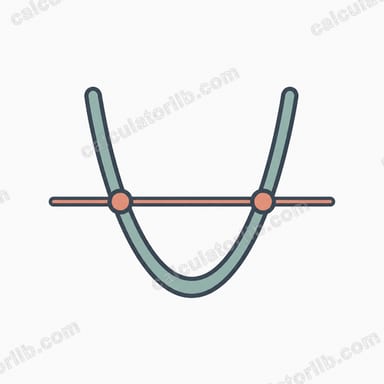
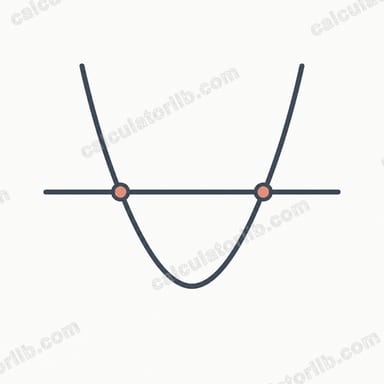
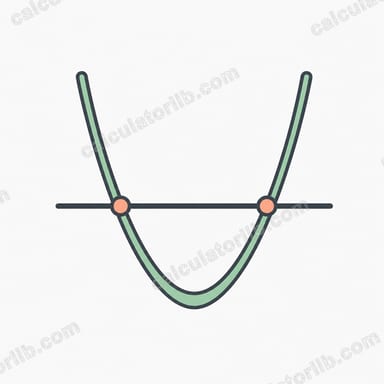
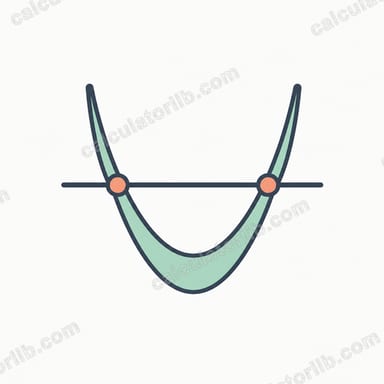
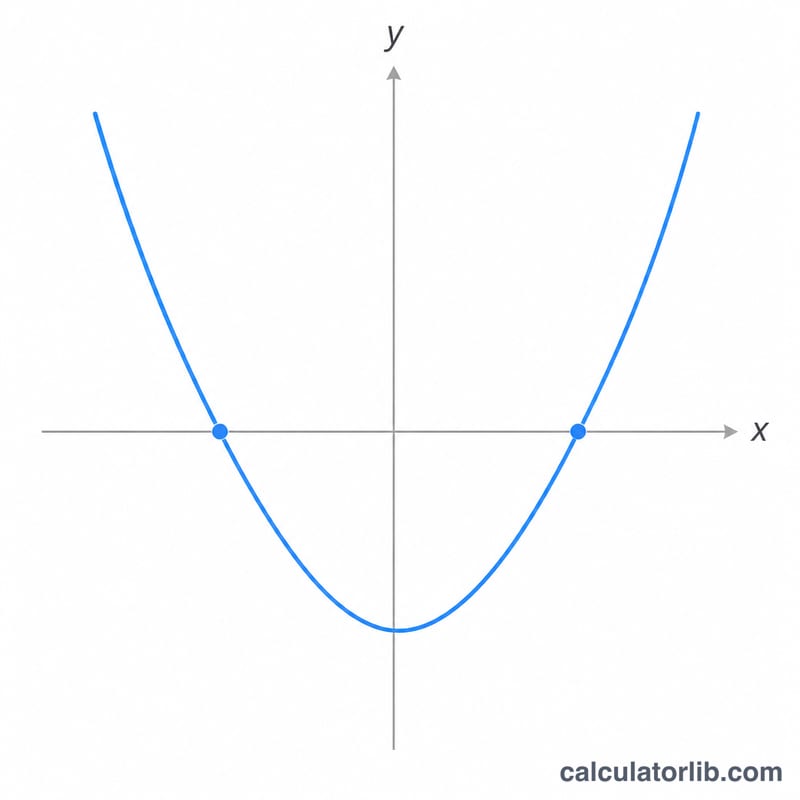
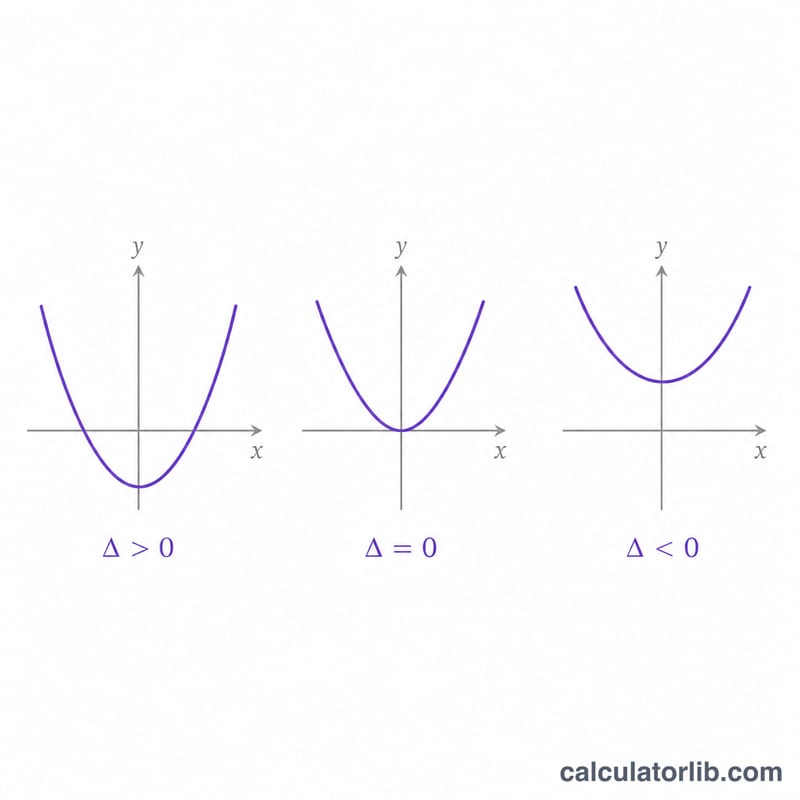
A quadratic equation is a second-degree polynomial of the form \(ax^2 + bx + c = 0\), where a, b, and c are constants and \(a \ne 0\). Its graph is a parabola, and its solutions — called roots — are the x-values where the parabola crosses the x-axis. This calculator finds those roots instantly, whether they are real or complex.
How to Use This Calculator
Enter the three coefficients: a (the coefficient of x²), b (the coefficient of x), and c (the constant term). The calculator computes the discriminant and returns the roots. If a = 0 the equation is not quadratic, so you'll be prompted to use a non-zero value.
The Formula Explained
The roots come from the quadratic formula $$x = \frac{-b \pm \sqrt{b^2 - 4ac}}{2a}$$ The expression under the square root, \(\Delta = b^2 - 4ac\), is the discriminant. When \(\Delta > 0\) there are two distinct real roots; when \(\Delta = 0\) there is one repeated real root; when \(\Delta < 0\) the roots are complex conjugates of the form \(\left(-\frac{b}{2a}\right) \pm \frac{\sqrt{-\Delta}}{2a}i\).
Worked Example
Solve \(x^2 - 3x + 2 = 0\). Here a = 1, b = −3, c = 2. The discriminant is $$(-3)^2 - 4(1)(2) = 9 - 8 = 1.$$ Then $$x = \frac{3 \pm \sqrt{1}}{2} = \frac{3 \pm 1}{2},$$ giving \(x = 2\) and \(x = 1\).
FAQ
What if the discriminant is negative? The equation has no real solutions; instead it has two complex roots, which this tool displays in the form \(a \pm bi\).
Can a be zero? No. If a = 0 the equation is linear, not quadratic, and the quadratic formula does not apply.
What does a repeated root mean? When \(\Delta = 0\) the parabola just touches the x-axis at a single point, so both roots are identical.