
What This Calculator Does
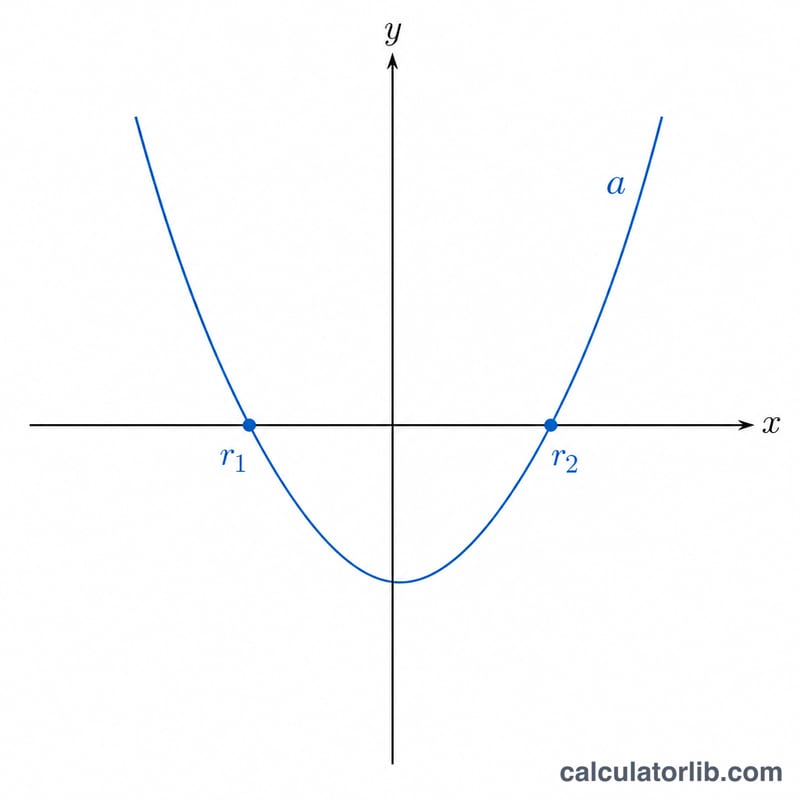
This tool rewrites any quadratic expression in standard form, \(ax^2 + bx + c\), into its complete factored form, \(a(x - r_1)(x - r_2)\). It first finds the roots \(r_1\) and \(r_2\) using the quadratic formula, then writes the quadratic as a product of linear factors scaled by the leading coefficient \(a\). This works for any real coefficients, including cases where the roots are irrational, fractional, or complex.
How to Use It
Enter the three coefficients \(a\), \(b\), and \(c\) from your quadratic \(ax^2 + bx + c\). The coefficient \(a\) must not be zero (otherwise the expression is linear, not quadratic). Click calculate to see the factored form along with the discriminant and each root.
The Formula Explained
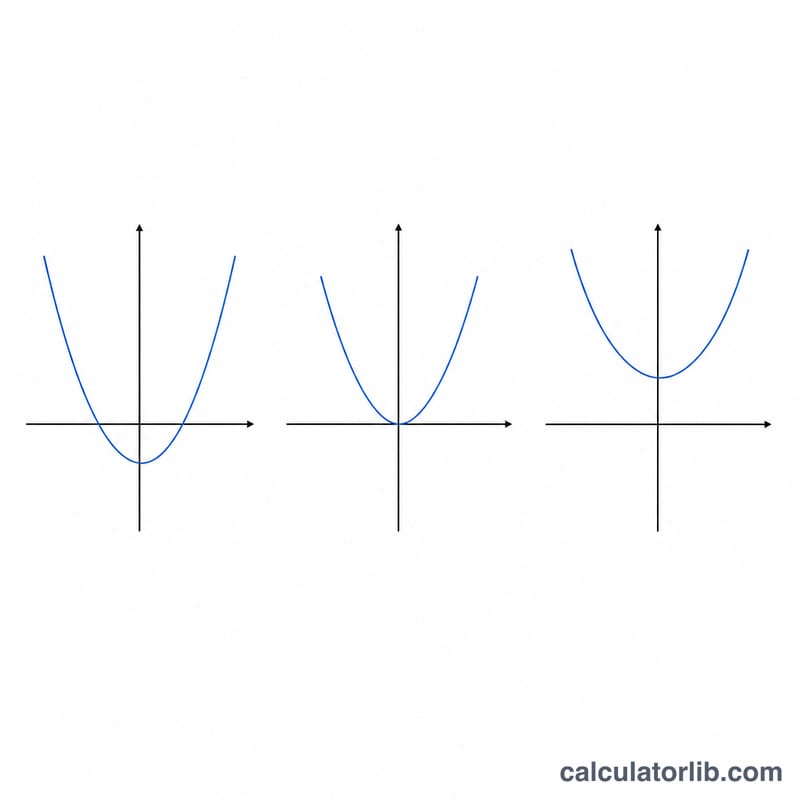
The roots come from the quadratic formula $$r = \frac{-b \pm \sqrt{b^2 - 4ac}}{2a}.$$ The quantity under the square root, \(b^2 - 4ac\), is the discriminant. When it is positive there are two distinct real roots; when it equals zero there is one repeated real root; when it is negative the roots are a complex conjugate pair. Once the roots are known, the original quadratic always factors exactly as \(a(x - r_1)(x - r_2)\).
Worked Example
Take \(x^2 - 5x + 6\) (\(a = 1\), \(b = -5\), \(c = 6\)). The discriminant is $$(-5)^2 - 4\cdot 1\cdot 6 = 25 - 24 = 1.$$ The roots are \(\frac{5 \pm 1}{2}\), giving \(r_1 = 3\) and \(r_2 = 2\). So the factored form is \(1(x - 3)(x - 2)\), or simply \((x - 3)(x - 2)\).
FAQ
What if the roots are not whole numbers? The calculator still works — it returns decimal roots, and the factored form uses those decimals.
What happens with complex roots? When the discriminant is negative, the result is shown using the real and imaginary parts as a conjugate pair, \(a \pm bi\).
Why is the leading coefficient a kept out front? Factoring out \(a\) guarantees the factored form expands back exactly to your original quadratic, including any stretch from \(a \neq 1\).