
What this calculator does
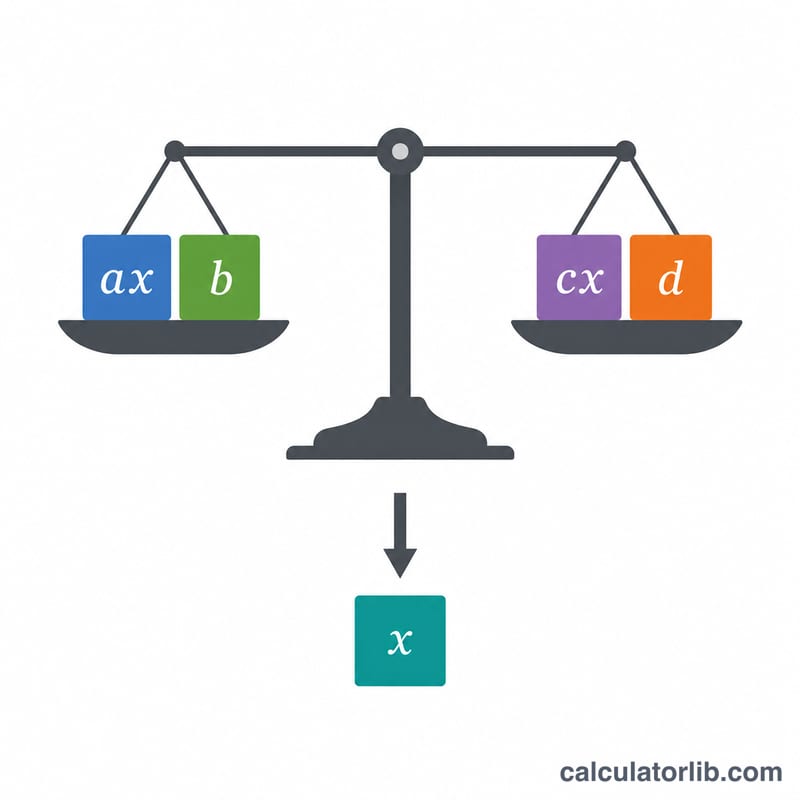
This tool solves linear equations that have the unknown variable on both sides of the equals sign, written in the standard form \(ax + b = cx + d\). Enter the four numbers — the coefficients a and c that multiply x, and the constants b and d — and it returns the exact value of x, or tells you when the equation has no solution or infinitely many solutions.
How to use it
Rewrite your equation so each side looks like (number)·x + (number). For example, \(3x + 5 = x + 11\) gives a = 3, b = 5, c = 1, d = 11. Type those values into the four fields and read off the answer. If your equation has no constant or no x on a side, just enter 0 for that slot.
The formula explained
Starting from \(ax + b = cx + d\), subtract cx from both sides and subtract b from both sides to group like terms: \((a - c)x = d - b\). Dividing by \((a - c)\) isolates the variable: $$x = \frac{d - b}{a - c}$$ This single step works for every solvable case where \(a \neq c\).
Worked example
Solve \(3x + 5 = x + 11\). Here \(d - b = 11 - 5 = 6\) and \(a - c = 3 - 1 = 2\), so $$x = \frac{6}{2} = \mathbf{3}$$ Check: \(3(3) + 5 = 14\) and \(3 + 11 = 14\) — both sides match.
FAQ
What if a equals c? The x terms cancel. If b also equals d the equation is true for every x (infinitely many solutions); otherwise it is a contradiction with no solution.
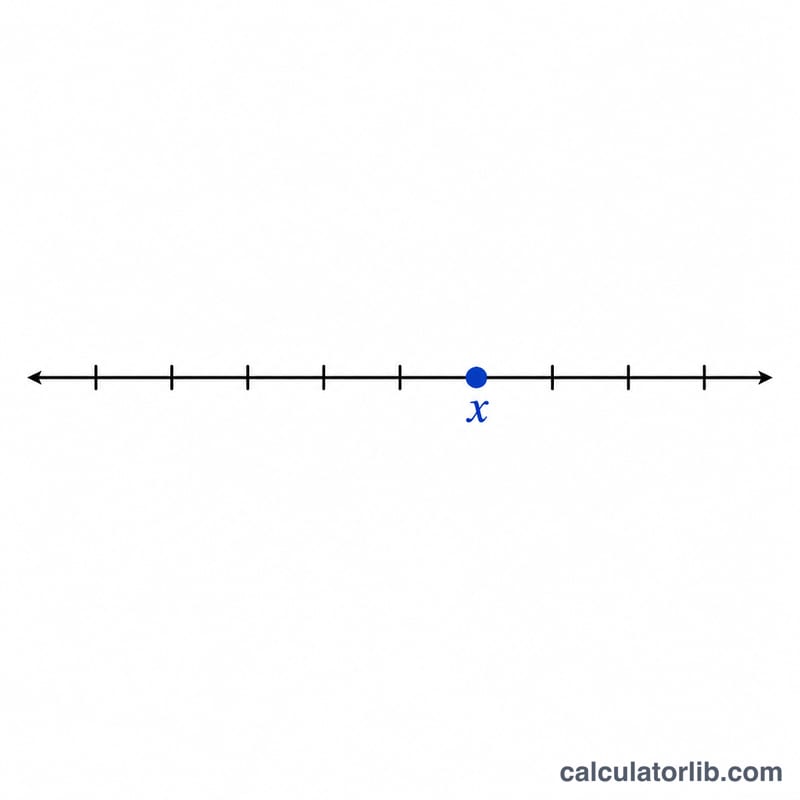
Can the answer be a fraction or negative? Yes. Division can produce decimals or negative values — both are valid solutions.
Does it handle decimals? Yes, you can enter decimal coefficients and constants; the result is computed at full precision.