
What this calculator does
This tool solves any one-variable linear equation written in the form ax + b = cx + d. Enter the four coefficients and it isolates x for you, while also detecting the two special cases that have no single numeric answer: no solution and infinitely many solutions.
How to use it
Rewrite your equation so both sides look like a coefficient times x plus a constant. For example 2x + 3 = x + 8 gives a = 2, b = 3, c = 1, d = 8. If a side has no x, set that coefficient to 0; if it has no constant, set the constant to 0. Then read the solution.
The formula explained
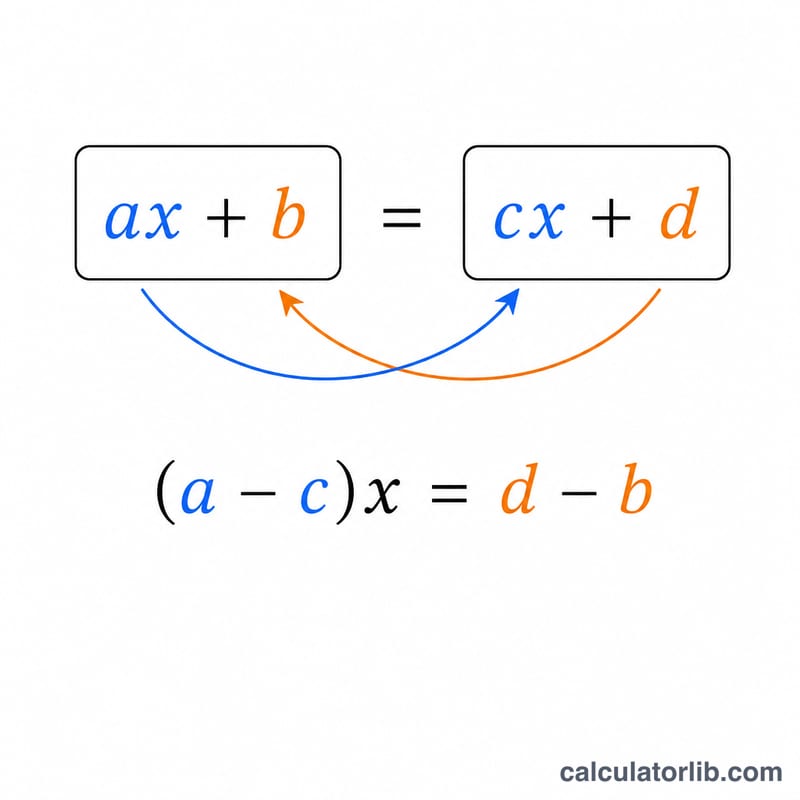
Start with ax + b = cx + d. Subtract cx from both sides and subtract b from both sides to get (a − c)x = d − b. Dividing by (a − c) gives:
$$x = \frac{\text{d} - \text{b}}{\text{a} - \text{c}}$$
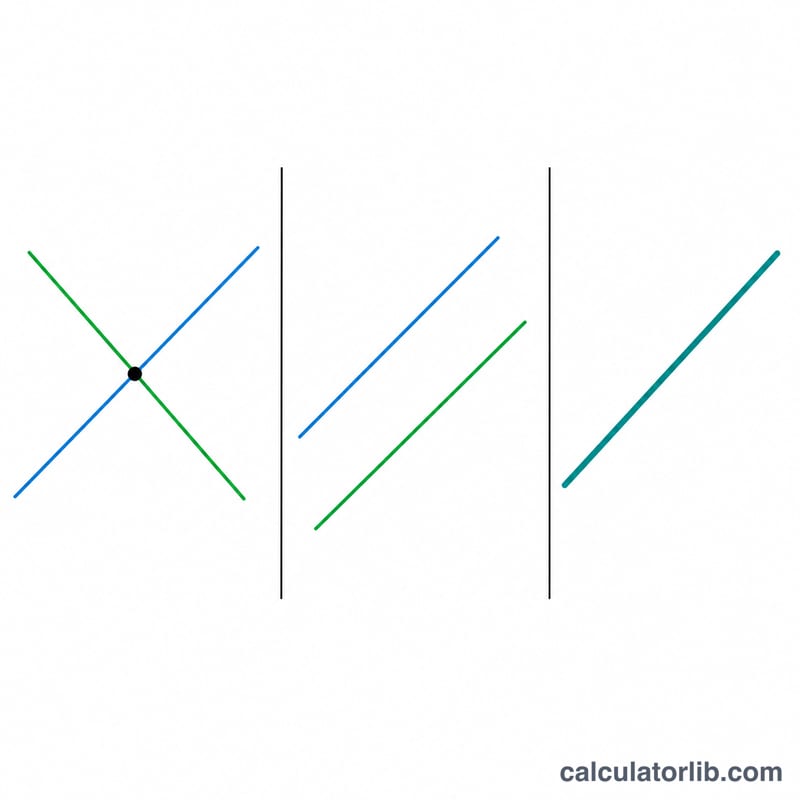
This works whenever \(a \neq c\). When \(a = c\) the coefficient of x vanishes. If the leftover constants are equal (\(b = d\)) the equation is an identity true for every x; if they differ it is a contradiction with no solution.
Worked example
Solve 2x + 3 = x + 8. Here a = 2, b = 3, c = 1, d = 8, so $$x = \frac{8 - 3}{2 - 1} = \frac{5}{1} = 5.$$ Check: \(2(5) + 3 = 13\) and \(5 + 8 = 13\). ✓
FAQ
What if my equation is just 3x + 5 = 20? Treat the right side as 0·x + 20, so c = 0 and d = 20. Then \(x = \frac{20 - 5}{3 - 0} = 5\).
Why does it say "No solution"? Because a = c but b ≠ d, e.g. 2x + 3 = 2x + 7 simplifies to 3 = 7, which is never true.
Can it solve quadratics? No — this handles only linear (first-degree) equations. Use a quadratic solver for x² terms.