
What this calculator does
This tool computes the sum of the first n perfect cubes, that is \(1^3 + 2^3 + 3^3 + \ldots + n^3\). Instead of adding every term one at a time, it uses a famous closed-form identity that returns the exact answer instantly, no matter how large n is.
How to use it
Enter a positive whole number for the number of terms n and read the result. The calculator also shows the underlying triangular number \(\frac{n(n+1)}{2}\) so you can see how the answer is built.
The formula explained
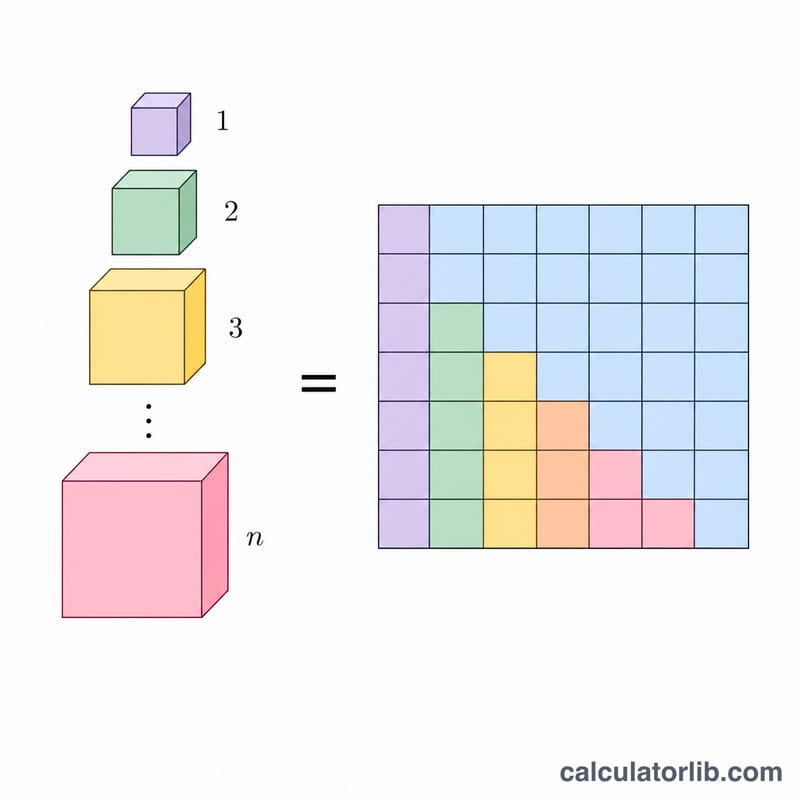
The key result is the Nicomachus identity:
$$\sum_{k=1}^{n} k^{3} = \left( \frac{n\left(n+1\right)}{2} \right)^{2}$$
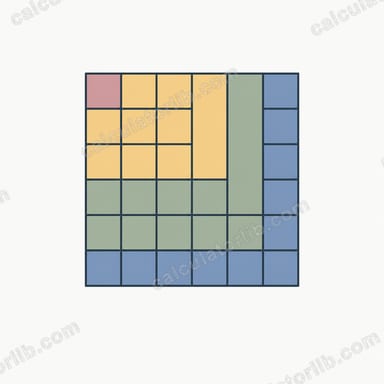
Remarkably, the sum of the first n cubes is exactly the square of the sum of the first n integers. The inner quantity \(\frac{n(n+1)}{2}\) is the nth triangular number, \(T(n)\). So the sum of cubes is simply \(T(n)\) squared. This makes the calculation O(1) rather than requiring a loop, and it is always exact for integer inputs.
Worked example
For n = 4: the triangular number is \(\frac{4\times 5}{2} = 10\). Squaring gives \(10^2 = 100\). Checking directly:
$$1 + 8 + 27 + 64 = 100$$
The two agree, confirming the identity.
FAQ
Does this only work for whole numbers? Yes — the identity applies to the sum over integer terms \(k = 1\) to \(n\), so n should be a positive integer.
Why is the answer always a perfect square? Because the sum equals \(T(n)^2\), where \(T(n)\) is the nth triangular number; squaring an integer always gives a perfect square.
Can n be very large? Yes. Since the formula is closed-form, even large n is computed instantly, though extremely large values may exceed standard floating-point precision.