
What Is a Digit Sum and Digital Root?
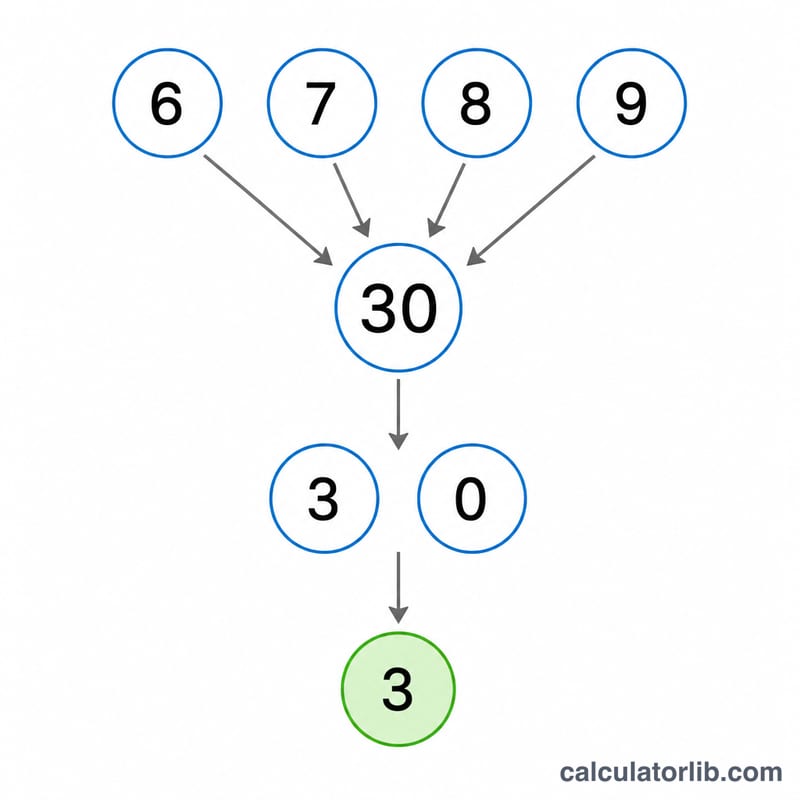
The digit sum of a number is simply the total you get by adding all of its individual digits together. The digital root goes one step further: you keep adding the digits repeatedly until only a single digit (1 through 9) remains. This calculator gives you both at once for any whole number.
How to Use It
Type any whole number into the box and submit. The calculator returns the digital root as the headline figure, plus the one-pass digit sum and the count of digits. Commas and other separators are ignored, so you can paste large numbers freely.
The Formula Explained
The slow way to find a digital root is to add digits over and over. The fast way uses modular arithmetic: for any positive integer n, the digital root equals
$$DR = 1 + \left((n - 1) \bmod 9\right)$$This works because a number and its digit sum always leave the same remainder when divided by 9. A digital root of 9 indicates the number is divisible by 9, and a digital root of 0 only occurs for the number 0 itself.
$$S = \sum_{i=1}^{k} d_i, \qquad DR = \begin{cases} 0 & S = 0 \\ 1 + \left((S - 1) \bmod 9\right) & S > 0 \end{cases}$$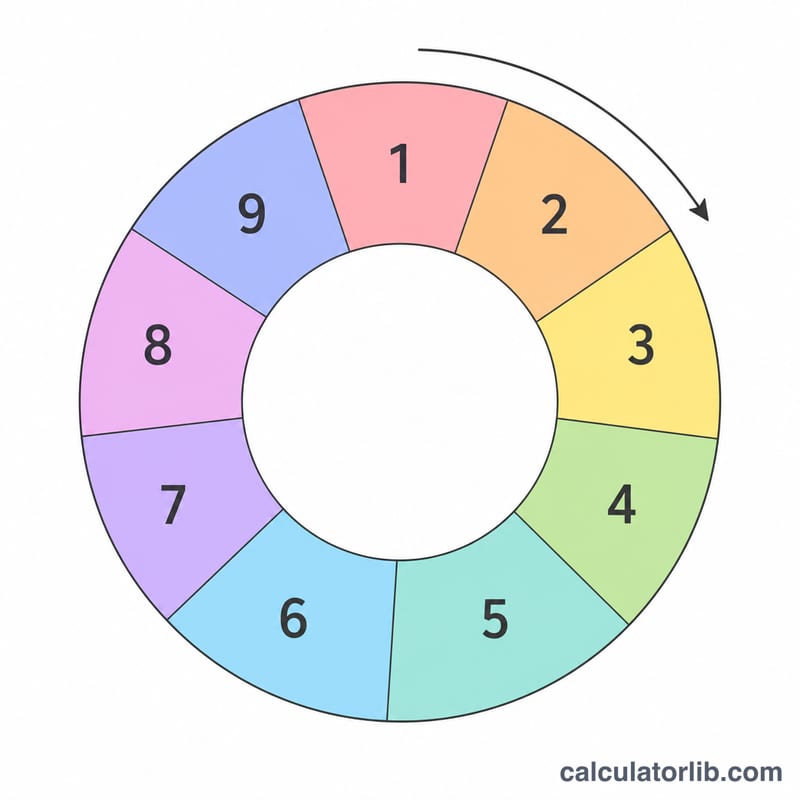
Worked Example
Take 12345. The digit sum is
$$1 + 2 + 3 + 4 + 5 = 15$$Adding again, \(1 + 5 = 6\), so the digital root is 6. Using the formula on the digit sum:
$$1 + (15 - 1) \bmod 9 = 1 + (14 \bmod 9) = 1 + 5 = 6$$Both methods agree.
FAQ
What is the digital root of a multiple of 9? It is always 9 (except for 0 itself).
Is the digit sum the same as the digital root? Not always. The digit sum is one pass of addition; the digital root repeats until a single digit remains. For numbers under 10 they are equal.
Why is the digital root useful? It is a quick divisibility test for 3 and 9, and it underpins the classic "casting out nines" method for checking arithmetic.