
What is a digital root?
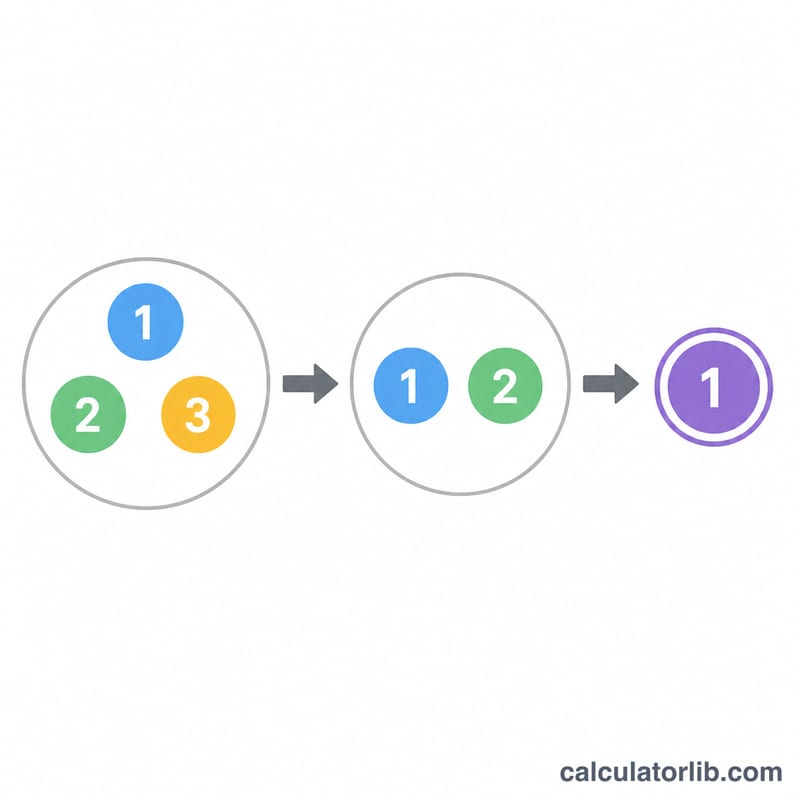
The digital root of a non-negative whole number is the single digit you reach by repeatedly adding its digits together until only one digit remains. For example, the digital root of 12345 is found by \(1+2+3+4+5 = 15\), then \(1+5 = 6\). This calculator does that instantly for any number.
How to use this calculator
Type any non-negative whole number into the box and submit. The tool returns the digital root, echoes your input, and also shows the first-pass digit sum so you can follow the process. Decimal points are ignored — the calculator uses the absolute integer part.
The formula explained
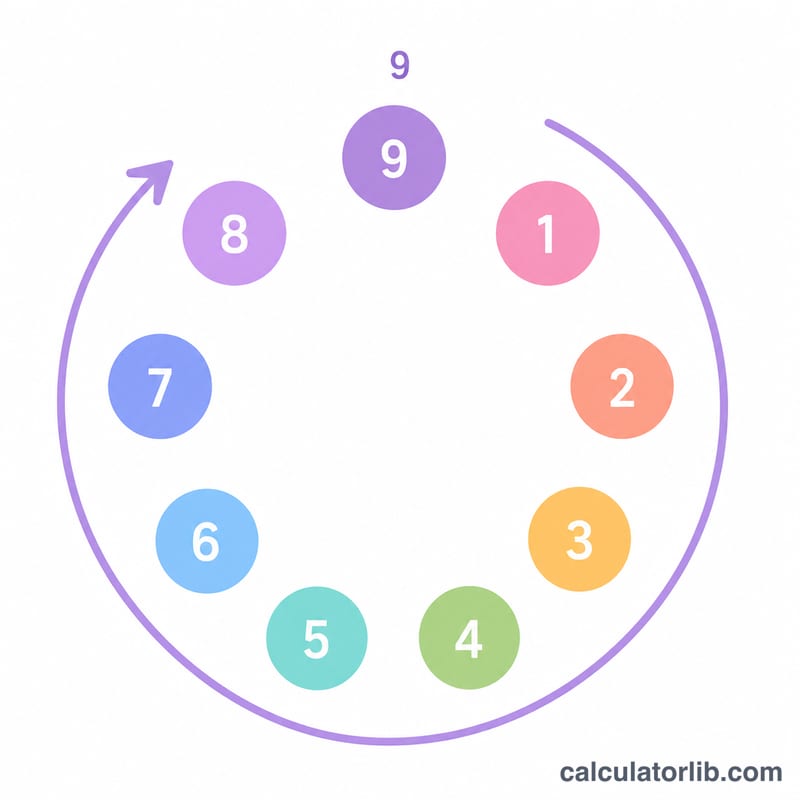
Rather than looping forever, the digital root has a neat closed form based on the fact that a number and its digit sum leave the same remainder when divided by 9 (this is the basis of "casting out nines"). For any positive integer \(n\):
$$\operatorname{dr}(n) = \begin{cases} 0 & \text{if } n = 0 \\ 1 + \big((n - 1) \bmod 9\big) & \text{if } n > 0 \end{cases} \qquad n = \left\lfloor \left| \text{Number} \right| \right\rfloor$$
This gives a value from 1 to 9 for every positive number, and 0 only for 0. Multiples of 9 have a digital root of 9.
Worked example
Take \(n = 9875\). The naive method: \(9+8+7+5 = 29\), then \(2+9 = 11\), then \(1+1 = 2\). The formula: \((9875 - 1) \bmod 9 = 9874 \bmod 9 = 4\), so \(\operatorname{dr} = 1 + 4 = 5\)? Let's check the digit sum: \(9+8+7+5 = 29 \to 11 \to 2\). Recompute \(9874 \bmod 9\): digit sum \(9+8+7+4 = 28 \to 10 \to 1\), so \(9874 \bmod 9 = 1\), giving \(\operatorname{dr} = 2\). Both methods agree on 2.
FAQ
Is the digital root the same as the digit sum? No — the digit sum is one pass of addition; the digital root keeps reducing until a single digit remains.
What is the digital root of a multiple of 9? Always 9 (except for 0, whose digital root is 0).
Why is it useful? Digital roots power the "casting out nines" check for verifying arithmetic and appear in numerology and recreational math.