
What the Nth Root Calculator Does
This calculator finds the n-th root of any number you enter. The n-th root answers the question: "what value, when multiplied by itself n times, gives my number?" It handles square roots (n = 2), cube roots (n = 3) and any higher root you need — fourth, fifth, tenth and beyond — all from two simple inputs.
The Two Inputs
- Number: the value (x) you want to take the root of, for example 27, 100 or 2.
- Root (n): the degree of the root. Enter 2 for a square root, 3 for a cube root, 4 for a fourth root, and so on. You can also use non-integer values like 2.5.
The Formula
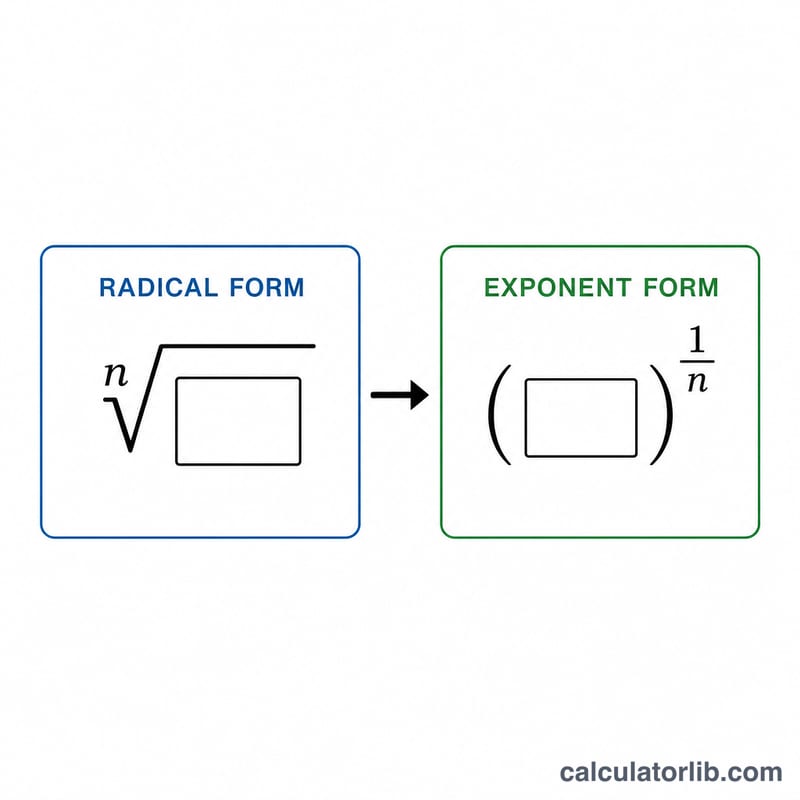
The n-th root is written as √[n]{x}, and it is computed using the equivalent exponent form:
result = x(1 / n)
Behind the scenes the tool runs Math.pow(number, 1 / root). Raising a number to the power of 1/n is mathematically identical to taking its n-th root, which lets the calculator handle fractional roots and large degrees with the same single operation.
Worked Example
Suppose you want the cube root of 27. Enter:
- Number = 27
- Root (n) = 3
The calculator computes 27(1/3) = 270.3333… = 3, because 3 × 3 × 3 = 27. As a second example, the fourth root of 16 is 16(1/4) = 2, since 2 × 2 × 2 × 2 = 16.
Frequently Asked Questions
Can I take the root of a non-perfect number? Yes. Most numbers do not produce whole results — for example the square root of 2 returns approximately 1.41421. The calculator gives the decimal value directly.
What about roots of negative numbers? Because the tool uses the power function x(1/n), even roots of negative numbers (like the square root of −4) are not real and will return "NaN" (not a number). Odd roots of negatives are also affected by this method, so it works best with non-negative numbers.
Can the root be a decimal? Yes. You can enter a root such as 2.5, and the calculator will compute x(1/2.5) just as accurately as a whole-number root.