Connect via MCP →

Enter Calculation

Formula

Formula: Square Root / Cube Root / Nth Root Table and Graph Calculator
Show calculation steps (1)
  1. Negative base, odd integer root

    Negative base, odd integer root: Square Root / Cube Root / Nth Root Table and Graph Calculator

    When x is negative and n is an odd integer, the real nth root is negative. Even or non-integer roots of negatives have no real value.

Advertisement

Results

Sample points computed
101
root index n = 2
Summary Value
First y 0
Last y 2.236068
y = nth root of x (table below)
x y
0 0
0.05 0.223607
0.1 0.316228
0.15 0.387298
0.2 0.447214
0.25 0.5
0.3 0.547723
0.35 0.591608
0.4 0.632456
0.45 0.67082
0.5 0.707107
0.55 0.74162
0.6 0.774597
0.65 0.806226
0.7 0.83666
0.75 0.866025
0.8 0.894427
0.85 0.921954
0.9 0.948683
0.95 0.974679
1 1
1.05 1.024695
1.1 1.048809
1.15 1.072381
1.2 1.095445
1.25 1.118034
1.3 1.140175
1.35 1.161895
1.4 1.183216
1.45 1.204159
1.5 1.224745
1.55 1.24499
1.6 1.264911
1.65 1.284523
1.7 1.30384
1.75 1.322876
1.8 1.341641
1.85 1.360147
1.9 1.378405
1.95 1.396424
2 1.414214
2.05 1.431782
2.1 1.449138
2.15 1.466288
2.2 1.48324
2.25 1.5
2.3 1.516575
2.35 1.532971
2.4 1.549193
2.45 1.565248
2.5 1.581139
2.55 1.596872
2.6 1.612452
2.65 1.627882
2.7 1.643168
2.75 1.658312
2.8 1.67332
2.85 1.688194
2.9 1.702939
2.95 1.717556
3 1.732051
3.05 1.746425
3.1 1.760682
3.15 1.774824
3.2 1.788854
3.25 1.802776
3.3 1.81659
3.35 1.830301
3.4 1.843909
3.45 1.857418
3.5 1.870829
3.55 1.884144
3.6 1.897367
3.65 1.910497
3.7 1.923538
3.75 1.936492
3.8 1.949359
3.85 1.962142
3.9 1.974842
3.95 1.987461
4 2
4.05 2.012461
4.1 2.024846
4.15 2.037155
4.2 2.04939
4.25 2.061553
4.3 2.073644
4.35 2.085665
4.4 2.097618
4.45 2.109502
4.5 2.12132
4.55 2.133073
4.6 2.144761
4.65 2.156386
4.7 2.167948
4.75 2.179449
4.8 2.19089
4.85 2.202272
4.9 2.213594
4.95 2.22486
5 2.236068

What this calculator does

This tool tabulates and plots a root function over a range of x values. You pick the function — the square root, the cube root, or a general nth root — choose where the x range starts and ends, and set the spacing between points. It then computes y = the nth root of x at each sample point and presents the results as a table of (x, y) pairs and a line graph. It is pure mathematics and applies identically everywhere; no units or country rules are involved. Only real-valued results are supported (complex numbers are not).

How to use it

Select the Function. For the nth-root option, enter the integer order n (for example 5 for the fifth root); n is ignored for the square and cube root presets, which fix n at 2 and 3. Set "Range x (start)", "Range x (end)" and "Increment". The increment must be greater than zero and n must be nonzero. The calculator generates points x = start, start + step, start + 2·step, … up to and including the end value, capped at 301 points.

The formula explained

Each sample point is \(x_i = x_{\min} + i\,\Delta x\), and \(y_i = x_i^{1/n}\). For \(x \ge 0\) this is computed directly. For \(x < 0\) the real nth root exists only when n is an odd integer, in which case \(y = -\,|x|^{1/n}\); for an even root (including the square root) or a non-integer order, a negative x has no real result and is marked undefined.
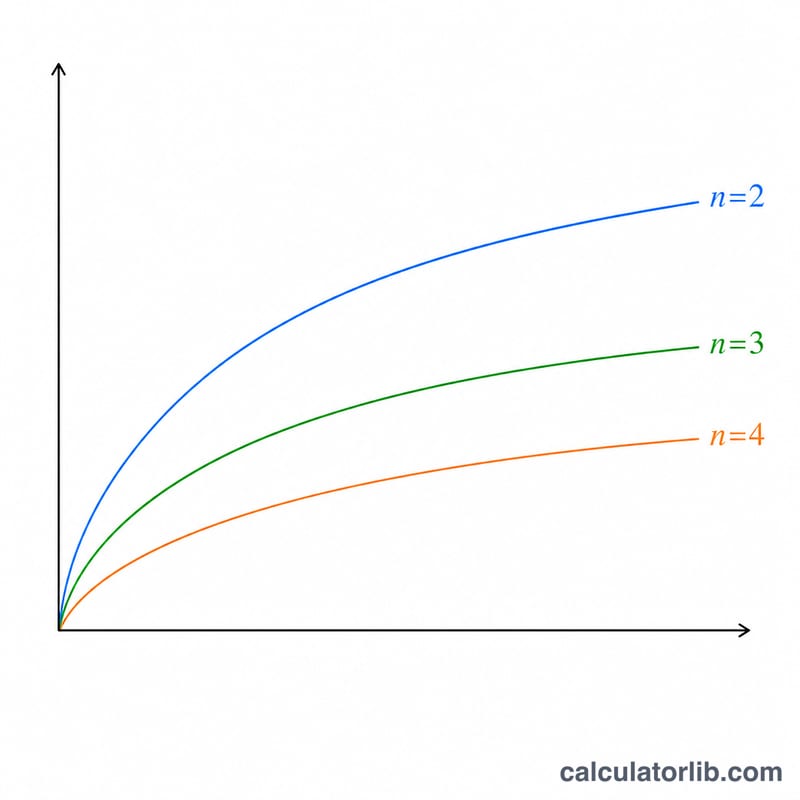
Curves of square root, cube root, and a higher nth root rising from the origin on x-y axes
Graphs of square root, cube root, and a higher-order nth root, all rising and flattening as x increases.

Worked example

Cube root (n = 3), x from −8 to 8 with increment 4 gives x = −8, −4, 0, 4, 8. The y values are −2, −1.5874, 0, 1.5874 and 2. Because the cube root order is odd, negative inputs return real negative roots.

$$y_i = \sqrt[3]{x_i} = x_i^{1/3}$$
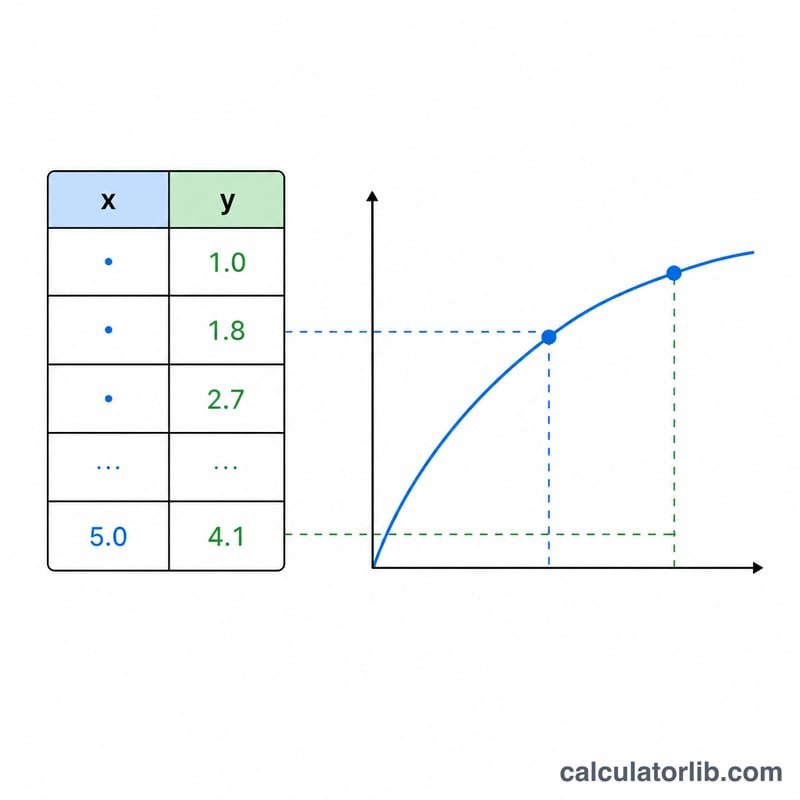
Data table of x values mapped to nth root values beside a small plotted curve
Each sampled x value produces a root value, forming both the table rows and the plotted points.

FAQ

Why is the square root of a negative number blank? Even roots of negatives are not real numbers; this tool does not handle complex results.

Why did my table stop early? Output is capped at 301 points. Reduce your range or increase the increment to cover the whole interval.

Can I use a non-integer order? Yes for non-negative x; for negative x a non-integer order has no real value and is shown as undefined.

Last updated: