
What this calculator does
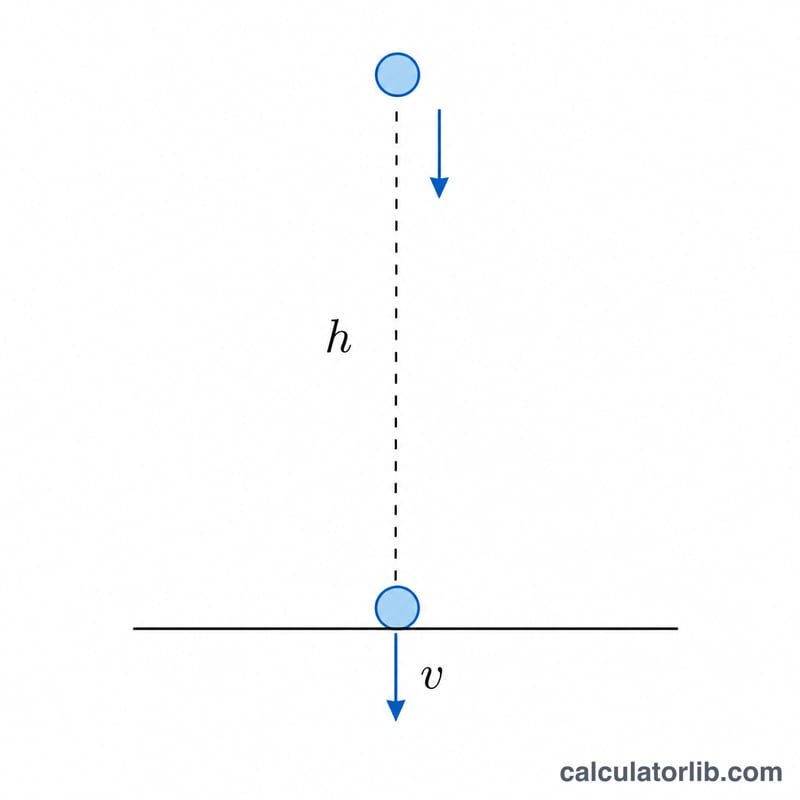
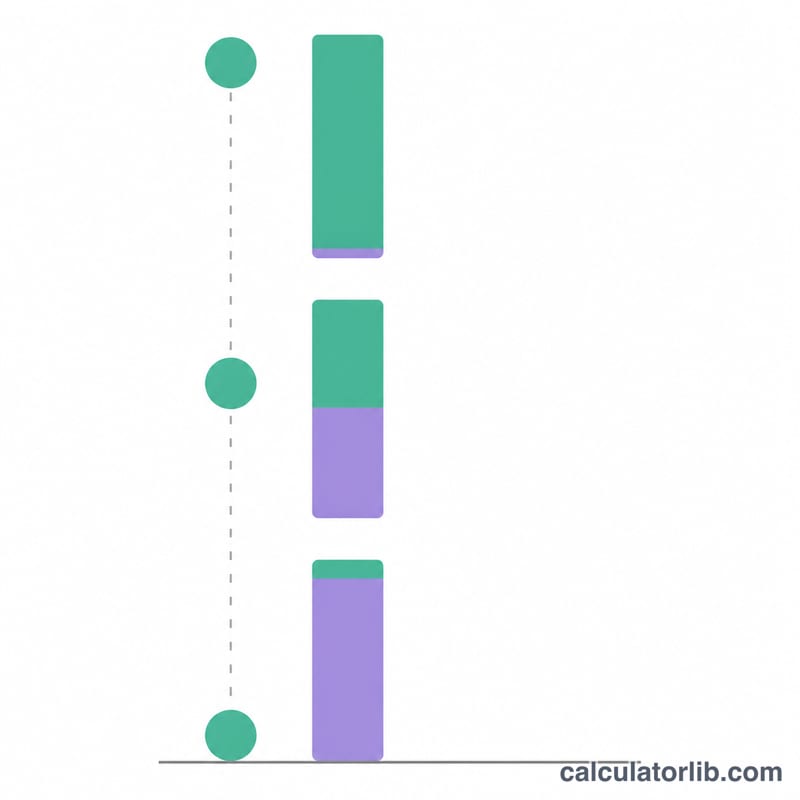
This tool computes the kinetic energy and impact velocity of an object that falls freely from rest through a given drop height, assuming no air resistance. As the object falls a distance h under gravitational acceleration g, its gravitational potential energy is fully converted into kinetic energy. The calculator reports the energy in both joules (J) and kilowatt-hours (kWh), plus the velocity (m/s) at the instant of impact.
How to use it
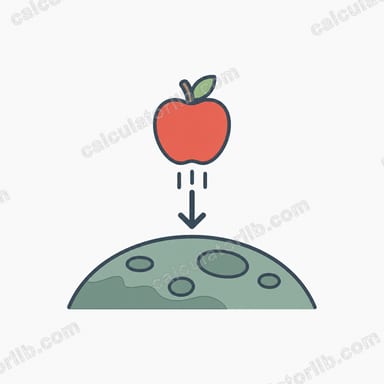
Enter the object's mass and choose its unit (kilograms or grams). Enter the drop distance in metres. The gravitational acceleration defaults to standard gravity, 9.80665 m/s², but you can edit it to model other locations or celestial bodies (for example the Moon at about 1.62 m/s²). Mass is internally converted to kilograms, then the results are computed in SI units.
The formula explained
Energy released is \(E = m \cdot \text{g} \cdot \text{h}\), measured in joules. To express this in kilowatt-hours, divide by 3,600,000 since \(1\,\text{kWh} = 3.6 \times 10^{6}\,\text{J}\). The impact velocity follows from energy conservation: \(\frac{1}{2} m v^2 = m g h\), which simplifies to $$v = \sqrt{2 \cdot \text{g} \cdot \text{h}}$$ Notice the mass cancels out of the velocity equation, so a feather and a hammer dropped in a vacuum hit the ground at the same speed.
Worked example
Drop a 72 kg object 4 m at standard gravity. Energy $$E = 72 \times 9.80665 \times 4 = 2824.3152\,\text{J}$$ which is \(2824.3152 / 3{,}600{,}000 \approx 7.8453 \times 10^{-4}\,\text{kWh}\). Impact velocity $$v = \sqrt{2 \times 9.80665 \times 4} = \sqrt{78.4532} \approx 8.8574\,\text{m/s}$$
FAQ
Does the velocity depend on mass? No. Impact velocity depends only on g and h. Mass affects the energy linearly but not the speed.
Is air resistance included? No. This model assumes a vacuum (free fall from rest with zero drag), so real-world values for light or large objects will be lower.
What if the drop height is zero? Both energy and velocity are zero, since there is no fall.