
What this calculator does
This tool builds a table — and a line graph — of one of four related quantities over a range of x values: the factorial x!, its natural logarithm ln(x!), the double factorial x!!, or its natural logarithm ln(x!!). It is pure mathematics and applies identically everywhere; no units or country rules are involved.
How to use it
Pick a function from the dropdown, then enter the start of the range (Range x from), the end (Range x to), and the Increment (step). Rows are generated for x = from, from+step, from+2·step, … up to and including the upper bound. The increment must be greater than zero, and a maximum of 101 rows is produced to keep tables manageable.
The formula explained
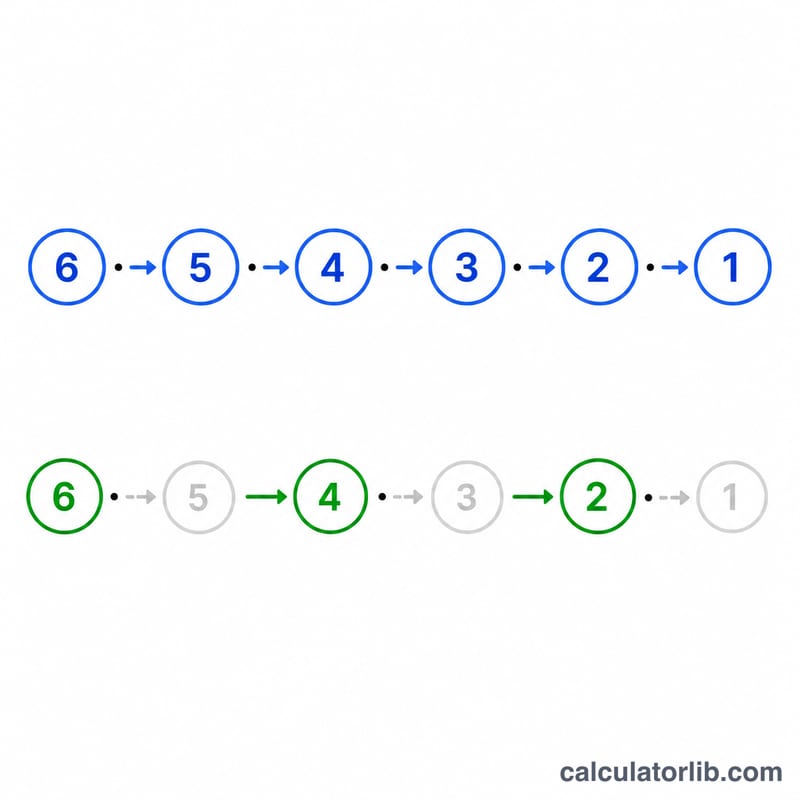
The factorial is the product 1·2·3·…·x with \(0! = 1\). To allow large values and continuous graphing it is evaluated as the gamma function, $$x! = \Gamma(x+1),$$ and the logarithm uses the log-gamma function $$\ln(x!) = \ln\Gamma(x+1)$$ so huge numbers never overflow. The double factorial multiplies every second term: \(6!! = 6\cdot 4\cdot 2 = 48\), while \(5!! = 5\cdot 3\cdot 1 = 15\). The base cases are \(0!! = 1\), \(1!! = 1\) and \((-1)!! = 1\). Negative integers make the factorial undefined (gamma has poles there), so those rows report "undefined".
Worked example
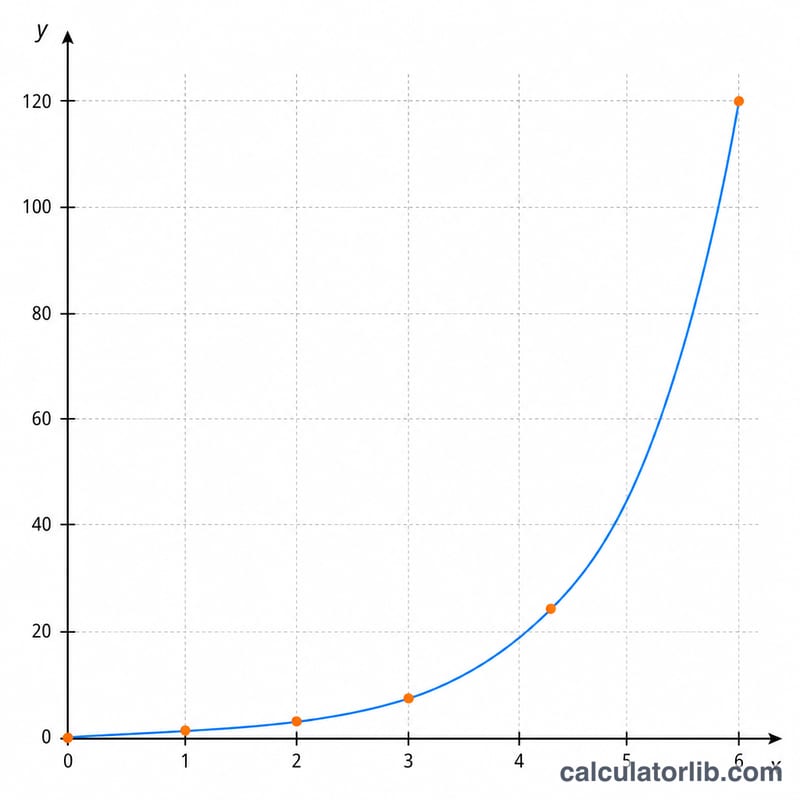
Choosing x! with range 0 to 6 and step 1 gives seven rows: \(0!=1\), \(1!=1\), \(2!=2\), \(3!=6\), \(4!=24\), \(5!=120\), \(6!=720\). Switching to ln(x!) at \(x=6\) gives \(\ln(720) \approx 6.5793\), and ln(x!!) at \(x=5\) gives \(\ln(15) \approx 2.7081\).
FAQ
Can x be a fraction? Yes. Non-integer arguments use the gamma-based continuous forms, so the curve is smooth.
Why does a row say "infinity"? Factorials grow extremely fast (\(70! \approx 1.2\times 10^{100}\)); when a value exceeds double precision it is flagged as infinity — use the ln variant instead, which stays finite.
Why is there a 101-row cap? To prevent runaway tables; narrow the range or increase the step to fit.