
What this calculator does
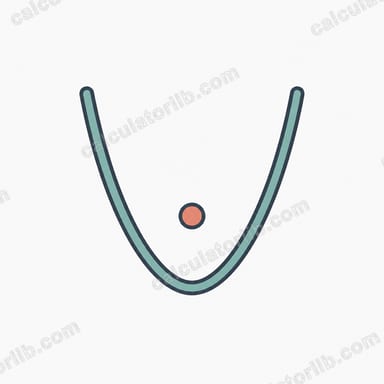
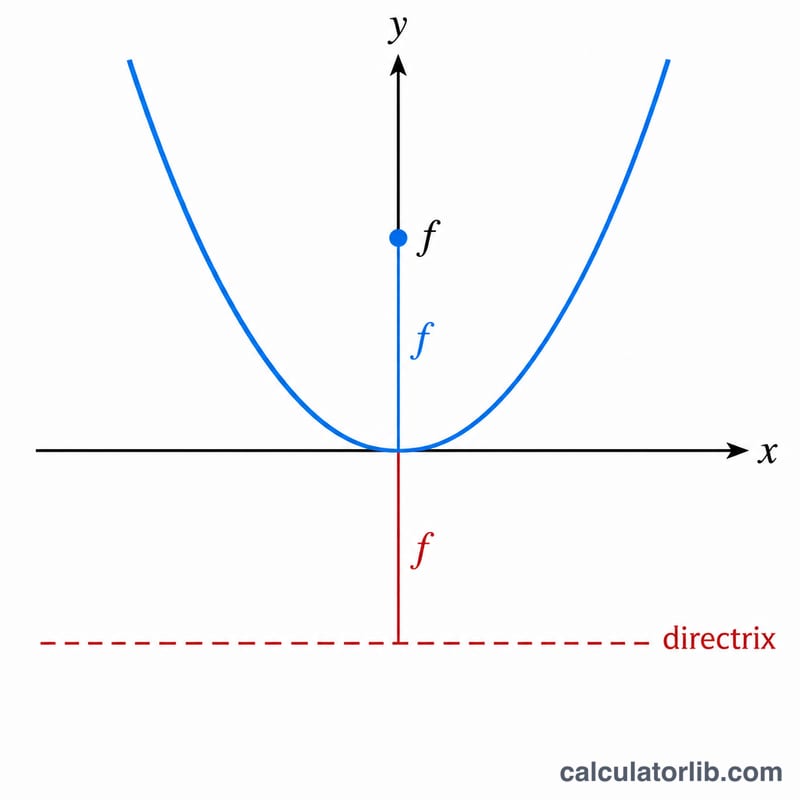
This tool tabulates and analyzes the standard vertical parabola whose vertex sits at the origin (0, 0) and whose focus lies at the point (0, f) on the y-axis. Its equation is \(x^2 = 4fy\), or in explicit form \(y = x^2 / (4f)\). Because it is built from pure analytic geometry, it works identically anywhere — every quantity is a dimensionless real number in one consistent length unit.
How to use it
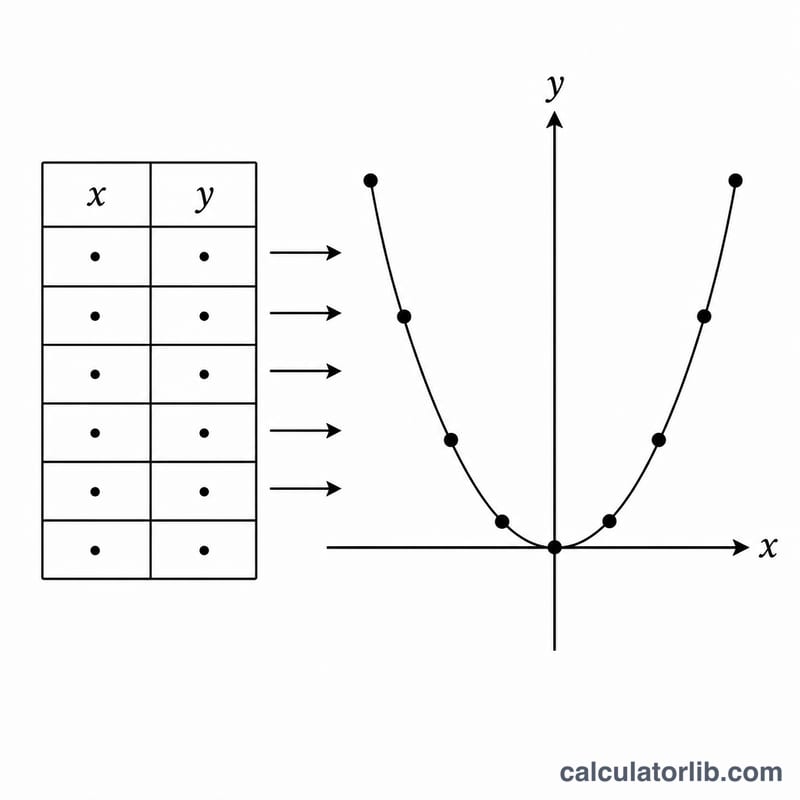
Enter the focus distance f (the y-coordinate of the focus), then choose the x-range you want to sample with a minimum, a maximum and a number of table rows. The calculator evenly samples x from xMin to xMax and returns each (x, y) pair, plus the parabola's equation, directrix line, focal length and latus rectum. A positive f opens the curve upward; a negative f opens it downward.
The formula explained
A parabola is the set of points equidistant from a focus and a directrix line. Placing the focus at (0, f) and the directrix at y = -f, equating the two distances and squaring gives \(x^2 = 4fy\). The sampling step is $$\text{step} = \frac{x_{\max} - x_{\min}}{n_{\text{points}} - 1}$$ and each point is \(x_i = x_{\min} + i \cdot \text{step}\), \(y_i = x_i^2 / (4f)\). The full focal chord (latus rectum) has length \(|4f|\), and its half-length (semi-latus rectum) is \(|2f|\).
Worked example
With f = 1, xMin = -2, xMax = 2 and 5 points, the step is $$\frac{2 - (-2)}{5 - 1} = 1,$$ giving x = -2, -1, 0, 1, 2. Using \(y = x^2/4\) we get y = 1, 0.25, 0, 0.25, 1. The equation is \(y = x^2/4\), the directrix is y = -1, the focal length is 1 and the latus rectum is 4 — whose endpoints (-2, 1) and (2, 1) match the x = ±2 rows.
FAQ
Why must f be non-zero? If f = 0 the formula divides by zero and the focus collapses onto the vertex, so the parabola degenerates. The tool rejects this case.
How does f relate to \(y = a \cdot x^2\)? Comparing \(y = a x^2\) with \(y = x^2/(4f)\) gives \(a = 1/(4f)\), so \(f = 1/(4a)\).
Is the table always symmetric? Yes — y depends only on \(x^2\), so a symmetric x-range produces a symmetric y-column.